

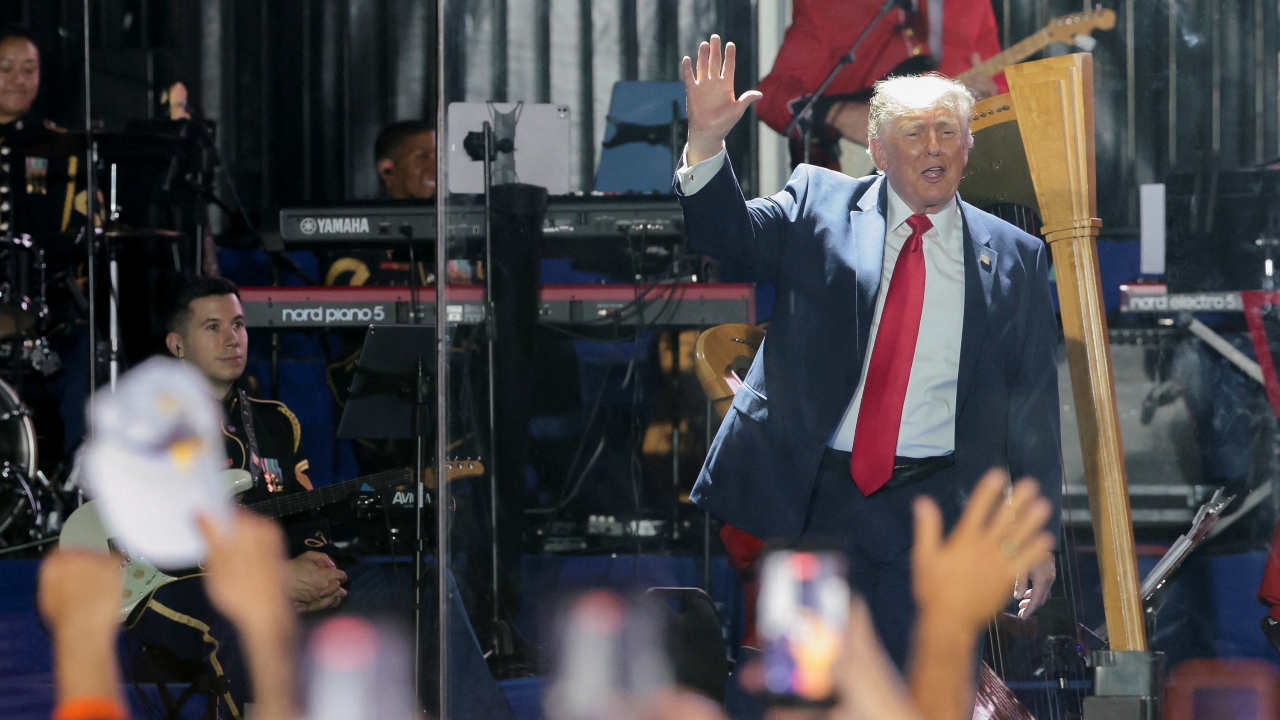
The White House under President Donald Trump submitted an additional funding request of $87.6 billion, approximately 2.9 trillion baht, to Congress, with over two-thirds allocated for defense and urgent costs related to the Iran war. This occurred just one day after the U.S. Senate voted to limit President Trump's war powers amid escalating conflicts within the Republican Party and pressure from the upcoming midterm elections.
The White House officially sent a request letter to Mike Johnson, Speaker of the U.S. House of Representatives, seeking approval for an additional $87.6 billion (about 2.92 trillion baht). A large portion, $67.15 billion (about 2.24 trillion baht), is allocated to the Department of Defense for military operations in Iran under the code name "Operation Epic Fury," following airstrikes launched by the U.S. and Israel against Iran since 28 February.
This budget includes $21 billion for purchasing weapons and ammunition, $17.3 billion for general operations and weapons stockpile replenishment, and $12.1 billion for classified projects. Additionally, about $300 million is allocated to enhance security at U.S. embassies and military bases in the Middle East and South Asia, which have been targeted early in the conflict.
The request faces obstacles in Congress as it came just one day after the joint legislature passed a resolution to "limit the president’s war powers," requiring Trump to end military operations against Iran, with some Republican lawmakers defecting to vote alongside Democrats.
Reports state that during a lunch at the Capitol building, Donald Trump engaged in a heated argument, shouting at Republican Senator Bill Cassidy, one of those who voted against the party line. Senator Cassidy told reporters, "I stood up and told him, 'You haven't told the American people what's really going on. At first, we said this war would last only four weeks, but it's dragged on for four months, and our initial objectives remain unmet.'"
Meanwhile, Trump vented his frustrations on social media, labeling the four Republican senators who voted against him as "losers," and told NATO Secretary General Jens Stoltenberg that these lawmakers are "stupid and want to lose the war."
Currently, despite both sides being under a temporary ceasefire agreement, the White House emphasizes that the Pentagon needs to "replenish used weapons." However, this budget has drawn strong disapproval from Democrats and the public, as the war has caused sharp increases in food and energy prices in the U.S.
Chuck Schumer, Senate Minority Leader from the Democratic Party, posted on platform X that "we should reduce the cost of living for Americans, not write blank checks for Trump to wage war." Similarly, Senator Patty Murray, chair of the Budget Committee, firmly declared there will be no approval of tens of billions more for "the disastrous war Trump chose."
Republicans are expected to face challenges pushing this budget through Congress as they hold a narrow majority and must rely on some Democratic support. The upcoming November midterm elections are pressuring conservative lawmakers, as the war is unpopular among voters. Previously, Pentagon CFO Jules Hurst revealed that over $29 billion of taxpayer money has been spent on this war, though experts believe the actual figure is much higher.
To increase chances of approval, the White House bundled other non-war-related funding into the request, including $11.1 billion to aid American farmers, $1.4 billion to combat and prevent the spread of Ebola in central Africa from reaching the U.S., $1 billion to support pension funds for former Delphi employees—a General Motors automotive parts supplier—cut during the 2009 bankruptcy crisis, $1 billion for improvements at New York City's Penn Station, and $500 million for construction projects around Washington, D.C.