

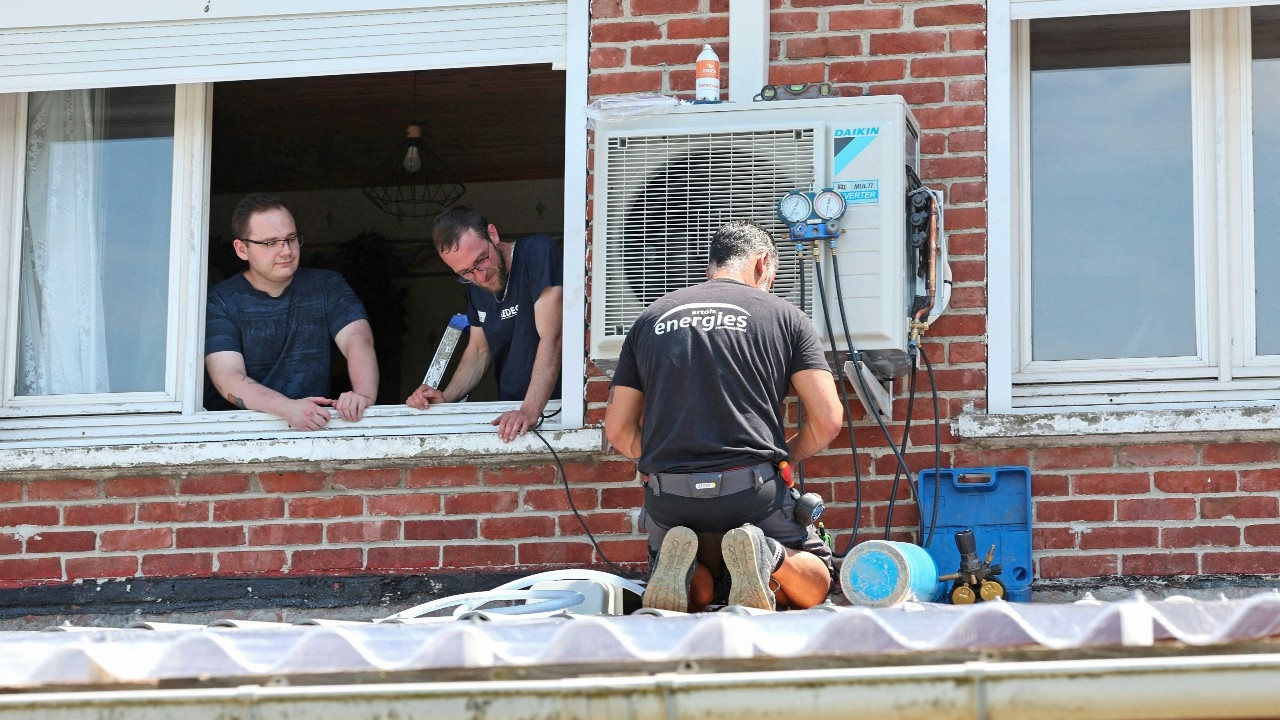
As temperatures soared past 40 degrees Celsius, marking France's hottest day on record, air conditioning—which French people had long viewed with suspicion—became a major political dispute. The conflict is between the populist right wing advocating state subsidies for nationwide AC installation and environmentalists who are beginning to accept that air conditioning may now be an unavoidable necessity amid the global warming crisis.
Amid escalating climate change impacts, France is forced to reconsider its attitude toward air conditioning, known in French as "la clim." This week, fierce political debate erupted over AC installation after the country experienced a severe heatwave with temperatures exceeding 40 degrees Celsius. Thousands of schools were temporarily closed, and healthcare workers complained that hospital conditions were unbearably hot.
Currently, France has one of the lowest rates of air conditioning installation, with only 25% of homes equipped. This contrasts sharply with neighboring countries like Spain and Italy, where 50% of homes have AC, and the United States and Japan, where the figure reaches 90%. Even French schools and hospitals rarely have air conditioning installed.
The most significant development this week is the shift in attitude among environmentalist politicians who previously condemned air conditioning as harmful to the planet. Marie Tondeur, leader of the Ecologists party, has begun to soften this stance, acknowledging that schools and hospitals now need air conditioning. Tondeur stated, "There are some places where we can no longer live without air conditioning."
This admission is painful because French environmentalists have long criticized air conditioning as the "worst solution"—a mere symptomatic relief that does not address the root causes of global warming. They highlight that AC worsens the climate crisis through greenhouse gas emissions from refrigerant leaks and electricity consumption, and by contributing to the "urban heat island" effect, where AC compressors expel hot air onto streets, raising city temperatures by 2-3 degrees Celsius according to studies.
While leftist politicians and the government promote regulations for new buildings emphasizing insulation and tree planting to reduce air conditioning use—leading to controversy such as a large new hospital in Nantes installing AC in only half of its rooms, sparking protests from medical unions—the right-wing parties have seized the issue to push populist policies.
Marine Le Pen, leader of the far-right National Rally (RN), has called on the government to create a "National Air Conditioning Master Plan" to install AC in every school and hospital nationwide. The party's spokesperson said the plan includes government-backed zero-interest loans worth up to 20 billion euros (about 757 billion baht) to help 30-40 million households purchase and install air conditioning at home.
Critics have attacked Le Pen's plan as political opportunism lacking clear budget calculations. They mock the far-right as the last group in France to accept the reality of global warming, thus lacking credibility to propose solutions.
The conflict has also extended to transportation. Valérie Pécresse, president of the Paris regional council from the center-right party, criticized the government for its "anti-air conditioning ideology" and announced a goal to install air conditioning on all buses and trains in the Paris region by 2032. She also accused former socialist left-wing officials of failure and ignoring the issue's importance.
Despite the heated political debate, the reality for French citizens this week is soaring sales of portable air conditioners in department stores. Apartment dwellers enduring the heat seek only to sleep comfortably at night and enable their children to study during the day. Ultimately, all sides are reaching the conclusion that amid dangerously high temperatures, "increased air conditioning" reflects an unavoidable truth for modern France.
,BBC