

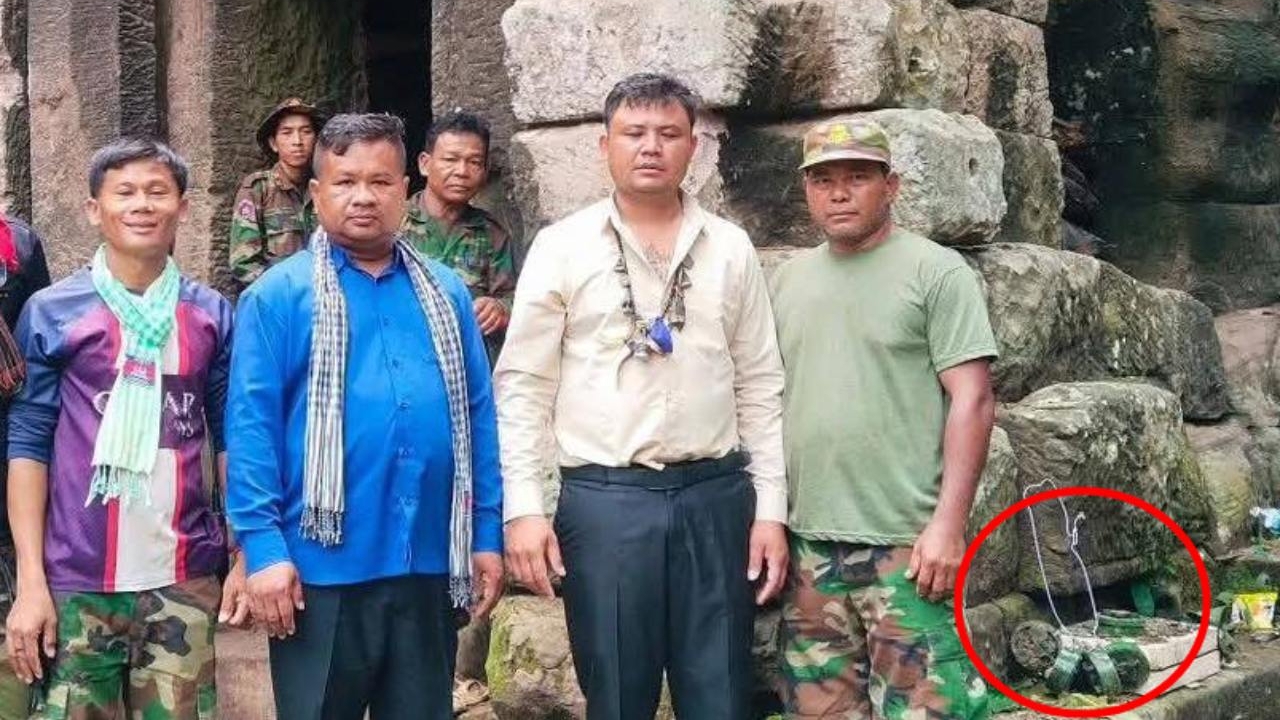
Cambodia's Supreme Court upheld the lower court's ruling, sentencing two online journalists to 14 years in prison for rebellion and revealing military secrets after posting images of the Thai-Cambodian border conflict zone on Facebook, including photos of landmines at Ta Kwai Temple cited by Thai media.
The Supreme Court confirmed the Appeal Court's decision to sentence Mr. Porn Sopheap, 39, a reporter for Battambang Post TV Online, and Mr. Pheap Para, 41, from TSP 68 TV Online, to 14 years in prison on charges of "rebellion" and "transmitting information harmful to national defense to foreign states" under Article 445 of Cambodia's Penal Code. This ruling is final and can only be overturned by royal pardon from the king.
The case stems from the journalists' arrest on 31 July 2025 after returning from reporting near the border area of Oddar Meanchey province, a conflict zone between Cambodia and Thailand. Cambodian authorities charged them with illegally photographing and publishing strategic locations and military secrets from a restricted zone on Facebook. The journalists deny the allegations, stating they had proper authorization from local officials.
A key piece of evidence was a photograph of "landmines," which Thai media circulated and referenced to support Thailand's claim that Cambodia had secretly laid new landmines along the border, causing Thai ranger injuries from stepping on mines during patrols.
Previously, Cambodian authorities officially denied using landmines in this conflict, citing compliance with international treaties, and claimed the mines were remnants from the civil war that ended in the late 1990s. Last year's border clashes resulted in about 100 military and civilian deaths and forced hundreds of thousands to flee before ceasefire negotiations.
Following the Supreme Court ruling, Briony Lu, Asia Deputy Director of Human Rights Watch, told the Associated Press, "The wrongful prosecution and excessively harsh punishment of these two journalists demonstrate the Cambodian authorities' disregard for press freedom. Hun Manet's government is blocking independent information sources and preventing journalists from revealing Cambodia's realities to the world."
Meanwhile, Mr. Neth Pheaktra, Cambodia's Minister of Information, responded to criticism by stating the courts acted independently under laws designed to protect the journalism profession alongside national security.
"Cambodia fully respects media freedom and the crucial role of journalists in a democratic society. However, journalists, like all citizens, must distinguish between lawful journalism and illegal acts. Freedom of expression is a constitutional right but is not without limits and does not grant criminal immunity," he said.
Mr. Am Sam Ath, Operations Director of Licadho, a Cambodian human rights group, expressed disappointment with the verdict, noting that if journalists err professionally or in content, they should be tried under the "Press and Media Law," which carries much lighter penalties, rather than invoking serious criminal charges like national security offenses or rebellion.
This verdict came less than a week after the Supreme Court upheld charges against Mr. Rong Chun, a prominent 56-year-old opposition politician, for inciting social unrest after meeting villagers affected by government land expropriation for construction projects.
According to the 2025 World Press Freedom Index by Reporters Without Borders, Cambodia ranks 161 out of 180 countries, categorized as experiencing a "severe crisis" in media freedom. The U.S.-based Freedom House downgraded Cambodia's media freedom rating this year, citing that "almost all independent news outlets in Cambodia have been forced to shut down."
Although Prime Minister Hun Manet, who graduated from the United States, succeeded his father Hun Sen in August 2023 amid hopes for greater political openness, recent arrests of environmental activists, opposition politicians, and investigative journalists covering corruption and call center scams indicate no signs of political liberalization in Cambodia.
.sourceAssociated Press/Reuters