

Global crude oil prices have steadily declined to their lowest level since before the Iran war, after the U.S. and Iran reached a temporary ceasefire agreement, leading to renewed activity in shipping through the Strait of Hormuz. Meanwhile, Donald Trump ordered investigations into major energy companies following observations that retail gasoline prices at the pump were moving opposite to the rapid decline in crude oil costs.
Global crude oil prices sharply declined today (25 June). Brent crude for August delivery dropped $1.28, or 1.74%, to a temporary low of $72.46 per barrel, while U.S. West Texas Intermediate crude fell $1.15, or 1.63%, to $69.19 per barrel. These levels are the lowest since 27 February, just one day before the U.S. and Israel launched airstrikes against Iran on 28 February.
The key factor driving the rapid drop in oil prices is renewed hope that Middle Eastern crude supply will return in large volumes after the Strait of Hormuz, the world's most important oil and natural gas shipping route, began reopening gradually following its closure by Iran in retaliation during the conflict.
Oil prices began to decline after the U.S. and Iran signed a memorandum of understanding (MOU) on 17 June, setting a 60-day framework for negotiations on Iran's nuclear program and measures to end the war. This led to significant talks in Switzerland last weekend, resulting in the U.S. temporarily easing sanctions on Iranian oil exports.
Chris Wright, U.S. Secretary of Energy, revealed at a forum that oil flow through the Strait of Hormuz has nearly returned to pre-war levels, with at least 20 million barrels transported through the strait in the past 24 hours. However, full normalization may take several weeks as authorities need to clear naval mines and waterway obstacles first.
Data from Kpler, a maritime analytics firm, shows a marked increase in ships passing through the strait, mostly carrying crude oil, liquefied natural gas, and fertilizers. Since Monday, about 80 vessels have passed, mostly via the southern route deemed safe by the U.S. Navy from naval mines. Oman also opened a temporary shipping route on Wednesday to help clear a backlog of oil tankers in the Persian Gulf.
However, major financial institutions indicate that Iranian production capacity may not significantly increase supply. Goldman Sachs predicts China will remain the main buyer of Iranian crude due to ongoing European Union and U.K. sanctions on Iranian vessels.
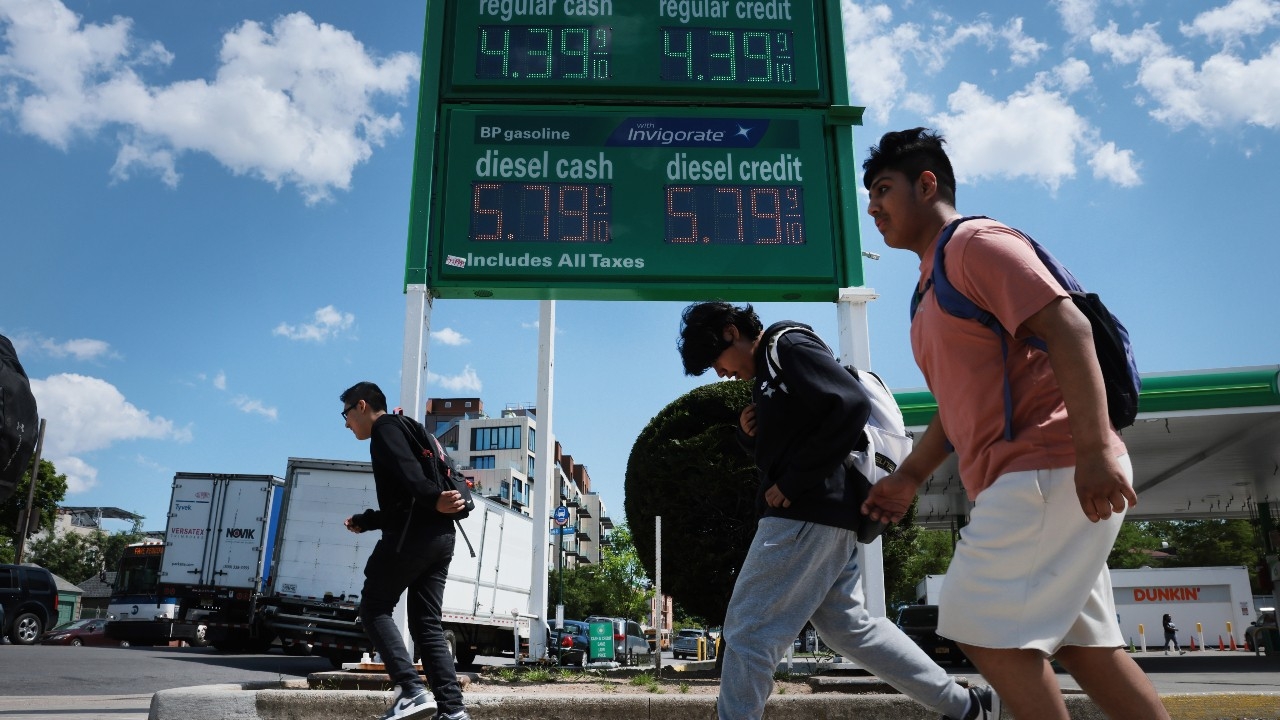
Despite the sharp global crude oil price drop, U.S. retail gasoline prices have not decreased proportionally. Currently, average gasoline prices in the U.S. stand around $3.93 per gallon, down from a 2022 peak of $4 per gallon in April, but still significantly higher than pre-war levels.
This discrepancy prompted President Donald Trump to order investigations into major energy firms such as Shell and ExxonMobil, accusing them of "exploiting" American drivers at the pump.
The American Petroleum Institute (API), representing the U.S. oil and gas industry, responded that retail gasoline prices cannot immediately fall in parallel with crude oil prices due to business considerations. In the U.K., competition regulators reported no widespread evidence of price gouging among energy companies, noting that average profit margins remained stable from February to March.
Another energy sector development to watch is a statement from senior Iraqi oil ministry officials indicating that Iraq may consider "all possible options" if OPEC does not increase its crude production quota. This threat to leave OPEC follows the recent departure of the United Arab Emirates. Iraq is one of the five founding members of OPEC, established in Baghdad.