

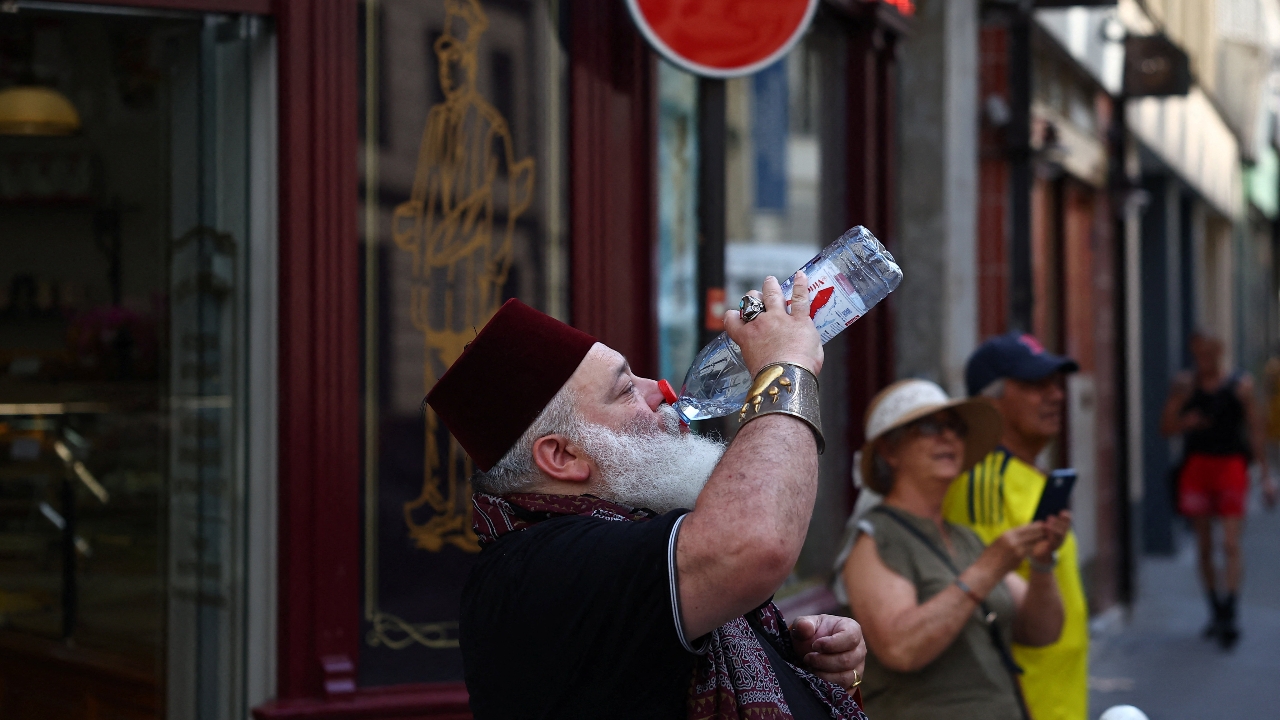
France has introduced strict measures to tackle the heatwave, banning alcohol consumption in public places and restricting alcohol purchases in Paris to ease hospital burdens from increasing patient numbers, while the heatwave approaches Germany and the Czech Republic.
France has issued an order prohibiting alcohol consumption in public and limiting takeaway alcohol sales in Paris to relieve hospitals facing a continuous rise in patients, as the heatwave covering Western Europe moves eastward, with several countries expecting temperatures reaching 40 degrees Celsius.
In Paris, authorities have banned public alcohol consumption from 12:00 p.m. Friday to 7:00 a.m. Saturday, with similar measures for the weekend; takeaway alcohol sales are suspended from 6:00 p.m. to 7:00 a.m. However, licensed restaurants and bars may continue normal service.
French Prime Minister Sébastien Lecornu revealed the government has raised the public health alert to the highest level to increase medical staff and support vulnerable groups, as hospitals face heavy loads from heat-affected patients. Paris Police Commander Patrice Four stated that city hospitals are nearing a crisis point, approaching full capacity.
France has experienced record high temperatures for several consecutive days, with nationwide minimum temperatures averaging 22 degrees Celsius last Wednesday night, and the city of Nantes recording nighttime temperatures as high as 27.2 degrees Celsius.
French Health Minister Stéphanie Rist warned that the heatwave is dangerous not only to the elderly but also affects young people, with a significant rise in cardiac arrest cases.
She reported that in the past 24 hours, ambulance units in Paris have received four times the usual number of cardiac arrest cases, although no confirmed deaths directly linked to the heatwave have yet been reported.
Meanwhile, reports indicate a three-year-old child died in a car in the Paris suburbs, just days after two other young children died in vehicles in Carpentras in southern France.
In Rennes, northwest France, the head of the hospital emergency department disclosed that 5-6 people have died at home, believed to be related to the extreme heat, with bodies found after safety checks when the deceased did not answer calls.
Paris Mayor Emmanuel Grégoire noted that the city’s death rate is rising and warned residents, especially young people, not to underestimate the weather conditions. He noted many still exercise outdoors in the evenings despite high temperatures and advised taking a break from physical activity for a few days.
The Health Minister also cautioned that even young, healthy individuals can be affected by the heatwave, including during cycling or outdoor activities, which may cause dizziness, fainting, and require hospital treatment.
Meteorologists forecast the heatwave will move into Central and Eastern Europe, with Germany and the Czech Republic expecting temperatures up to 40 degrees Celsius this weekend, while countries such as Luxembourg, the Netherlands, Austria, Switzerland, and the UK have issued high-level heat warnings.
The extreme heat has caused the cancellation of the half marathon in Hamburg, Germany; German railways are allowing passengers to cancel tickets free of charge; and Florence’s Uffizi Gallery in Italy has temporarily halted ticket sales due to air conditioning systems being unable to cope with visitor numbers and the heat.
Additionally, three French nuclear power plants have temporarily shut down operations due to the heatwave’s impact.
Simon Stiell, the UN Executive Secretary for Climate Change, stated that Europe’s severe heatwave is clear evidence of the climate crisis’s effects, urging all countries to accelerate the shift to renewable energy, conserve forests, and enhance resilience to extreme weather.
Data from the Copernicus Climate Service shows Europe is the fastest-warming continent globally, with temperature increases twice the global average, leading to more frequent and severe summer heatwaves, intensified wildfires, and significant pressure on water resources in many countries.
. BBC
Click to read news aboutInternational news