

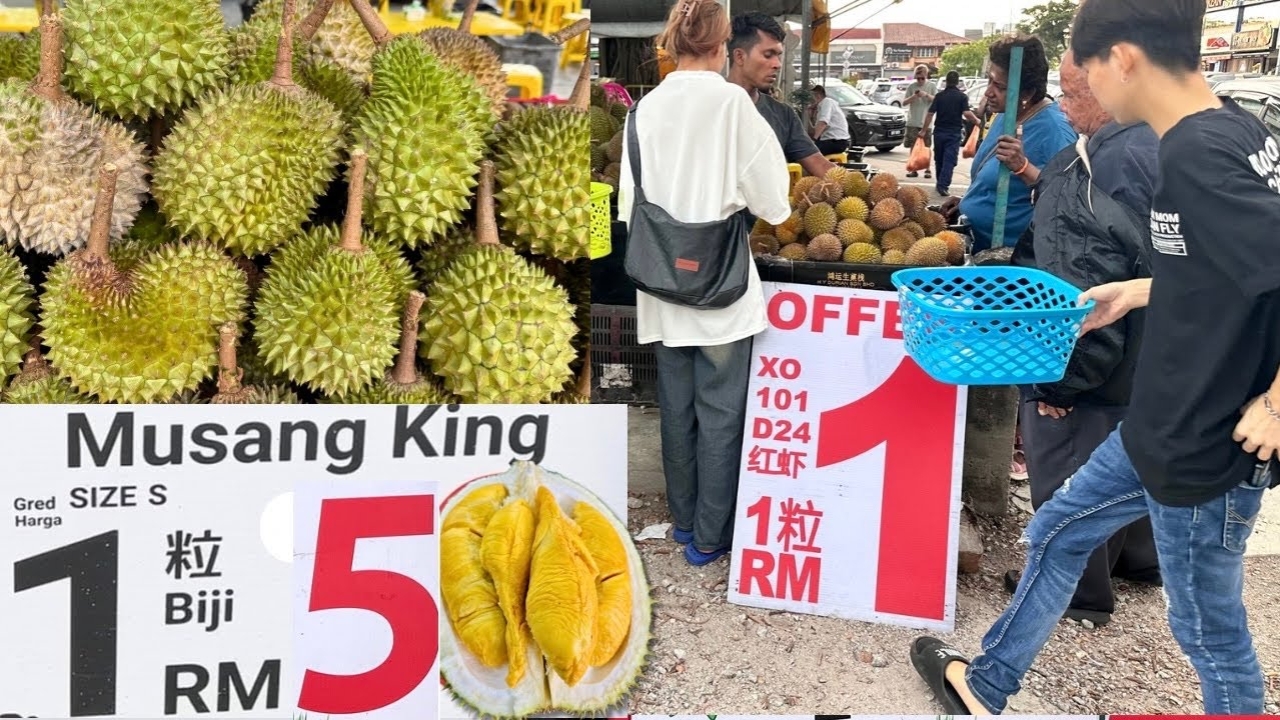
Malaysians flocked to roadside tents and fruit stalls to eagerly eat durians following the "Durian Tsunami" phenomenon, where an oversupply and returned exports caused prices to plummet by over 90%. Premium varieties like "Musang King" dropped to about 70 baht per kilogram, while local durians were sold cheaply at just 4 baht per fruit.
A nationwide phenomenon emerged in Malaysia as large crowds poured into fruit stalls and roadside tents around Kuala Lumpur to buy durians enthusiastically. The fruit, known as the king of fruits, faced a rapid price decline due to production exceeding demand and some shipments failing export standards, resulting in severe domestic oversupply.
Local media and AFP reported this durian price crash as the "Durian Tsunami" phenomenon. Malaysia, a major durian producer in Southeast Asia with over 550,000 tons annually, is currently in peak production season, leading to a dramatic price drop of up to 90% for many premium varieties.
Reports noted that the "Musang King" variety, a popular premium export to China, plunged from about 90 ringgit (approximately 730 baht) per kilogram to just 6 to 9 ringgit (about 49–73 baht) per kilogram. Similarly, other premium types like "Black Thorn" fell sharply. Retail prices at roadside stalls in the Segambut area showed Musang King and Black Thorn whole fruits priced under 25 ringgit (around 204 baht). Common varieties were bundled in sets of seven fruits for just 100 ringgit (approximately 815 baht).
Even more shocking, other varieties such as 101 and Red Prawn dropped to 2 ringgit (about 15 baht) per fruit, while local Kampung durians experienced the steepest price fall in years, down to just 0.50 ringgit or roughly 4 baht each. This unprecedented situation offered durian lovers an exceptional opportunity.
To quickly clear stock and cut losses, many durian vendors adopted aggressive marketing strategies. Some shops handed out large plastic bags allowing customers to pick their own durians priced per fruit, while others offered promotions giving customers large jute sacks to fill tightly with durians for a flat rate of 100 ringgit (around 815 baht), attracting massive queues of buyers.
Mr. Chia Kim Wai, manager of "DurianMan" in Petaling Jaya near Kuala Lumpur, said, "This year’s durians have become the cheapest ever. Now durians are accessible and affordable to the general public, with prices similar to local durians in the past."
However, Mr. Chia acknowledged that many traders worry about the situation due to sharply reduced profits but must continue selling to sustain their businesses. As durians are perishable and cannot be stored long, failure to sell quickly leads to spoilage and heavier losses. Price cuts are currently the only option to recoup some costs.
Mr. Faisal Iswardy Ismail, Deputy Director of the Federal Agricultural Marketing Authority (FAMA) of Malaysia, told the media, "We received advance industry information predicting a 'Musang King Tsunami' this year, which has indeed occurred as expected. Nonetheless, we hope durian prices will recover and stabilize within the next few weeks."
A consumer survey at an agriculture-organized event showed participants excited and pleased about the price crisis. One Malaysian said, "Now Malaysians can enjoy durians at much lower prices, which truly makes us happy."
Experts attribute the phenomenon mainly to rapid expansion of durian plantations in Malaysia over recent years coupled with tighter import restrictions in some export markets. This caused a flood of durians back into the domestic market, creating severe saturation. While this pressures farmers heavily, consumers are enjoying a golden period of affordable access to the king of fruits at historically low prices.
. . .AFP / The Straits Times