

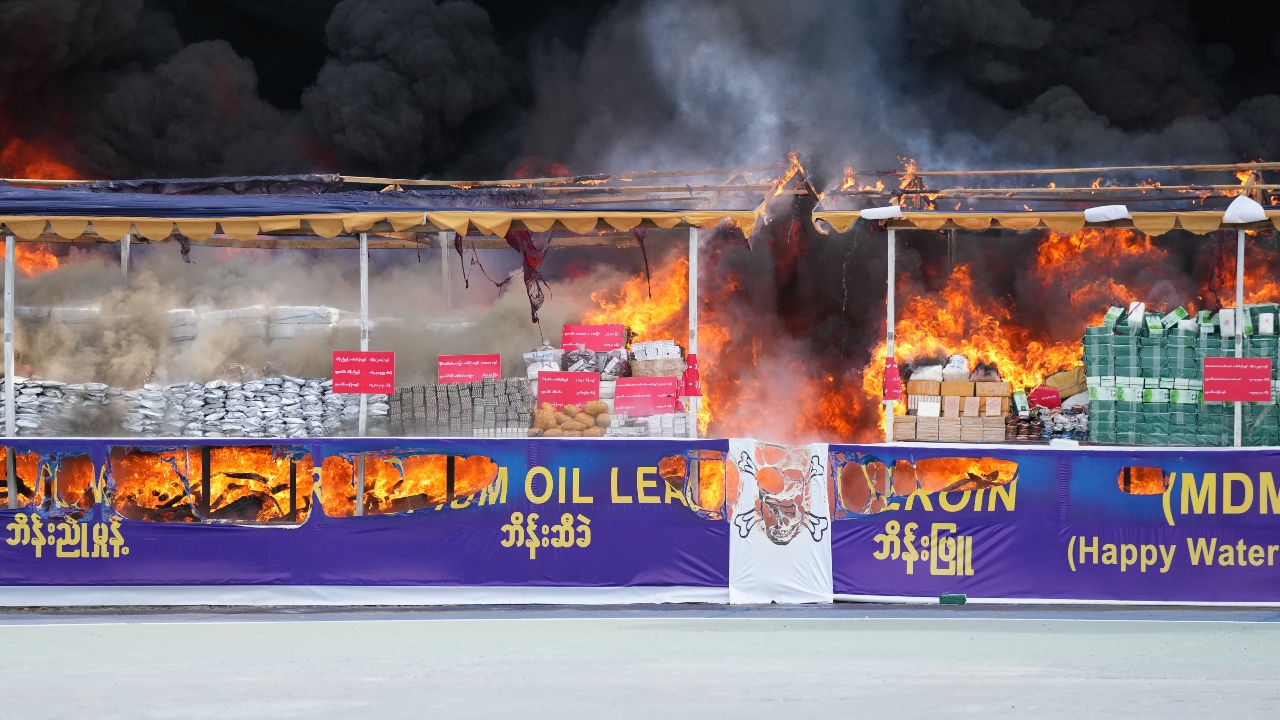
Myanmar authorities held a ceremony to burn over 50 tons of seized drugs, including heroin, opium, ketamine, cannabis, and methamphetamine, valued at more than $525 million (about 17.5 billion baht), on International Day Against Drug Abuse and Illicit Trafficking. They accused armed groups of using the civil war unrest as a means to expand their drug trafficking networks.
Myanmar officials incinerated seized illicit drugs from across the country, with a total value estimated at about $525 million (approximately 17.5 billion baht). The country's Minister of Home Affairs blamed ethnic armed forces and various rebel groups for rapidly expanding the illegal drug trade amid a nation suffering from civil war.
Analysts stated that since the military coup in Myanmar in 2021, the country's administrative systems and law enforcement mechanisms have severely collapsed, triggering a nationwide civil war. This conflict has allowed all parties involved to exploit the situation for profit and income through illegal drug trafficking.
Currently, Myanmar has become the world's largest opium producer after the Taliban returned to power in Afghanistan in 2021 and launched a serious crackdown on opium cultivation. Additionally, the United Nations Office on Drugs and Crime (UNODC) reports that Myanmar is the largest source and producer of methamphetamine (including yaba and ice) in Southeast Asia.
Local officials revealed that police in Yangon brought 31 types of drugs for incineration to mark the United Nations' "International Day Against Drug Abuse and Illicit Trafficking," producing thick black smoke rising widely into the sky.
The ceremony was held at an industrial estate on the outskirts of Yangon, where officials conducted a three-second countdown before igniting the drugs, which had been pre-soaked in gasoline. The flames burned intensely for over 30 minutes before firefighters sprayed water to control and fully extinguish the fire.
Police Lt. Col. Aung Matt So, a narcotics suppression officer, told reporters, "Methamphetamine, or ice, constitutes the largest quantity among all seized drugs, with a total weight exceeding 28 tons."
The amount of drugs destroyed in the simultaneous ceremonies in three major cities—Yangon, Mandalay, and Taunggyi, the capital of Shan State in eastern Myanmar and a center for opium trade—was double the amount destroyed last year.
Myanmar's Minister of Home Affairs, Maj. Gen. Myint Swe, said in a speech published through government media that "Rebel groups have taken advantage of the country's political uncertainty to expand and participate more extensively in illegal drug trafficking." He added, "These illegal activities not only prolong the existence of insurgent groups but also pose ongoing threats to national security and stability."
In January, Myanmar authorities revealed they had simultaneously raided and dismantled three large drug production factories deep in forested areas. These factories had the capacity to produce up to one-third of all methamphetamine seized in Myanmar over the past year.
The three factories were hidden in mountainous regions of Shan State, about 180 kilometers from the Chinese border. Each was as large as a small village and equipped with their own systematic electric power and water supply infrastructure.
However, analysts and security experts note that since the democratic government of Aung San Suu Kyi was overthrown, the chaos and unresolved civil war have not only allowed drug production to grow but also other illegal businesses, such as unregulated mining and the booming online scam call center operations.
/sourceAFP