

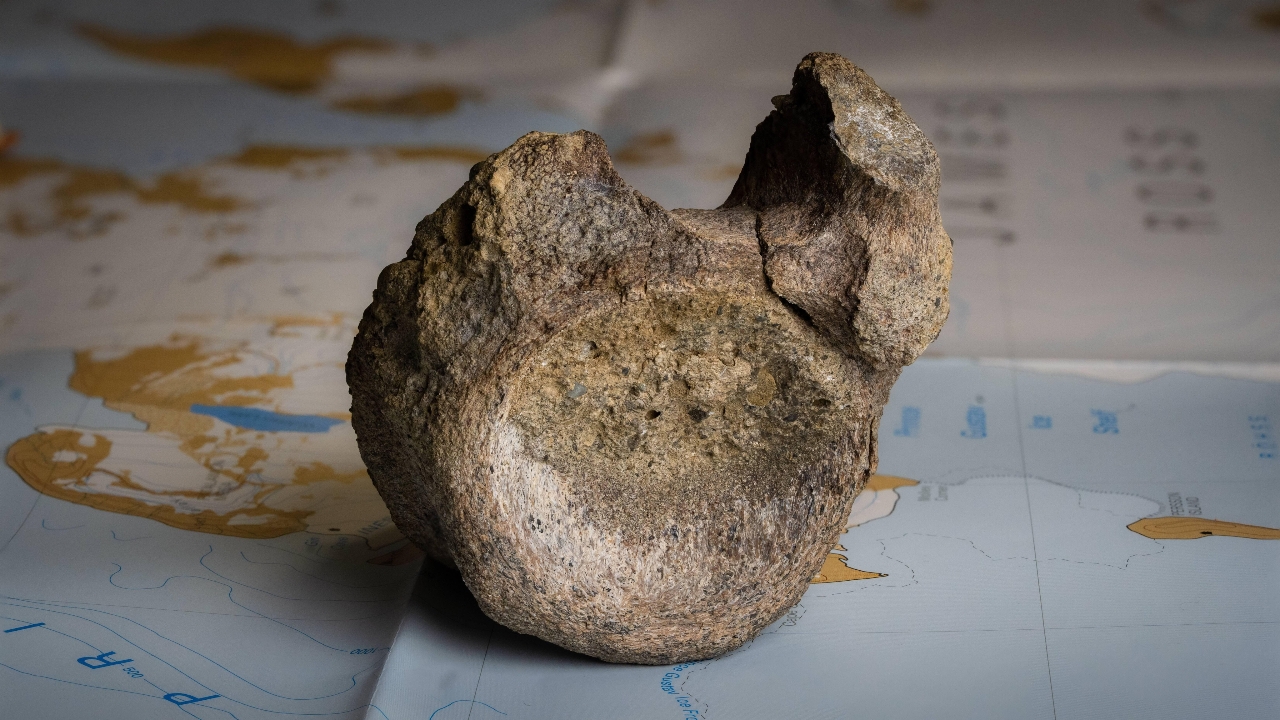
A paleontologist revealed a historic discovery after finding a fossil bone forgotten in a storage drawer for 40 years. It has now been identified as the "first dinosaur bone" ever found on the continent of Antarctica, or the South Pole. The bone is part of the tail of a "Titanosaur," a herbivorous dinosaur, providing new evidence that the South Pole was once a lush forest teeming with life.
The British Antarctic Survey (BAS) in Cambridge revealed this incredible discovery after Dr. Mark Evans, the BAS collections manager, noticed an unremarkable fossil bone among thousands of rock and fossil samples brought back from Antarctic expeditions over several decades. The bone had been forgotten in a geological drawer for 40 years.
This fossil was first excavated on 9 December 1985 at James Ross Island in Antarctica. Dr. Mike Thomson, a geologist at the time, sketched a small drawing in his field notebook noting it as a "vertebra of a large reptile" about 10 centimeters wide. However, the team was unsure of its exact identity and speculated it might be from an ancient marine reptile, so it was stored away and left untouched.
Dr. Mark Evans described the moment he found the fossil: "It happens when you start wondering 'What’s in this drawer?' and then you come across something and think, 'Hmm... this is interesting.'"
Dr. Evans noticed that this vertebra resembled dinosaur bones more than marine creatures. Considering the excavation date, it meant this was the earliest dinosaur fossil found on Antarctica, challenging previous beliefs of earlier finds. He then invited Professor Paul Barrett, an expert from the Natural History Museum (NHM) in London, to verify the discovery.
Professor Barrett examined the bone's structure closely, pointing out a groove at one end and a round knob at the other—characteristic ball-and-socket joints running from head to tail.
Professor Barrett confirmed, "The moment I saw it, I knew what we were dealing with... It’s 100 percent clear that this is a Titanosaur because it combines unique skeletal features exclusive to this dinosaur group."
"Titanosaurs" are a group of four-legged herbivorous dinosaurs with long necks and tails for balance. This group includes some of the largest dinosaurs ever to walk the Earth, some exceeding 35 meters in length and weighing up to 60 tons. However, based on the size of the tail bone found in Antarctica, scientists estimate this individual was only about 7 meters long, possibly a juvenile or a dwarf species that evolved smaller size compared to the main group.
This long-forgotten discovery fills a gap in the sparse fossil record of Antarctica. Scientists estimate the dinosaur lived around 82 million years ago in the late Cretaceous period, when Antarctica’s environment was vastly different from today’s icy continent. Back then, it was covered in lush green forests, providing abundant food for large herbivores.
Today, paleontological work in Antarctica remains extremely challenging because thick ice sheets cover prehistoric evidence in the rock layers. Thus, finding this fossil in a drawer has significant historical importance.
Professor Barrett concluded, "It shows that areas we now think uninhabitable were once thriving habitats with diverse life forms. This discovery helps us understand how they lived and adapted to the vast ecosystems at the bottom of the world about 80 million years ago."
/sourceBBC