

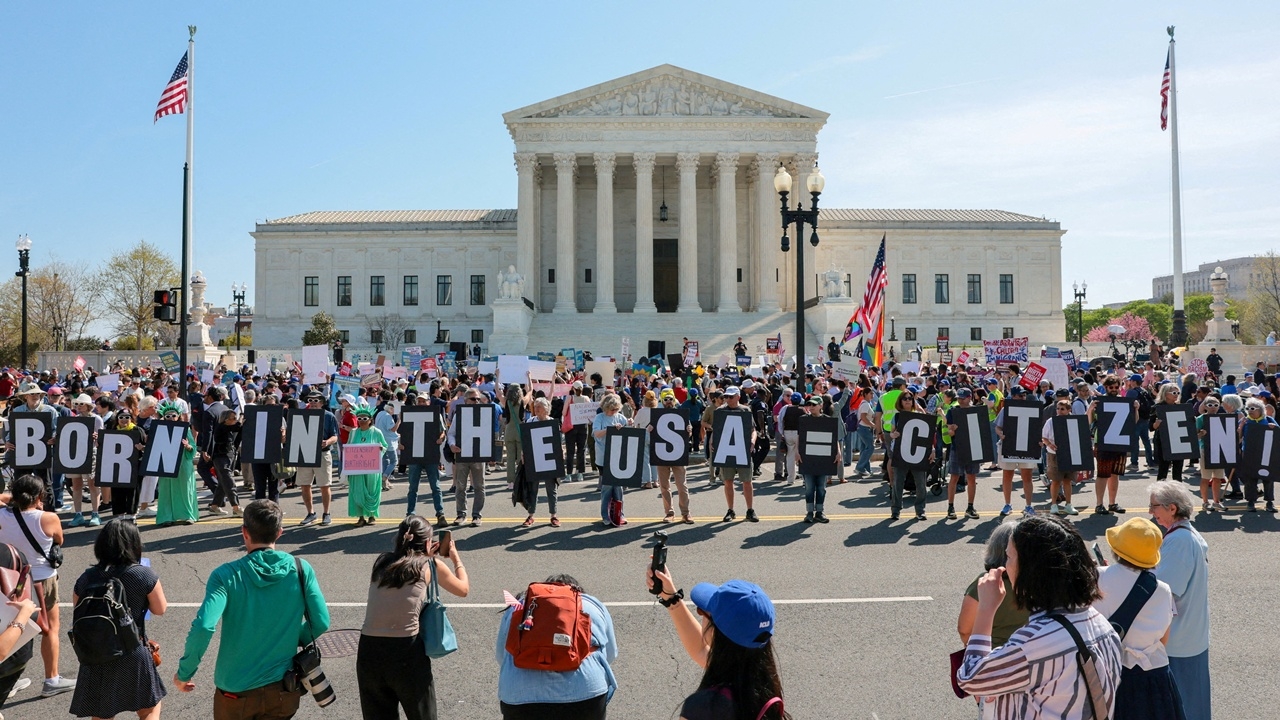
US Supreme Court justices voted to support the right of those born on US soil to receive American citizenship, rejecting a Trump administration order that sought to eliminate this right. Tags: [US Supreme Court, birthright citizenship, Donald Trump, immigration policy]
On Tuesday, 30 Jun 2026 GMT+7, US Supreme Court justices delivered a split but majority decision to preserve the broad concept of "birthright citizenship," rejecting President Donald Trump's administration order that declared children born to people residing illegally or temporarily in the US would not be granted American citizenship.Tags: [US Supreme Court, birthright citizenship, Donald Trump, immigration policy]
The justices relied on a long-standing understanding of the 14th Amendment to the Constitution, enacted after the Civil War, as well as subsequent federal laws, concluding that anyone born in the country is considered an American citizen, with only very limited exceptions.Tags: [14th Amendment, citizenship law, US Constitution, legal precedent]
“Citizenship, both past and present, is the right to hold various rights — including full participation in our political community. The framers of the 14th Amendment extended that promise to ‘all persons born free on this soil,’” Chief Justice John Roberts wrote in the court's opinion, citing congressional debates on the provision. “And today, we uphold that promise.”Tags: [Chief Justice John Roberts, 14th Amendment, birthright citizenship, constitutional promise]
However, three conservative justices believed Trump’s restrictions should be enforceable.Tags: [US Supreme Court dissent, conservative justices, Trump administration]
“Today the Court has done something unprecedented by ruling that the president’s order denying citizenship to children of temporary visitors and unauthorized immigrants is plainly unconstitutional,” Justice Clarence Thomas stated in a dissenting opinion spanning 91 pages, more than three times longer than Roberts' opinion.Tags: [Justice Clarence Thomas, dissenting opinion, birthright citizenship, constitutional law]
“In doing so, the Court adds a sad chapter to the 14th Amendment, originally designed and understood to guarantee equal rights to freed Black Americans, but now repurposed for a political agenda not supported by the Reconstruction-era Congress.”Tags: [14th Amendment history, equal rights, Reconstruction era, judicial interpretation]
The order ending birthright citizenship was one of several directives Trump signed on the first day of his second presidential term and was a key part of his immigration crackdown policies. However, lower courts blocked this order, and it has not been enforced anywhere in the US.Tags: [Trump administration, birthright citizenship, immigration crackdown, lower courts]
During April hearings, both conservative and liberal justices questioned the legality of the order in this landmark case, which grew tense as Trump attended the court session in person, an unprecedented move.Tags: [US Supreme Court hearings, Trump attendance, legal challenge, birthright citizenship]
The case represents an unprecedented use of executive power by Donald Trump and a test for the Supreme Court, where conservative justices hold the majority and often rule in favor of this president.Tags: [executive power, Supreme Court, conservative majority, Donald Trump]
The issue of birthright citizenship is the first immigration policy of Trump’s to reach the Supreme Court for a definitive ruling. Previously, justices overturned Trump’s global tariff measures imposed under emergency powers, a use never before seen.Tags: [birthright citizenship, immigration policy, Supreme Court, Trump tariffs]
Trump reacted with intense anger to the tariff ruling in late February, saying he was ashamed of the judges opposing him and labeling them unpatriotic.Tags: [Donald Trump, tariff ruling, judicial criticism, political reaction]
Meanwhile, research from the Migration Policy Institute and the Population Research Institute at Penn State University indicates that if this executive order were enforced, it would affect more than 250,000 babies born in the US each year.Tags: [Migration Policy Institute, Penn State University, birth statistics, immigration impact]
Additionally, the birthright citizenship restrictions would also apply to individuals legally residing in the US, including international students and those applying for permanent residency (Green Card).Tags: [legal residents, international students, Green Card applicants, birthright citizenship]
Follow international news:Tags: [international news, news sources]https://www.thairath.co.th/news/foreignTags: [news website, Thairath]
Source:Tags: []apnewsTags: [news agency, AP News]