

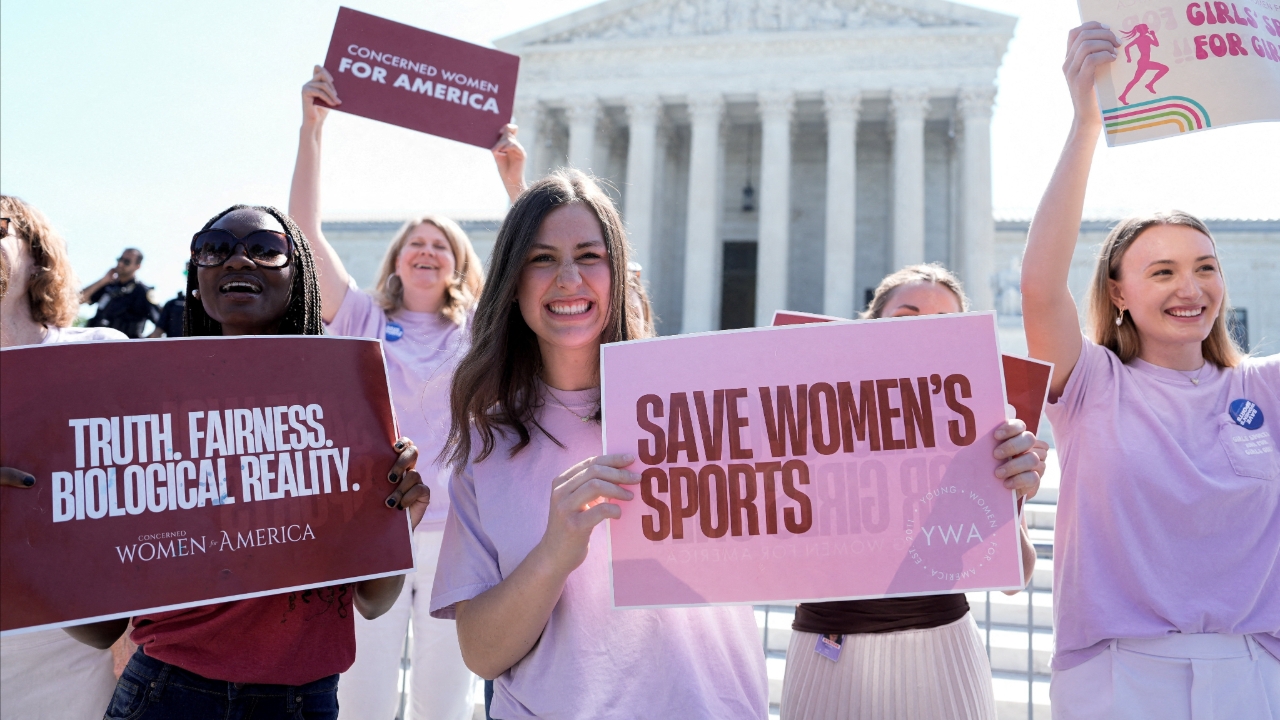
The U.S. Supreme Court ruled that states can prohibit transgender athletes from competing in women's sports following lawsuits in West Virginia and Idaho.
On Tuesday, 30 Jun 2026 GMT+7, the U.S. Supreme Court decided that states may ban transgender athletes from participating in girls' and women's sports teams. This broad binding ruling will certainly affect transgender rights across the United States.
The Supreme Court justices voted 6 to 3 to uphold West Virginia and Idaho laws limiting transgender athletes' participation in school sports. The cases involved two athletes: Becky Pepper-Jackson, a high school student from West Virginia, and Lindsay Hecox, a university student in Idaho. These cases are known as West Virginia v. B.P.J. and Little v. Hecox.
Justice Brett Kavanaugh authored the majority opinion, stating that under Title IX—which mandates equal opportunities in sports—and the constitutional equal protection clause, schools may set eligibility for girls' and women's teams based on biological sex.
"To comply with Title IX and the equal protection clause, we rule that states may preserve female sports for biological females. They may set qualifications for girls' and women's sports based on biological sex," Kavanaugh stated in the opinion.
"The Constitution and Title IX do not require dismantling girls' and women's sports programs across America."
However, the three liberal justices dissented from the majority's interpretation of the equal protection clause, arguing that the court should not decide this issue yet because some factual matters remain unresolved.
On the Title IX issue, the court's liberal justices agreed with conservatives. Justice Sonia Sotomayor read her dissent from the bench, signaling strong disagreement with the majority's ruling.
"Ultimately, for this court, facts no longer matter, even though the consequences are severe. This ban decisively prevents B.P.J. from practicing with the girls' team, even if she does not displace anyone in actual competition, even if all tryouts result in everyone qualifying, and even though participation greatly alleviates B.P.J.'s gender dysphoria," she said in her dissent.
This Supreme Court ruling protects similar laws in 27 states enacted in recent years in response to high-profile cases of transgender athletes competing in girls' and women's sports.
In 2025, U.S. President Donald Trump signed an executive order banning federally funded educational programs from allowing transgender women to compete on women's sports teams.
Additionally, the National Collegiate Athletic Association (NCAA) and the International Olympic Committee (IOC) have revised eligibility policies, restricting women's competitions to athletes who are biologically female at birth.
Follow international news:https://www.thairath.co.th/news/foreign
Source:The Guardian,CBS News