

The United Nations Secretary-General warned that artificial intelligence (AI) is developing so rapidly that regulations cannot keep pace, urging the global community to accelerate setting standards and joint oversight mechanisms, particularly for child protection, societal safety, and banning AI-driven autonomous lethal weapons.
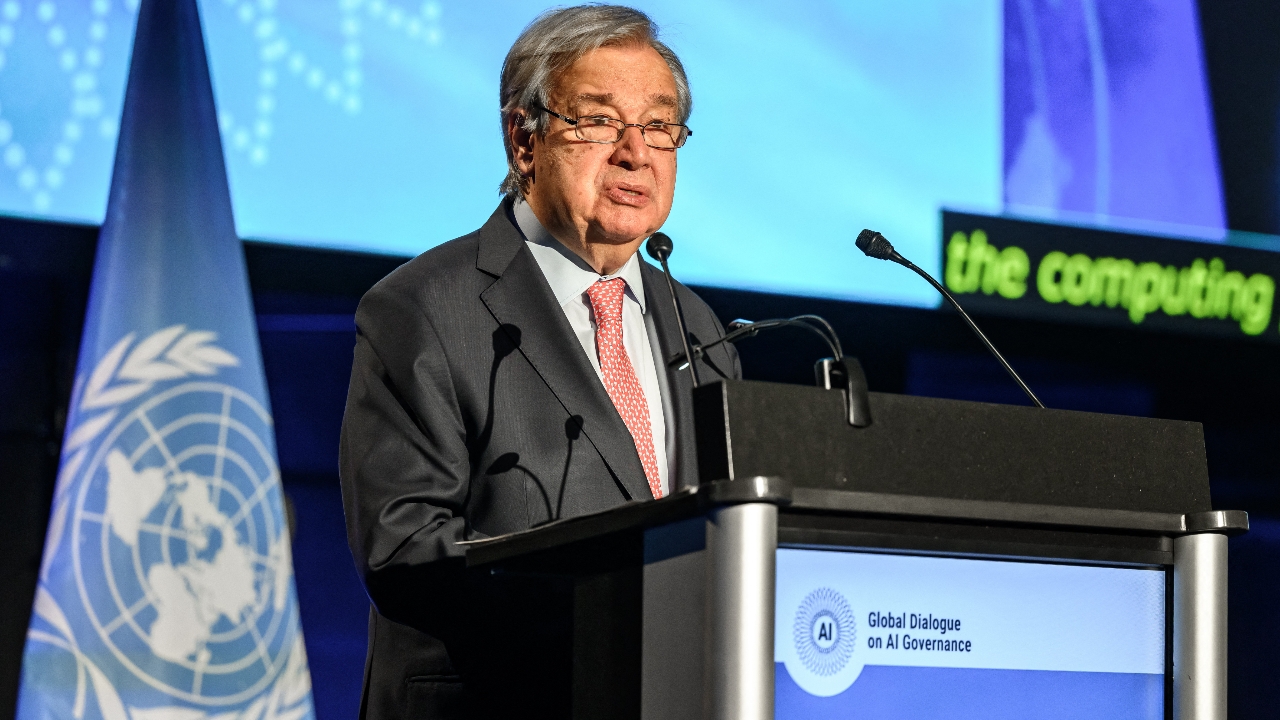
Antonio Guterres, the United Nations Secretary-General, opened the first-ever government-level Global Dialogue on AI Governance in Geneva, warning that AI technology is advancing so quickly that regulations cannot keep up, and called on all countries to jointly establish a global governance framework to ensure AI benefits humanity.
Guterres stated that AI is a transformative technology capable of reshaping economies, labor markets, influencing elections, and potentially altering global security balances. However, its deployment is accelerating faster than even developers can control. "Innovation must come with safety barriers; if AI is powerful, it must be under oversight."
He warned that the world is conducting an "experiment on human society" without proper planning or societal consent, questioning whether humanity will collectively shape AI's direction or allow AI to determine the future of humans.
The UN Secretary-General noted that AI today is no longer merely a tool awaiting human commands but can program itself, operate online, and make many decisions with diminishing human supervision.
He expressed concern that AI is blurring the line between "truth" and "false information," with many people relying on AI-generated results without verifying their accuracy.
Guterres mentioned the trend called "Vibe Coding," where AI generates programs from natural language instructions instead of manual coding. While this greatly improves efficiency, he emphasized that AI should not be allowed to define "truth" or humanity's future.
He further warned that AI development power is concentrated in a few tech companies and countries, while most nations have little say in decisions affecting their own futures. He stated the world faces a choice between structured AI governance or letting technology advance without direction.
The UN Secretary-General called for international standards to assess and monitor AI risks, giving special attention to child protection. He compared how medicines and toys must be safety-tested before reaching children, yet AI is already integral to children's daily lives—in learning, friendships, and personal questions—without serious impact evaluation.
Guterres proposed creating an "AI Child Safety Pledge," requiring AI developers to prove their systems accessible to children are safe, include strong protections against sexual exploitation, and connect children showing signs of mental distress to human experts. He said, "No child should become an unregulated AI test subject."
He suggested the UN General Assembly establish a Global Fund for AI to support developing countries in building human resources, data infrastructure, and computing capabilities, preventing digital inequality from turning into "AI inequality."
Additionally, he urged tech companies to disclose AI's environmental impact and commit to powering all data centers with renewable energy by 2030 to mitigate climate change effects.
One of Guterres' greatest concerns is the military use of AI, especially autonomous weapons systems that can select and kill targets without human control.
He stated such systems should be called "killer robots" and constitute a serious moral violation, urging the global community to enact international laws banning their use outright.
The two-day Global Dialogue on AI Governance aims to provide a forum for governments, tech companies, academics, and civil society to discuss AI regulatory approaches, though it is not yet a treaty negotiation platform.
The meeting will also review the first global AI assessment report, prepared by 40 independent experts supported by the UN, before completing the full report and holding the next global meeting in New York next year.
Guterres concluded that the world may be at a crucial moment for setting rules for coexistence between humans and AI, warning, "The door of opportunity is still open now, but it will not remain open forever."
Source: AFP /Reuters