

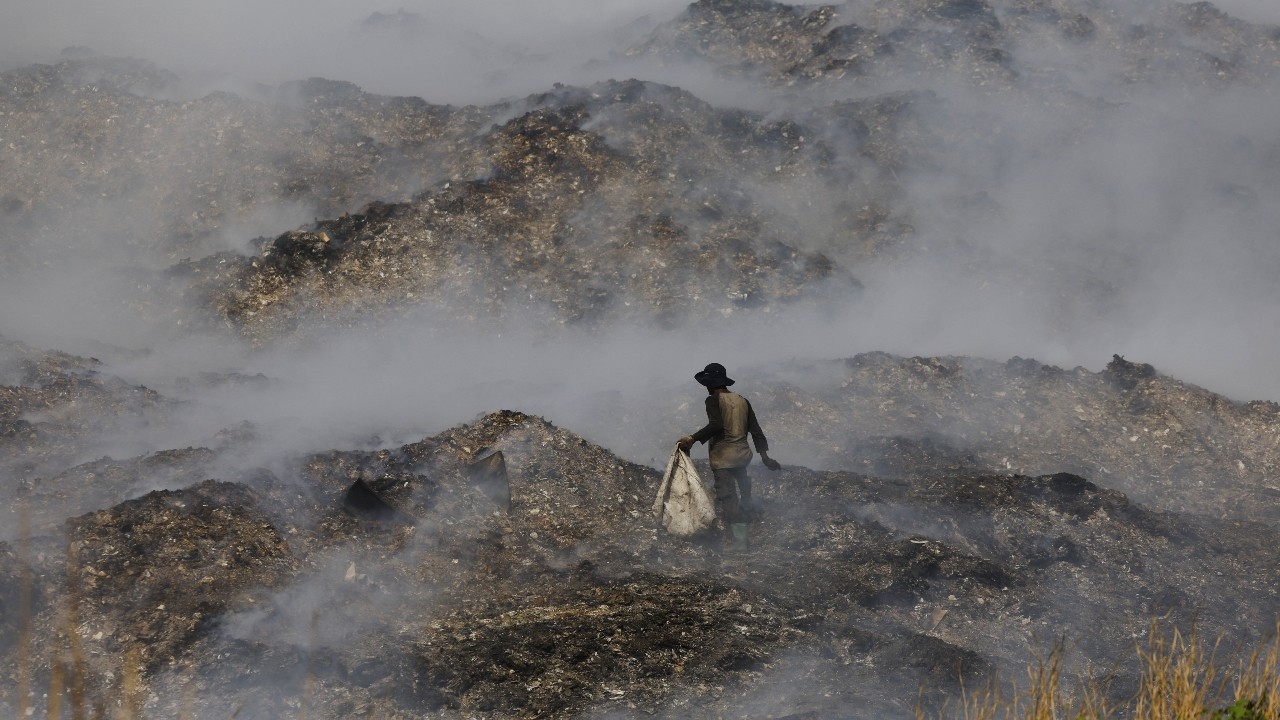
Indonesia is facing an environmental crisis after a massive fire broke out at the Jatiwaringin landfill near Jakarta. The blaze has burned continuously for over eight days, covering more than 94 rai. Thick toxic smoke has engulfed surrounding communities, causing air pollution levels to surge tens of times above safety standards. Hundreds of residents have evacuated, and many have fallen ill with respiratory diseases.
The intense fire at the giant landfill within the Jatiwaringin site, located in the suburban Tangerang area of Banten province near Jakarta, has been burning for eight consecutive days since it started on 30 June. The fire has spread across more than 94 rai, producing dense black toxic smoke that blankets the area and has forced hundreds of households to urgently evacuate.
Indonesia’s Ministry of Environment revealed that air quality around the landfill has reached dangerously hazardous levels, with fine particulate matter exceeding 1,000 micrograms per cubic meter. This is many times higher than the safety standard limit of 15.5 micrograms per cubic meter, although the situation has slightly improved in recent days.
Sarmana, a 45-year-old local resident, said the thick toxic smoke overwhelmed her home to the point that visibility was zero and severely affected her health. "The smoke was so thick we couldn’t see anyone. It irritated my nose, caused coughing, runny nose, and difficulty breathing. We had to abandon our homes because we couldn’t tolerate it any longer," she said.
Local health authorities reported that at least 234 residents affected by the toxic smoke have received medical treatment, with 72 diagnosed with acute respiratory infections.
Diaz Hendropriyono, Deputy Minister of Environment, stated that extinguishing the landfill fire is extremely difficult because the flames are not just on the surface but "smoldering under the garbage pile," similar to peatland wildfires.
Indonesian authorities have mobilized personnel from various agencies, including deploying a 30-member Manggala Agni team—experts in peatland wildfire suppression from Sulawesi and West Java—equipped with high-pressure water gear. They are also using heat-detection drones with infrared cameras to locate hotspots beneath the waste. Coordination with the National Disaster Management Agency and Meteorological Agency is underway to prepare artificial rain to expedite fire suppression by the end of the week.
Although officials have not yet confirmed the cause, Indonesia’s environmental NGO Walhi clearly attributes the fire to methane gas accumulation from decomposing organic waste piled for years, a consequence of uncontrolled open dumping systems.
Wahyu Eka Stiyawan, an activist with Walhi, said the Jatiwaringin landfill was designed to handle only 2,700 tons of waste daily, covering just 59% of Tangerang’s waste. The remainder is illegally dumped in surrounding areas, forming smelly "garbage mountains" swarming with flies less than 100 meters from residential homes. Combined with extreme heat from the climate crisis, methane gas under the waste piles acts as a powder keg, ready to ignite from even a small spark.
Police Major General Rizal Irwan, Deputy Director for Environmental Law Enforcement at the Ministry of Environment and Forestry, stated that the Jatiwaringin landfill was administratively sanctioned in 2022 for poor management. Authorities ordered a switch to a controlled landfill system using machinery to compact waste and cover it periodically with soil to reduce methane buildup. However, local authorities have only improved 5-6 hectares out of the total 33 hectares, and the current fire occurred outside the controlled area.
The Ministry of Environment has prepared strict measures, planning a major inspection and evaluation operation of 390 landfills across Indonesia starting in early August 2023 to prevent repeated tragedies like this, which have occurred multiple times nationwide.
Environmental rights groups emphasize that this problem will persist as long as the government fails to enforce laws seriously, local waste management budgets remain low, and public education on organic waste separation at the source is lacking. If the mixed waste disposal system continues, underground methane gas will keep accumulating, and whenever temperatures rise again, new fires are likely to erupt.