

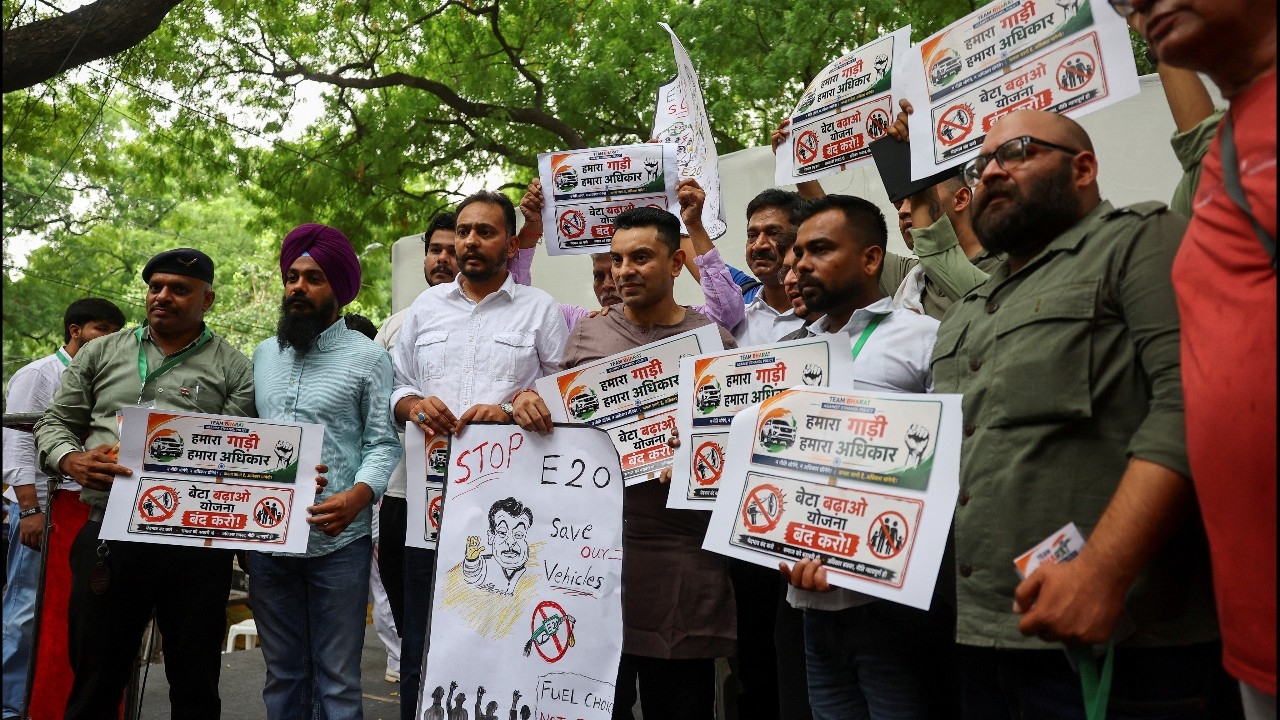
India is promoting a clean energy policy by mandating E20 gasoline as the standard fuel at service stations nationwide to reduce imports. However, backlash has emerged as vehicle users complain about higher fuel consumption and engine damage risks.
The Indian government began blending ethanol into gasoline in the mid-2000s to reduce reliance on crude oil imports, cut greenhouse gas emissions, and boost income for sugarcane and corn farmers, the main raw materials for ethanol production.
However, the latest transition has been rapid, with India increasing ethanol content from 10% in 2022 to 20% by 2025, five years ahead of the original plan, leaving many cars and motorcycles unprepared for this fuel type.
Although non-ethanol gasoline is still available, it costs about 40-50% more depending on the region, and many vehicle owners are unaware that they can choose to use this fuel instead.
In recent months, many motorists have posted complaints on social media, stating that after using E20 fuel, their vehicles consume more fuel, lose engine power, and require more frequent servicing.
Recently, a group of vehicle users protested in New Delhi, accusing the government of rushing policy enforcement without offering people a choice and claiming they are burdened with higher maintenance costs.
The government under Prime Minister Narendra Modi denied all allegations, asserting that many complaints stem from misinformation on social media and emphasizing that E20 fuel has been thoroughly tested and does not cause engine damage.
Six major Indian automakers also supported the government's position, sharing test results and service center data showing no widespread engine damage caused by E20 fuel use.
However, automakers acknowledge that E20 fuel reduces fuel efficiency by about 3-3.5% because ethanol has lower energy content than gasoline, while some experts estimate fuel consumption may increase by 4-12%.
Analysts point out that concerns mainly involve older vehicles made before 2023, as over 75% of vehicles on Indian roads were not specifically designed for E20, raising fears that continued use might accelerate fuel system wear, cause corrosion, and increase long-term repair costs.
Automotive experts explain that ethanol absorbs more moisture than gasoline, potentially causing corrosion in fuel systems over prolonged use, and may loosen engine deposits that could clog fuel pumps or injectors.
So far, no publicly released scientific study conclusively proves that E20 fuel damages engines or confirms the government and automakers’ claims that the fuel is safe, leaving the debate about E20’s vehicle impact ongoing in India.
Despite opposition, the Indian government continues to advance its biofuel policy, viewing it as a way to reduce crude oil imports, enhance energy security, and lower greenhouse gas emissions amid global oil market volatility caused by Middle East conflicts.
. Source: BBC
Click to read more international news