

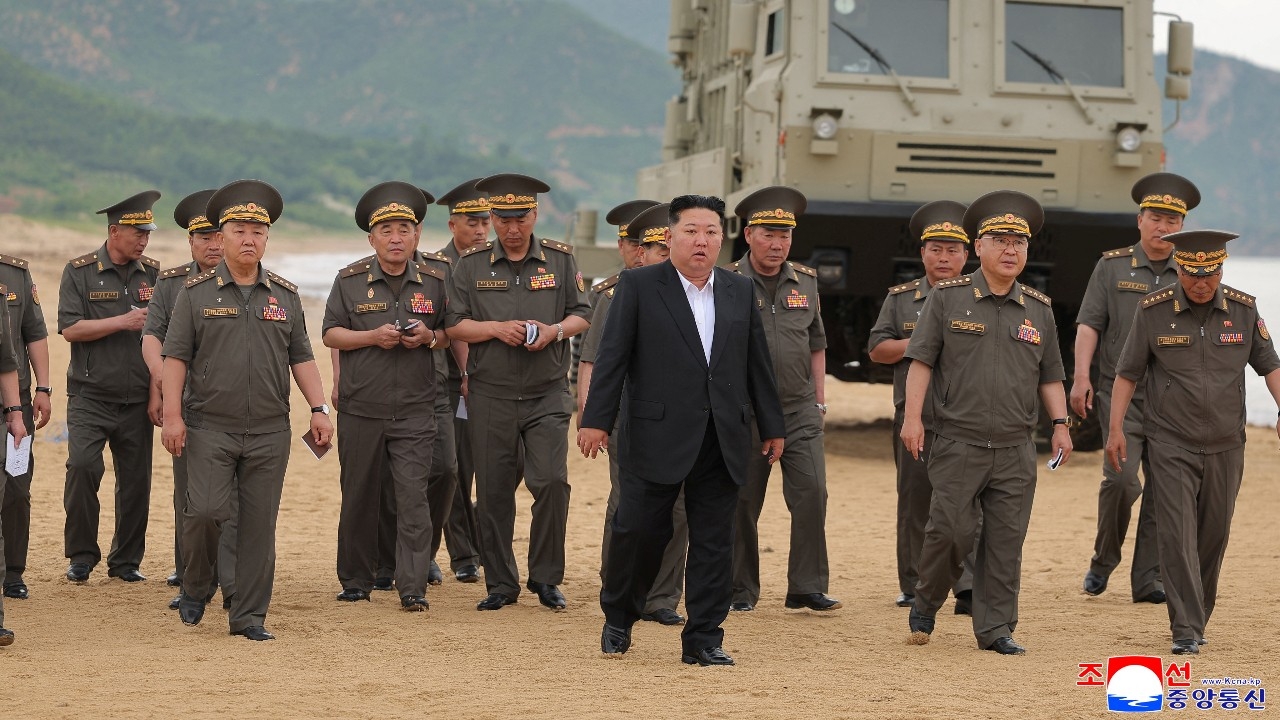
North Korea has announced an increase in its nuclear weapons capabilities in both "quality and quantity," along with an expansion of the military intelligence unit responsible for operations concerning South Korea, according to a resolution from the Central Military Commission meeting of the Workers' Party amid heightened tensions on the Korean Peninsula and South Korea's rejected proposals for relationship building.
The Korean Central News Agency (KCNA) reported that North Korea has reached significant agreements and measures to strengthen its nuclear forces "both qualitatively and quantitatively," while also upgrading and expanding the role and duties of its military intelligence unit focused on operations against South Korea.
This announcement followed an extended session of the Central Military Commission of the Workers' Party of Korea on Thursday, 9 Jul 2024 GMT+7, chaired by Supreme Leader Kim Jong Un, who emphasized that North Korea's security and "true peace" can only be guaranteed by building a powerful military capable of controlling and destroying all threats.
Beyond plans to expand the nuclear arsenal, the meeting outlined strategies to upgrade technical combat infrastructure, modernize military bases to meet international standards, and enhance shipyard capabilities while constructing modern naval bases, signaling a major shift in the role of North Korea's navy.
A key highlight of the meeting was the order to expand the duties and mission of the Reconnaissance General Bureau (RGB), Pyongyang's military intelligence agency responsible for covert operations and espionage specifically targeting South Korea.
KCNA noted that this agency "plays a crucial role in controlling potential enemy threats and gathering critical intelligence," and the meeting discussed ways to dramatically transform military reconnaissance and intelligence capabilities.
Hong Min, a senior researcher at South Korea's Korea Institute for National Unification, analyzed that this recent move reflects Pyongyang's changed attitude, viewing South Korea as an "absolutely hostile state" rather than merely the southern border of the armistice zone. "Military reconnaissance and espionage will take on new significance under the ‘two hostile states’ concept, as espionage targeting a sovereign state has more severe diplomatic consequences."
Security experts observe that North Korea's accelerated development of its surveillance systems likely involves military technological aid, including reconnaissance satellites, from Russia, possibly in exchange for North Korea's deployment of troops to assist Russia in the Ukraine war. Earlier in 2023, North Korea successfully launched a military reconnaissance satellite into orbit, claiming it can capture images of key U.S. and South Korean military sites.
South Korea’s Ministry of Unification stated it is "closely monitoring" the developments and expansion of North Korea's intelligence units.
Since the Korean War ended with an armistice in 1953 without a peace treaty, technically leaving the two countries in a state of war, North Korea has continuously conducted espionage and assassination missions, including the notorious 1997 assassination attempt on defector Lee Han-young and the case of Jung Soo-il, one of North Korea's most famous spies who infiltrated South Korea in 1984 disguised as a Filipino-Lebanese professor before being captured.