

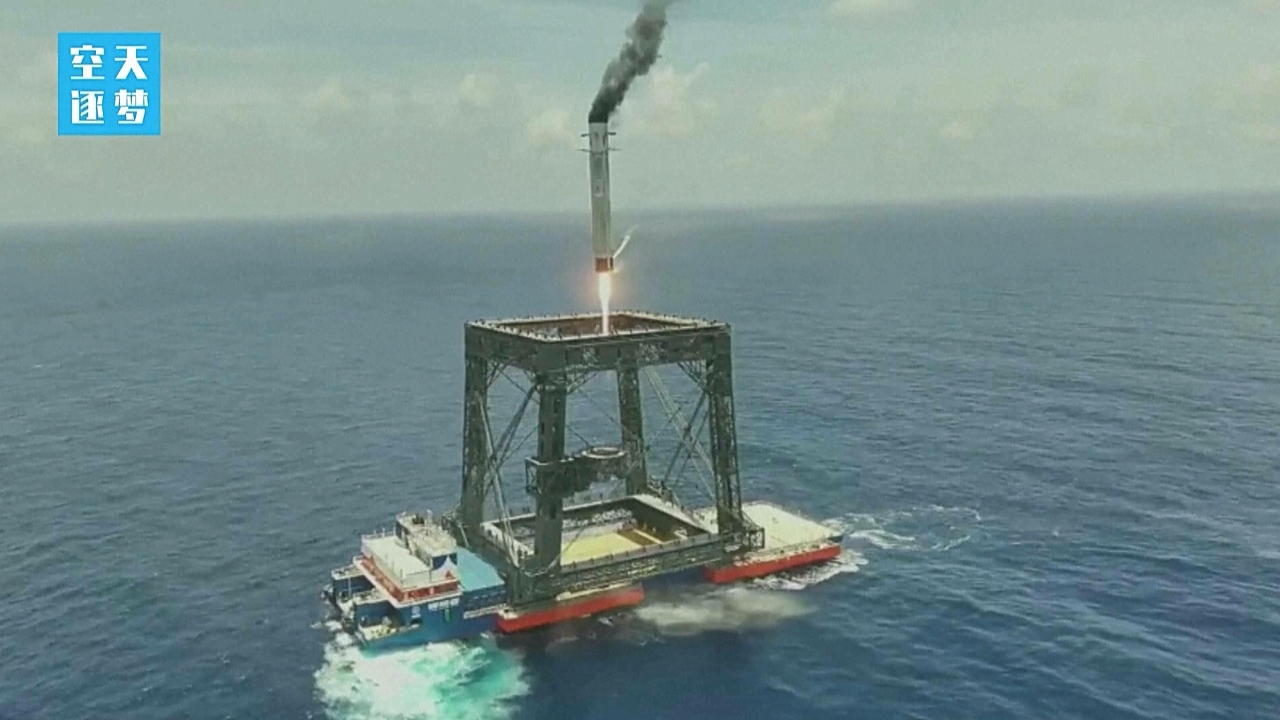
China has successfully launched the Long March 10B rocket into space and, for the first time, vertically landed its booster section on a floating sea platform. This marks a significant milestone in China's space program aimed at developing reusable rocket technology to reduce satellite launch costs and enhance competitiveness against the U.S. in the aerospace sector.
Chinese state media reported a major achievement in the country's space program after the Long March 10B rocket safely returned and landed vertically on Earth for the first time, a crucial step enabling China to challenge the U.S. dominance in the reusable rocket market.
The China Aerospace Science and Technology Corporation (CASC), together with the China Academy of Launch Vehicle Technology (CALT), announced that the Long March 10B was launched from a commercial rocket center on Hainan Island in southern China at 12:15 local time on 10 July. About six minutes after the upper rocket stage separated, the main propulsion booster returned vertically and accurately landed on a floating sea platform.
This success immediately boosted the stock prices of Chinese aerospace companies, with shares of China Spacesat and China Satellite Communications surging to the maximum daily limit of 10 percent under Chinese financial market regulations.
Traditionally, space launch rockets have been single-use and discarded after launch, resulting in very high costs per mission. The shift to reusable rocket technology, especially recovering the booster—the most valuable and engine-packed section—can drastically reduce costs for satellite deployment and space exploration.
Until now, the U.S. has led in this technology, notably through Elon Musk's SpaceX, which first landed its Falcon 9 rocket in December 2015, followed by Jeff Bezos's Blue Origin New Glenn rocket in November 2025. Currently, Falcon 9 rockets are launched about three times weekly—nearly 150 times annually—with boosters reused multiple times.
China's Long March 10B rocket is designed for commercial transport and can deliver at least 16 metric tons to low Earth orbit, performance comparable to Falcon 9 but featuring a completely different landing system. While Falcon 9 deploys landing legs to touch down autonomously on land or drone ships, Long March 10B uses a hook system to catch a net installed on a sea platform.
China has spent nearly a decade developing reusable rocket technology, progressing from low-altitude hover tests to efforts to recover boosters from orbit in recent years. Previously, in February, China tested the Long March 10A rocket's landing but only achieved a splashdown near the platform. Additionally, last year, Chinese private startup LandSpace failed in the final landing stage. These challenges have prompted the Chinese government to relax IPO regulations to help such companies raise funds more easily.
The Long March 10B is part of the Long March 10 rocket family under development to support China's goal of sending humans to the Moon before 2030. This test success not only lowers costs for China's commercial satellite network but also provides crucial data and innovations to advance the country's future lunar exploration ambitions.