

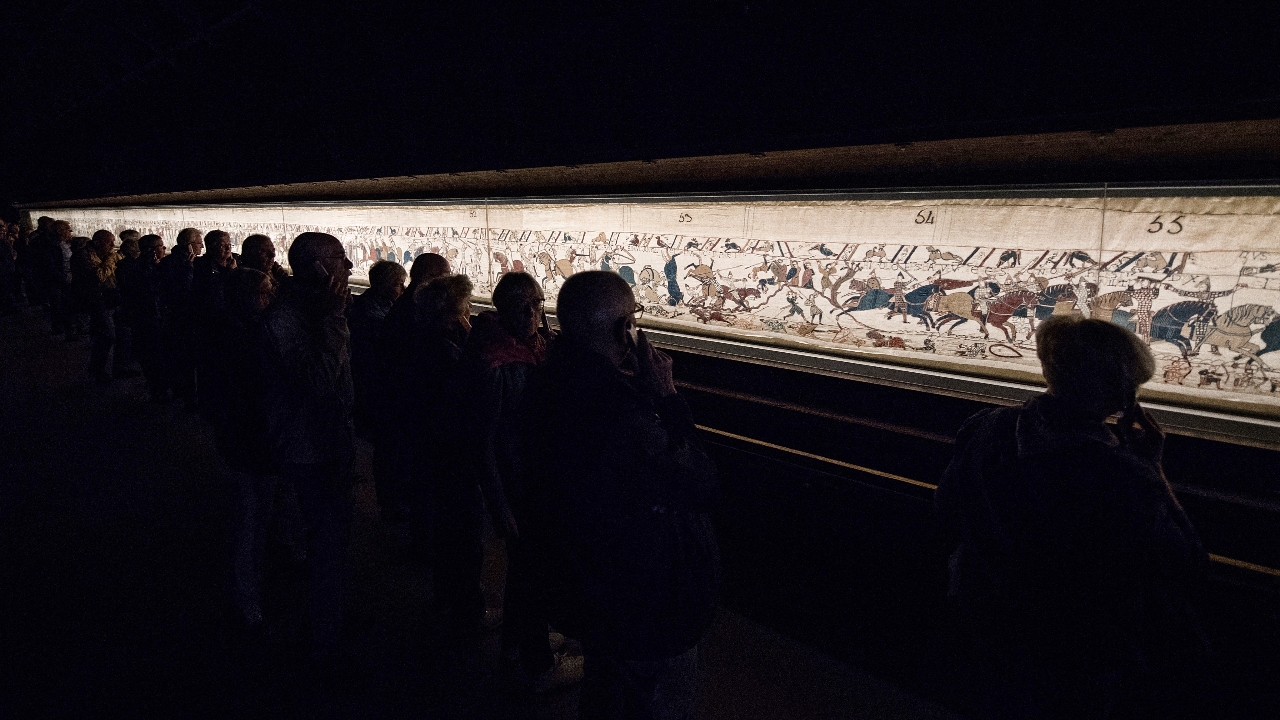
The Bayeux Tapestry, a priceless artifact recording the Norman conquest of England in 1066, has traveled from France to the United Kingdom for the first time in 900 years under strict security measures. It is set to be exhibited at the British Museum this September amid great excitement in England, breaking advance ticket sales records with over 100,000 tickets sold in a single day.
The Bayeux Tapestry, a world-renowned embroidered linen artwork over 900 years old, arrived safely in London, England, at 02:50 local time today (10 July). It was secretly transported from northern France and escorted by heavily armed police along the entire route, preparing for a grand public exhibition this September.
A large aluminum-framed container was unloaded from the truck into the British Museum's storage room, witnessed by dignitaries including the French Ambassador to the UK and Neil MacGregor, the British Museum's director, who expressed excitement: "We have just witnessed something extraordinary. This is the Bayeux Tapestry's first return to England in nearly a thousand years. It is truly remarkable."
The Bayeux Tapestry is a 70-meter-long linen cloth intricately embroidered with colorful wool in the 11th century. It is divided into 58 scenes featuring 626 characters, only six of whom are women, 202 horses, as well as ships, swords, and arrows.
This artwork tells the story leading up to the Battle of Hastings and the Norman Conquest of England in 1066, a major turning point that forever transformed England's history, culture, and language. It introduced many French words into modern English, such as law, parliament, justice, mutton, and beef, and shifted England’s political orientation from ties with Scandinavia towards continental Europe.
Milly Horton-Innes, the exhibition’s curator, stated that the tapestry’s survival from threats like rodents, moths, humidity, mold, and wildfires for over 900 years is truly "a genuine miracle."
Due to the tapestry's fragility and priceless historical value, its transport was meticulously planned. The cloth was stored in a temperature- and humidity-controlled box, then encased in an external steel cage with a spring suspension system to absorb shocks from road vibrations. Prior to the journey, officials conducted two "test runs" using a replica embroidered cloth to measure vibration levels along the route through the Eurotunnel.
Previously, this transfer caused concern among some French conservationists who viewed transporting such a fragile ancient artifact over 560 kilometers as too risky. A petition against the move called it a "cultural heritage crime," and the late renowned British artist David Hockney had expressed before his death that the tapestry should not be moved. Nevertheless, the British Museum director emphasized the museum would never take any action that might endanger the artifact under its care.
This nine-month loan of the Bayeux Tapestry is part of an agreement reached last year between French President Emmanuel Macron and British Prime Minister Keir Starmer. It coincides with the temporary closure of the museum in Bayeux, Normandy, where the tapestry has been displayed since 1983. President Macron described this as "a symbol of trust and an expression of the long-standing friendship in building a shared future between the two countries."
Meanwhile, the UK has reciprocated by lending valuable items such as treasures from the Sutton Hoo burial and the famous Lewis chessmen for temporary exhibition in France.
George Osborne, chair of the British Museum's executive committee, said this exhibition would be one of the greatest and most spectacular of our time, comparable to past exhibitions of Tutankhamun's treasures or the Terracotta Army. Public enthusiasm led to record ticket sales of 100,000 on the first day. The museum will display the tapestry flat with a raised walkway allowing visitors to view the entire 70-meter length simultaneously for the first time in history, after detailed fabric condition assessments in the coming weeks.
/sourceBBC