

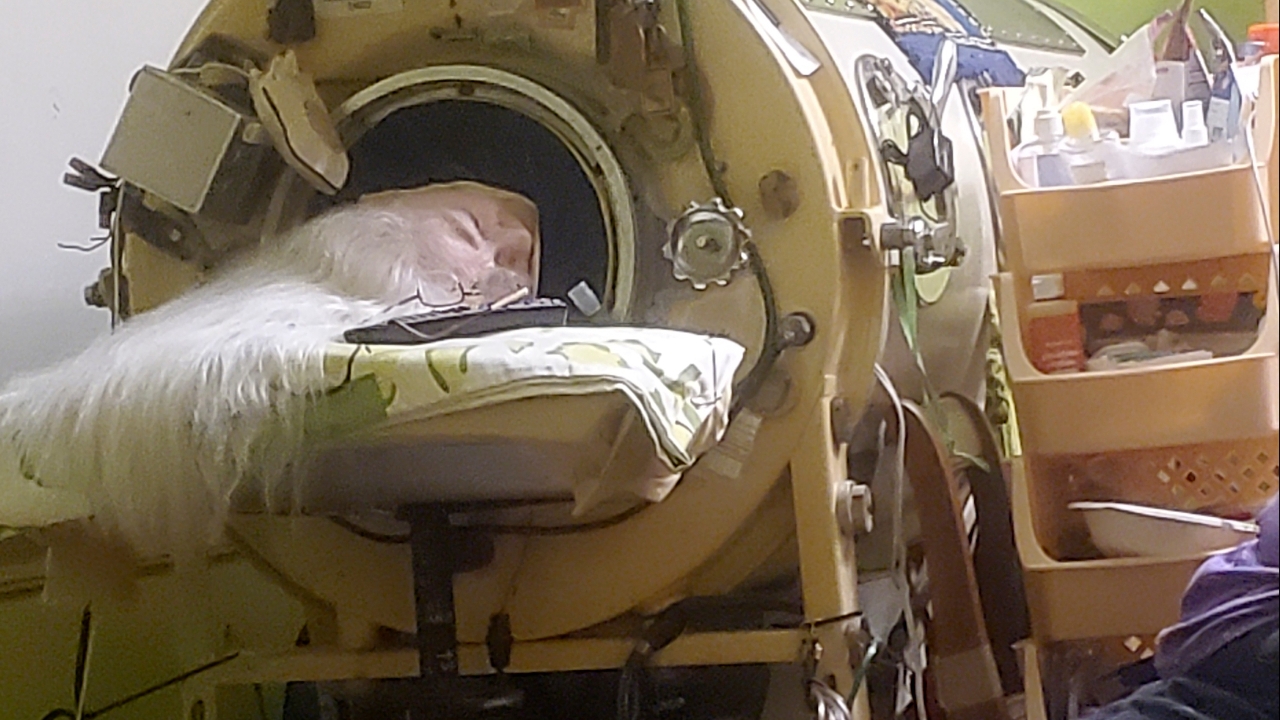
Martha Lillard, an American woman and the last polio patient in the United States who depended on a negative pressure ventilator, known as an "iron lung," for over seven decades, has peacefully died in Oklahoma after battling long COVID.
Cindy McVay, Martha Lillard's sister, told the Associated Press that her sister passed away on 26 June at age 78 in Oklahoma. Martha was recognized as the last polio patient in the U.S. still living with the support of a negative pressure ventilator, or "iron lung."
McVay stated that Martha's death was caused by complications from long COVID after she contracted COVID-19 twice during the pandemic. The death certificate listed chronic respiratory failure and post-polio syndrome as causes. "When she was a child, doctors said she wouldn’t live past 20," said McVay, 75, about her sister. "But she had the drive and determination to keep living and make the most of her life."
Martha Lillard was diagnosed with polio shortly after her fifth birthday. The disease caused paralysis from the neck down and required her to be placed inside an iron lung, a cylindrical machine that encases the body and uses air pressure changes inside to help inflate and deflate the lungs, enabling her to breathe.
Despite severe physical limitations, Lillard refused to let obstacles stop her education. As a child, she traveled two hours daily to attend elementary school and took extra lessons at home. In high school at Shawnee, she learned through telephone and intercom systems to communicate with teachers and classmates. Her family also took her on trips to Missouri using a specially made trailer, and her father would call hotels ahead to ensure room doors were wide enough to accommodate the iron lung. At one point, Lillard was even able to drive a car herself.
Later, Lillard underwent therapy that allowed partial movement of her left arm and some leg mobility. Although her left arm could only move up to waist level and not above, she lived independently and cooked for herself for many years. However, in her final five years, her health deteriorated significantly. Her lung capacity fell below 25%, confining her to her home, and in the last two years, she required the iron lung nearly 24 hours a day.
The advent of internet technology opened a window to the world for Lillard. It helped her research her condition and also led her to find true love. After the September 11, 2001 attacks, she joined an online chat room to learn about the event and met an Egyptian man. They maintained an online relationship for over 20 years.
In February this year, the couple married after the man obtained a visa to travel to Oklahoma. "They truly seemed like soulmates. Now, he is heartbroken and deeply mourning," McVay said.
Additionally, Lillard was passionate about art and creativity. She enjoyed writing poetry and composing songs, and volunteered for an animal protection organization. A devoted Beagle dog lover, she regularly shared animal welfare information on Facebook. Lillard wrote her own obituary in advance, stating she "died from long COVID-19," with her sister later adding the date of death.
McVay tearfully concluded that in recent years, she and her sister desperately sought a technician to repair the iron lung, one of the few machines Lillard had used throughout her life. "But now that she is gone as the last person, we no longer need to find someone to fix this machine," she said.
Polio was once among the most feared epidemics in the United States, especially affecting children. Annual outbreaks caused thousands of paralysis cases until a vaccine was developed in 1955. The U.S. government launched nationwide vaccination campaigns, reducing cases to under 100 in the 1960s and fewer than 10 in the 1970s. By 1979, the United States officially declared polio eradicated, as natural transmission ceased.