

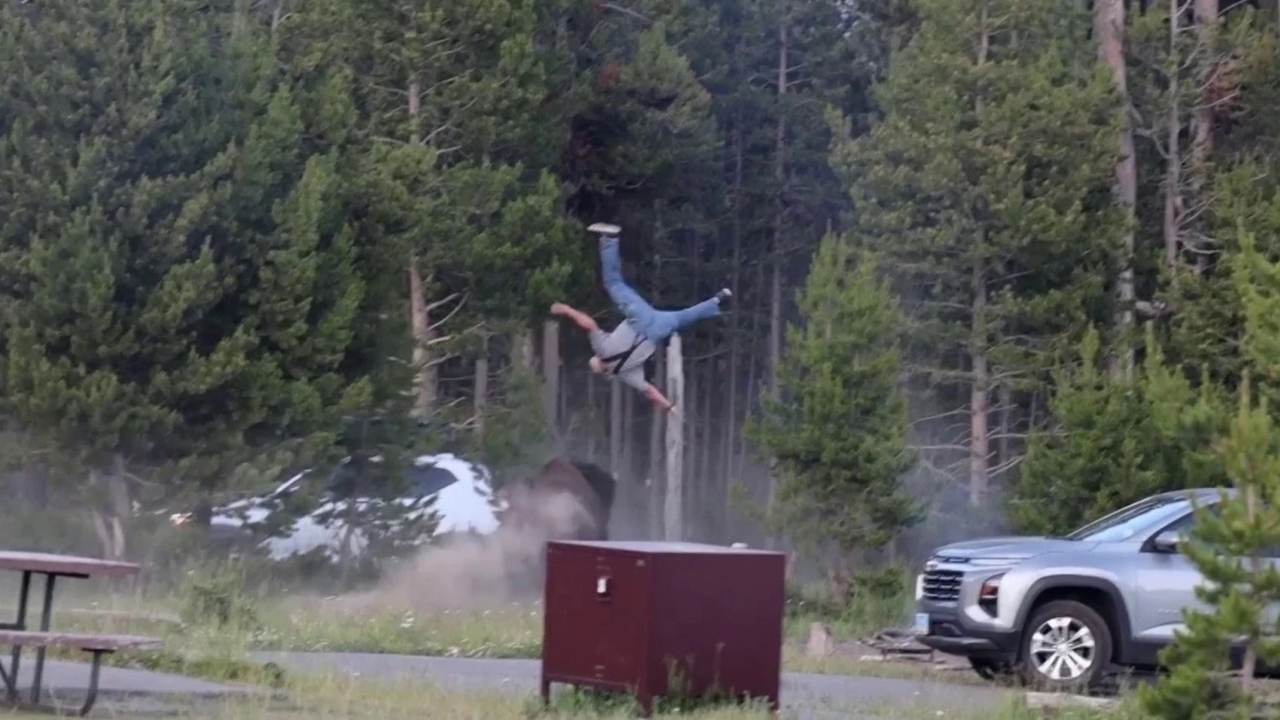
A dramatic incident unfolded in Yellowstone National Park, USA, when a 65-year-old man was charged by a bison weighing about 900 kilograms, causing his body to be thrown nearly 3 meters into the air. This happened after he approached the wild animal to take photos with his grandson. Park officials emphasized that bison are the most dangerous animals to visitors in the area and warned to maintain a minimum distance of 23 meters.
The incident took place on the evening of 10 July near the Bridge Bay campground close to Yellowstone Lake in Wyoming. Viral video footage shows Mr. Carl Isom-McDaniel, 65, and his grandson stopping to raise a camera and photograph a bison lying on the grass.
At first, the bison appeared agitated, restless, and rolling around before quickly standing up. Despite a white pickup truck trying to approach to divert its attention, the bison charged the vehicle, forcing the driver to accelerate away. The giant animal, weighing over 900 kilograms, then ran straight toward Carl and his grandson.
Although the pair tried to escape into a wooded area, the bison's speed prevented Carl from getting away. Witness Mike McLeod, who recorded the video, told local media, “The bison used its left horn to hook his hip and tossed him over 2.4 meters into the air. He flipped once mid-air before landing hard on his side.” Carl suffered multiple injuries and severe leg pain but remained conscious and was later transported to a hospital.
The U.S. National Park Service has not yet officially released detailed information about the incident. However, its website clearly warns, “Bison may appear calm and slow, but they are the large wild animals that most frequently injure visitors in Yellowstone. Moreover, they can run three times faster than humans, so keeping distance is critically important.”
The park has a strict rule prohibiting visitors from approaching bison closer than 25 yards (about 23 meters) under any circumstances and forbids getting close to photograph them. Summer months from June to August see the highest number of visitors, accounting for 60% of the annual total.
Professor Jennifer Barfield, head scientist of the Bison Conservation Project at Colorado State University, explained that July is the “peak breeding season,” during which testosterone levels in male bison rise significantly.
“This hormone drives their behavior, making them more aggressive and emotionally unpredictable than at other times of the year,” Professor Barfield said. She added that even her research team avoids close contact during this period, observing from inside safe vehicles only. She also stressed that the 23-meter distance is the minimum safe boundary, and it is safer to stay even farther away to protect lives.
/sourceBBC