

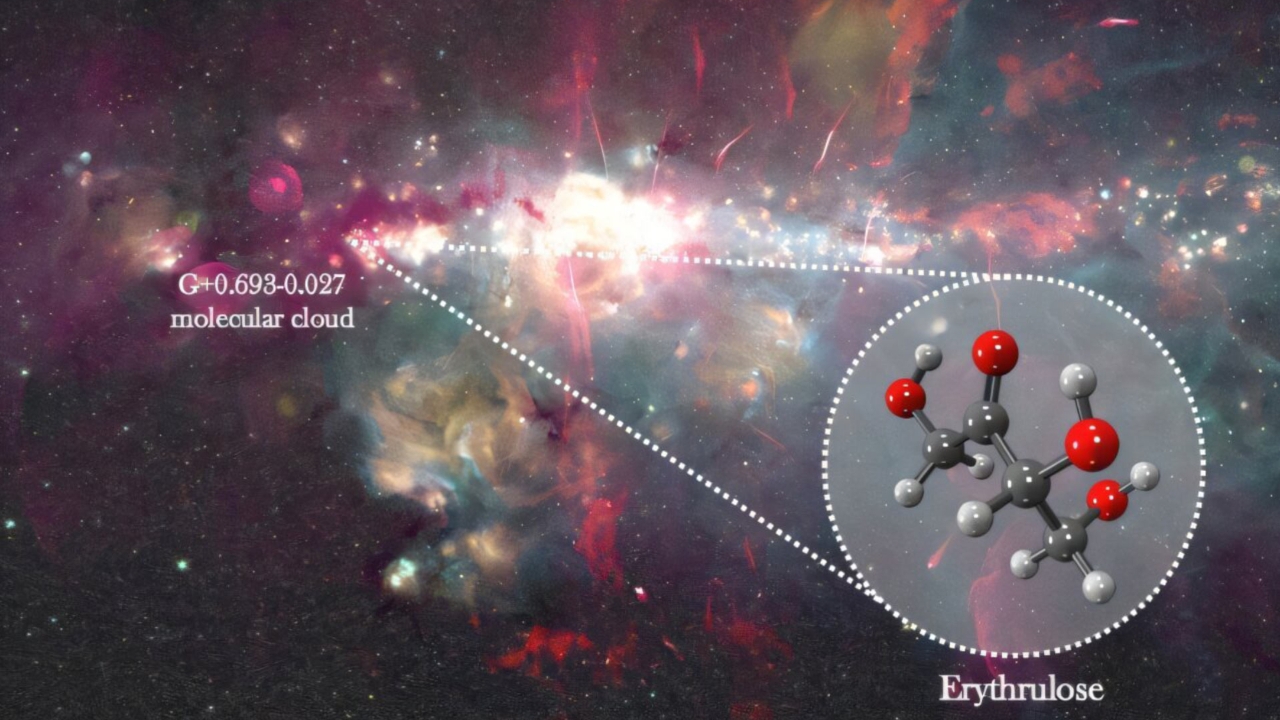
Astronomers have succeeded in detecting "Erythrulose," a natural sugar found in raspberries and tanning lotions, hidden within a cloud of dust and gas near the center of the Milky Way. This discovery may support the hypothesis that the "building blocks of life" formed in space before being delivered to Earth via comets and meteorites.
The scientific journal Nature Astronomy published this significant discovery by a research team led by Dr. Isaskun Jiménez-Serra, an astrophysicist from the Spanish Center for Astrobiology. The team used two radio dish telescopes in Spain to survey a massive dust and gas cloud named "G+0.693-0.027," located near the Milky Way's galactic center.
By analyzing the reflected radio wave signals and comparing them with laboratory models, the team detected gaseous molecules of "Erythrulose," a highly complex four-carbon sugar. On Earth, this sugar naturally occurs in red raspberries and is commonly used in tanning lotions, where it reacts with amino acids in dead skin cells to produce a brown color.
This finding surprised the researchers because the space cloud’s temperature is about minus 250 degrees Celsius, yet two abundant organic molecules in space—glycolaldehyde and ethylene glycol—can combine on tiny dust grain surfaces to form this sugar.
Previously, scientists struggled to explain how such single-molecule sugars became so abundant on Earth, since laboratory studies indicate that early Earth conditions were not conducive to easily producing these sugars.
However, detecting erythrulose in interstellar material—through which NASA’s Voyager spacecraft is passing—supports the important hypothesis that fundamental components of life may not have formed on Earth but were delivered from deep space.
Dr. Jiménez-Serra explained that during Earth's early history, heavily bombarded by meteorites and comets, "rain of sugars and organic compounds" likely fell onto the planet in millions of tons. These substances combined into a "prebiotic soup," providing the basis for early biomolecules to synthesize themselves. These sugars could transform into ribonucleotides, the building blocks of RNA, and eventually develop into DNA, the genetic code of living organisms.
Professor Erika Hamden, an astrophysicist at the University of Arizona not involved in the research, praised the work as the purest and clearest example of organic compounds drifting in our galaxy.
Meanwhile, Professor Yoshihiro Furukawa from Tohoku University in Japan, who previously discovered sugars in dust samples from asteroid Bennu collected by NASA’s OSIRIS-REx mission, stated that this finding confirms that sugars traveling through cometary dust can indeed reach Earth. Nonetheless, the process by which life develops from these molecules remains a mystery requiring further study.
Dr. Jiménez-Serra concluded, "Finding these essential building blocks here suggests they may also be hidden in other dark regions of the galaxy. The precursors necessary for life’s origin may be widespread throughout the Milky Way, opening the possibility that life could also develop elsewhere in the universe."