

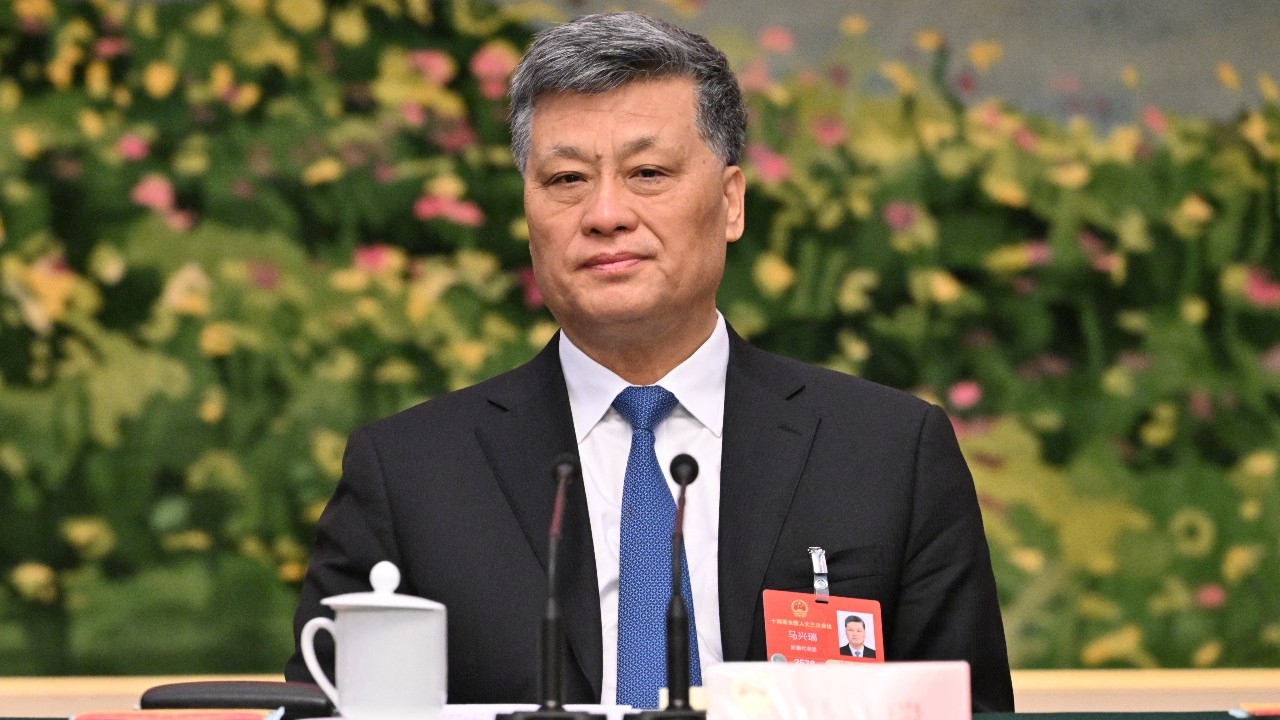
Chinese authorities have ordered the removal of Ma Xingrui, former member of the Communist Party of China's Politburo, from the party and dismissed him from public office after investigations found serious violations of discipline and law, including bribery, abuse of power to benefit associates, and allowing relatives to exploit his authority. He is the third Politburo member purged since 2025.
The Central Commission for Discipline Inspection and the National Supervisory Commission of the Communist Party of China (CPC) issued a statement today (14 Jul) stating that 66-year-old Ma Xingrui, former Politburo member—China's top executive decision-making body—and former deputy head of the Central Rural Work Leading Group, has been expelled from the CPC and dismissed from all government positions. He has been under investigation since April on charges of "serious violations of discipline and law."
The investigation found that Ma violated political regulations and party discipline, failing to strictly supervise himself and subordinates by deliberately ignoring disciplinary breaches and suspected criminal acts among close associates. Additionally, he abused his position to unfairly promote and assign work to others, concealed facts, and lied during official investigations.
Furthermore, reports from Xinhua News Agency indicate that Ma and his family accepted large amounts of gifts and cash, secretly helped relatives purchase real estate at suspiciously below-market prices, and engaged in exchanging favors involving status and authority, including sexual scandals and financial misconduct. He allowed family members to exploit his influence for substantial business gains, constituting "family-based corruption." All illicit assets will be confiscated, and evidence will be forwarded to prosecutors for legal proceedings.
Ma Xingrui is considered a technocrat who transitioned from academia to governance, with a distinguished career and rapid rise in Chinese politics. Born in Shandong Province, he joined the Communist Party in 1988 and began his career as an aerospace engineer.
Between 1996 and 2012, Ma held senior management positions at the China Academy of Space Technology (CAST) and China Aerospace Science and Technology Corporation (CASC), state-owned enterprises responsible for spacecraft and missile production. He led and managed several of China’s most important space projects.
In 2013, he was appointed Vice Minister of Industry and Information Technology, Director of the China National Space Administration (CNSA), and Chairman of the China Atomic Energy Authority. Later that year, he was transferred to local government in Guangdong Province in southern China, rising to Governor of Guangdong, a key economic hub, in 2017.
From late 2021 to 2025, Ma served as Communist Party Secretary of the Xinjiang Uyghur Autonomous Region, a sensitive border area in the northwest with high security concerns, before his political career collapsed amid corruption investigations.
Ma’s fall occurred amid intensified scrutiny of China’s defense and aerospace industries. In 2013, he was head of the regulatory body overseeing the defense industry. In February this year, Zhang Jianhua, former Deputy Director of the Office for Science, Technology and Industry for National Defense and once Ma’s subordinate, was also indicted on bribery and abuse of power charges.
In recent months, several former senior officials in Xinjiang who were promoted during Ma’s tenure have been arrested and investigated. In March, Guo Yonghang, Ma’s former chief of staff during his time in Shenzhen (2015-2016), was also placed under investigation by authorities.
President Xi Jinping’s longstanding anti-corruption campaign has purged many senior officials in the party, government, and military. In January, China launched a corruption probe into General Zhang Youxia, the military’s top-ranking officer. Previously, in October last year, He Weidong, former Vice Chairman of the Central Military Commission, was expelled from the Communist Party, demonstrating that no official, regardless of influence, is immune from these crackdowns.
/sourceChina Daily/Reuters