

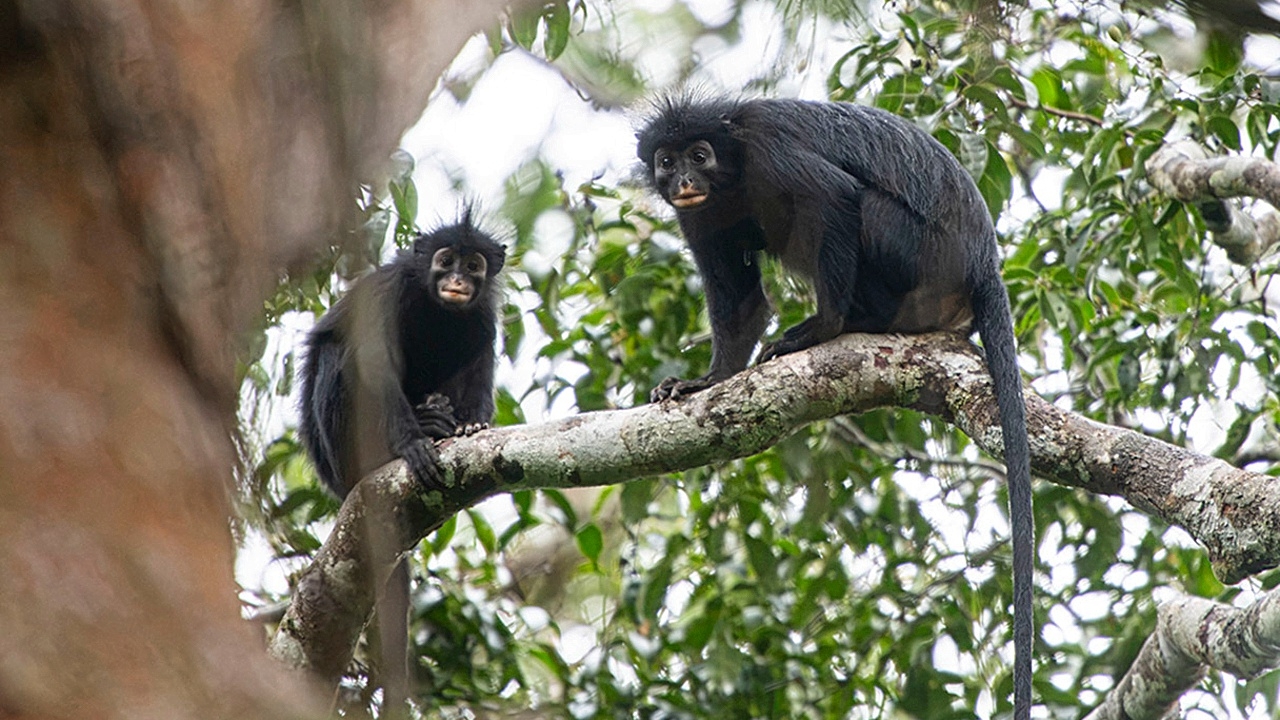
Researchers have confirmed the discovery of a new monkey species in Lomami National Park, Democratic Republic of Congo, after over 15 years of field research. They found a black-furred monkey with distinctive pinkish-orange lips, locally called "Likweli." This is only the fifth new monkey species discovered on the African continent in the past 75 years.
A research report published in the scientific journal PLOS ONE states that the new monkey species, locally named "Likweli" by the Balangwa tribe, was first spotted by conservationists in 2008. However, at that time, only one very blurry photograph was taken. It was not until 2018, ten years later, that it was seen again, leading to the formation of an international research team from the Democratic Republic of Congo, the United States, and Germany that spent over four years investigating.
Junior Ambogo, a conservation biologist and key doctoral student at Florida Atlantic University, revealed that the Likweli monkey is quite shy and prefers to hide high in the canopy of the humid forest. "During field interviews with communities in 52 villages around the forest, only eight villages reported ever seeing this monkey. It is an amazing feeling to gaze upon the face of a creature barely known to exist on Earth," he said.
The scientific team named this new species Colobus congoensis, honoring the biodiversity of the Congo River basin. It belongs to the "Colobus" group, African monkeys characterized by the absence of thumbs, having only four fingers, and serving as important herbivores in the treetops that aid in seed dispersal and plant regeneration.
Detailed DNA and physical analyses found distinctive differences from other Colobus monkeys, such as prominent cream-pinkish-orange markings around the lips on a jet-black face, along with uniquely pointed fur.
This monkey is noticeably smaller than typical Colobus monkeys and has white fur patches near its rump. They emit a distinctive roaring call, usually heard before the animal is seen. Genetically, although similar in appearance to the black Colobus (C. satanas), DNA tests confirm they diverged over 5 million years ago.
Professor Kate Detwiler, a primatologist from FAU, hypothesizes that the bright orange markings on the face likely serve as visual signals for communication within the dense forest or may play a role in attracting mates.
Researchers estimate that Colobus congoensis is an endemic species with a very limited habitat range, believed to occupy only about 1,700 square kilometers within the rich deep forest.
During data collection, the research team also seized carcasses of this species from local poachers, proving that they are victims of illegal bushmeat hunting. Additionally, ongoing agricultural expansion around the park continues to destroy their habitat.
Ecology experts point out that having such a limited habitat greatly increases the risk of extinction. The research team is urgently recommending that international organizations classify this monkey as "Near Threatened" to ensure official legal protection and is preparing detailed surveys to assess their population and behavior further.
SourceBBC/Science Magazine