

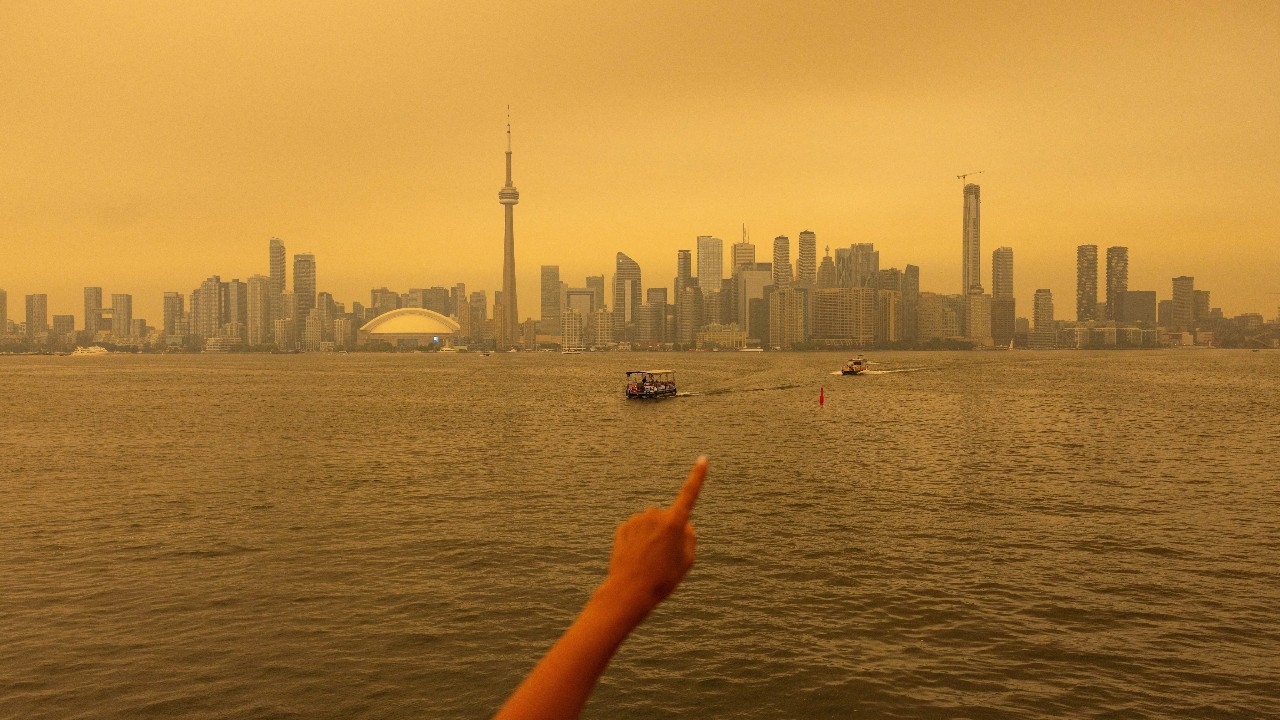
Doug Ford, Premier of Ontario, Canada, responded to U.S. President Donald Trump’s accusations that Canada manages wildfires inefficiently, causing smoke to cover several U.S. states, and to Trump’s threat to increase tariffs on Canadian imports. Ford recalled that Canada had previously sent aircraft to help fight wildfires in California and said a good neighboring country should assist, not threaten.
Doug Ford, Premier of Ontario, Canada, expressed displeasure at U.S. President Donald Trump’s criticism accusing Canada of inefficient wildfire management, which caused widespread smoke coverage in the U.S., and his threat to factor the costs of air pollution damage into tariffs on Canadian imports.
At a press conference in Thunder Bay, Ford said the U.S. administration’s remarks were "completely unacceptable". He added that if the U.S. faced a major wildfire disaster, Canada would send personnel and resources without hesitation because that is how good neighbors behave. He also referred to U.S. officials as having a "short memory," reminding that last year Canada sent water-dropping aircraft and staff to help fight wildfires in California.
Ontario’s Aviation, Fire, and Emergency Services Office reported that currently there are 191 active wildfires in northern Ontario, with 73 still "uncontrollable." The largest fire has burned nearly 319,000 hectares (about 1.9 million rai) in a single area, while the total burned area across the province exceeds 655,000 hectares (around 4.1 million rai). Authorities have deployed 155 teams and about 80 water-dropping aircraft to combat the fires.
The Ontario government has ordered evacuations from over 12 communities, including the Namaygoosisagagun Indigenous community, also known as the "Collins community," in the province’s northwest, which has been nearly destroyed by fire.
Previously, President Trump said the smoke entering the U.S. was due to Canada’s ineffective forest management and indicated he was considering including the "huge costs" the U.S. bears from air pollution when calculating tariffs on Canadian imports currently in place.
Four Republican members of the U.S. House of Representatives from Michigan also sent a letter to Canadian Prime Minister Mark Carney urging the Canadian government to take serious action to address the wildfire problem.
Ford replied that if Trump wants Canada to do more forest management and trimming, the U.S. should lift tariffs on Canadian softwood lumber, which would enable Canada to manage forest resources more effectively.
Canada’s Ministry of Natural Resources reported detecting 69 new wildfires in a single night, raising the total number of wildfires nationwide to 955. Although the total burned area of about 28,500 square kilometers is still below the five-year average, winds have carried smoke across the border into the U.S., prompting several states to issue air quality and health risk warnings.
The U.S. Environmental Protection Agency reported that air quality is at "unhealthy" levels across southern Ontario and several U.S. states including Ohio, West Virginia, Pennsylvania, New Jersey, Virginia, Maryland, Delaware, and Washington, D.C. Some parts of Pennsylvania, including Pittsburgh, are experiencing "very unhealthy" air quality.
However, weather forecasting agency AccuWeather stated that smoke from Canadian wildfires will have minimal impact on the upcoming FIFA World Cup final at New York’s MetLife Stadium, New Jersey, on 19 July.
Mike Harris, Ontario’s Minister of Natural Resources, said wildfire activity has slowed over the past 24 hours and that weather conditions over the next several days are expected to be more favorable for fire control, with possible rainfall in many areas that could help reduce wildfire spread.
Nevertheless, Indigenous leaders and opposition members in Ontario continue to criticize the government for insufficient budget allocation and resources for wildfire prevention and response, calling for a review of disaster management measures to prevent severe damage in the future.