

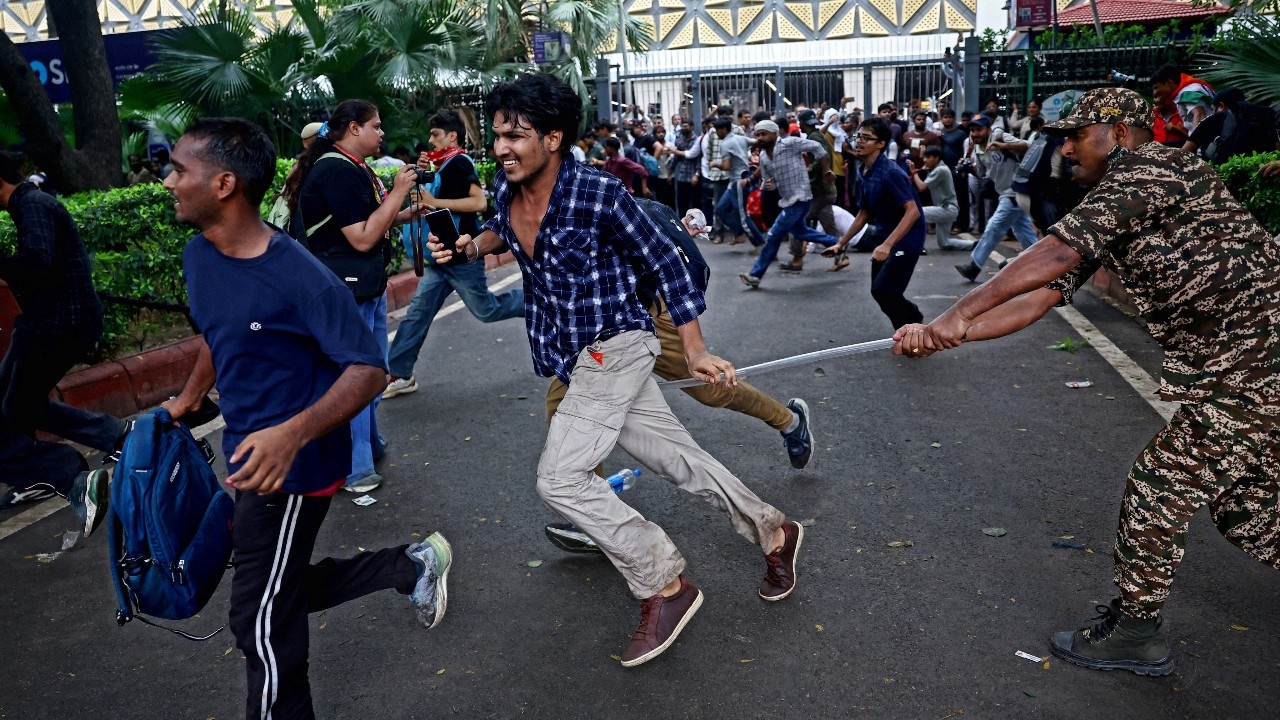
Indian police used tear gas and batons to disperse supporters of the "Cockroach People's Party" after thousands tried to march to the Parliament in New Delhi, demanding the resignation of the Minister of Education over repeated leaks of medical entrance and civil service exam papers, affecting over 2 million candidates.
Clashes erupted between police and protesters in New Delhi after thousands of supporters of the "Cockroach People's Party" (CJP) attempted to march from Jantar Mantar to the Parliament building, calling for the resignation of Education Minister Dharmendra Pradhan.
Police stated the march was unauthorized because Parliament was in session the same day, leading to barricades and restricted areas for security. When protesters tried to breach the barricades, police used tear gas and batons to disperse the crowd, while demonstrators threw objects and shouted demands for both the Education Minister and Prime Minister Narendra Modi to resign.
Local media and reporters on site reported heavy police and paramilitary deployment throughout New Delhi, road closures causing severe traffic jams, and government buildings near Parliament being shut down to prevent protesters from entering.
Delhi police revealed that over 10,000 protesters gathered at Jantar Mantar since morning. Authorities affirmed the situation was handled "professionally" and denied allegations of excessive force, although TV footage showed officers striking some protesters with batons. Protesters claimed tear gas was used to prevent them from approaching Parliament.
The 'Cockroach People's Party' movement originated in May after the Chief Justice of India referred to some unemployed youth as "cockroaches" during an unrelated court case. Students and young people adopted the term as a satirical symbol, naming their group the "Cockroach People's Party," quickly gaining millions of followers on social media.
The movement gained momentum following multiple exam paper leaks in medical college admissions and civil service recruitment tests, affecting millions of students who had to retake exams and sparking widespread criticism of corruption in the education system.
Protesters demand government accountability for exam management failures, nationwide exam reforms, and compensation for families of students who died by suicide linked to the exam leak scandal.
The protests drew further attention after prominent activist Sonam Wangchuk, who had been on a hunger strike since late June, was hospitalized last Saturday. Before the march, Wangchuk announced he would end his hunger strike after more than three weeks if the government admitted responsibility for educational failures and exam leaks, or if protesters were allowed to reach Parliament with assurances that MPs would discuss the issues in both houses.
Amid tensions, a CJP spokesperson revealed that he and another representative were invited to meet Health Minister J.P. Nadda, marking the first sign of government willingness to negotiate with protest leaders, although officials have not formally confirmed such talks.
However, senior government ministers under Modi remain firm, with Dharmendra Pradhan accusing protesters of acting against national interests. Other ministers acknowledged student issues as important but insisted there was no need to negotiate with the protest movement.
Analysts view the "Cockroach Movement" as a significant challenge to Prime Minister Narendra Modi's third term, reflecting young people's growing dissatisfaction with unemployment, exam corruption, and restrictions on political expression—issues increasingly scrutinized in recent years.
SourceAFP/Associated Press