

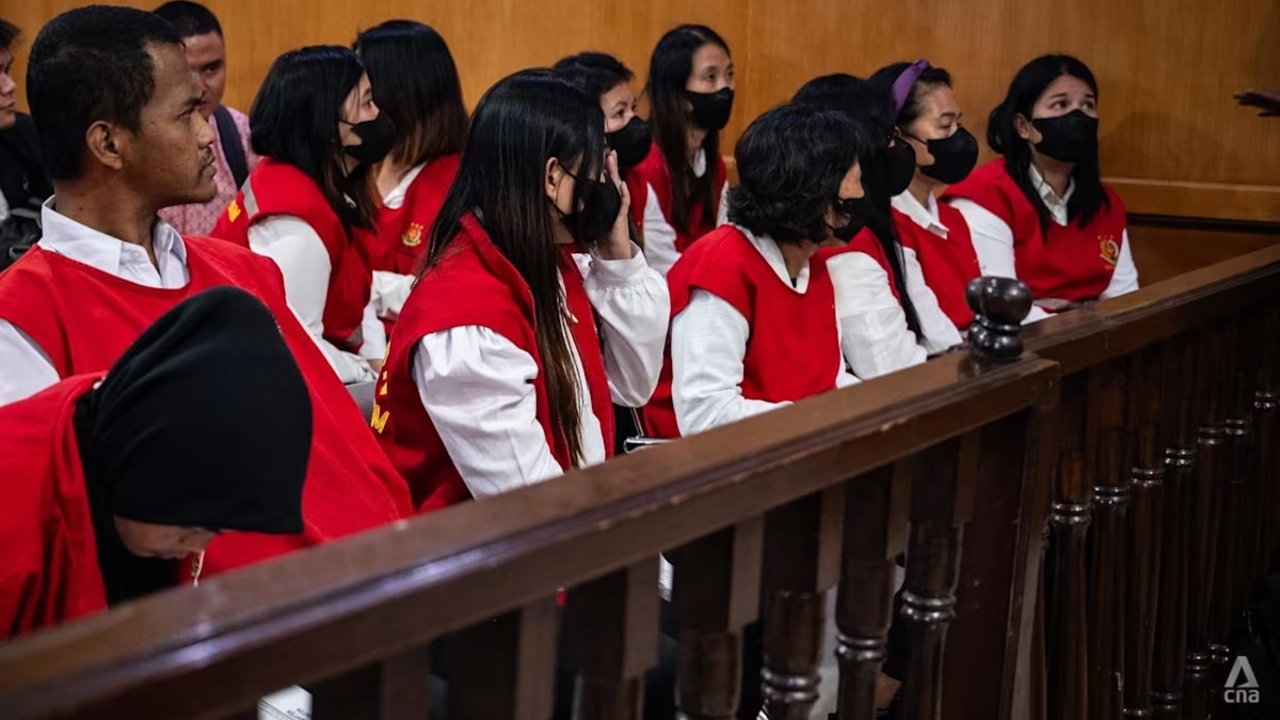
An Indonesian court sentenced 19 members of an international baby trafficking network to prison terms ranging from 3 years and 4 months to 7 years. They were found guilty of deceiving and selling at least 34 infants to couples in Indonesia and Singapore under the guise of adoption. The ringleader, a 70-year-old woman, admitted to sending babies to Singapore and earning hundreds of thousands of baht per child.
The Bandung District Court in Indonesia issued its verdict today (21 Jul) sentencing 19 members of a human trafficking ring who illegally sold babies by falsely claiming they were for adoption, both within Indonesia and Singapore, during 2022–2025.
The court stated that the 18 female and 1 male defendants were involved in selling at least 34 babies, some of whom were sent to Singapore. The babies were sold for several thousand Singapore dollars each.
The defendant receiving the harshest sentence is Li Siu Luan, also known as Lily, aged 70, identified by the court as the network's leader and mastermind. She recruited members and planned operations, receiving a 7-year prison term. Astri Fitrinika, 26, and Jaka Hamdani, 35—the only male defendant—were sentenced to 6 years and 7 months for procuring babies into the network.
Lai Siu Ha, 60, was also sentenced to 6 years and 7 months for forging documents to conceal the children's origins. Elin Marlina, who helped procure babies for the network, received the same sentence. The other 14 defendants, who played lesser roles such as falsely claiming to be the babies' parents on forged birth certificates or participating in video calls with prospective adoptive parents, were each sentenced to 3 years and 4 months.
The court also ordered that the 8 babies rescued during the network’s arrests last year remain under the care of the West Java provincial social welfare agency.
However, prosecutor Kuku Kantina revealed after the trial that authorities have yet to identify the adoption intermediaries in Singapore, so the fate of the babies sent there remains unknown. The police will continue their investigation.
Although the court sentenced all defendants, the penalties were lighter than those requested by the prosecution, which had sought 10-year prison terms for the five main defendants and 5 years for the others.
Both the prosecution and defendants retain the right to appeal. The document forger immediately declared intent to appeal, while the network leader and baby procurers accepted the court’s decision.
Court documents show Lily admitted sending at least 12 babies to Singapore, receiving payments of 17,000 to 21,600 Singapore dollars (approximately 430,000 to 550,000 baht) per child.
She testified that at the end of 2022, a man named "John" contacted her, saying a Singaporean couple wanted to adopt Indonesian babies. She then contacted an Indonesian couple in West Kalimantan province who could not afford childbirth costs and offered them 58 million rupiah to give up their baby. After deducting expenses such as medical, document, and processing fees, Lily said she earned a profit of about 2,000 to 3,000 Singapore dollars per baby.
Lily also named individuals using the aliases "Petter," "Mr Tan," and "Mr Chew" as adoption intermediaries in Singapore who repeatedly contacted her to buy babies. She was arrested in July 2025 while arranging delivery of a third baby to "Mr Tan."
Investigations found the network used social media and joined online adoption groups to contact pregnant women or families willing to give up children, mostly in West Java province, offering 9 to 15 million rupiah to incentivize giving up babies.
Once they obtained the babies, the network forged birth certificates and official documents, with members impersonating the parents or guardians to enable the children to obtain passports and paperwork needed for the adoption process in Singapore.
Indonesian authorities arrested all network members in July last year during simultaneous raids in Bandung, Jakarta, and Pontianak, locations used as temporary baby holding sites before export.
The case has attracted widespread attention in Indonesia and Singapore. The Singapore government confirmed close coordination with Indonesian authorities and is reviewing whether international adoption procedures have vulnerabilities that need to be addressed.
Experts say poverty remains a key factor driving this type of human trafficking. Misunderstanding of legal adoption processes and easier access to social media have allowed the network to quickly connect pregnant women with prospective adoptive parents, even across provinces or countries.
/sourceCNA