

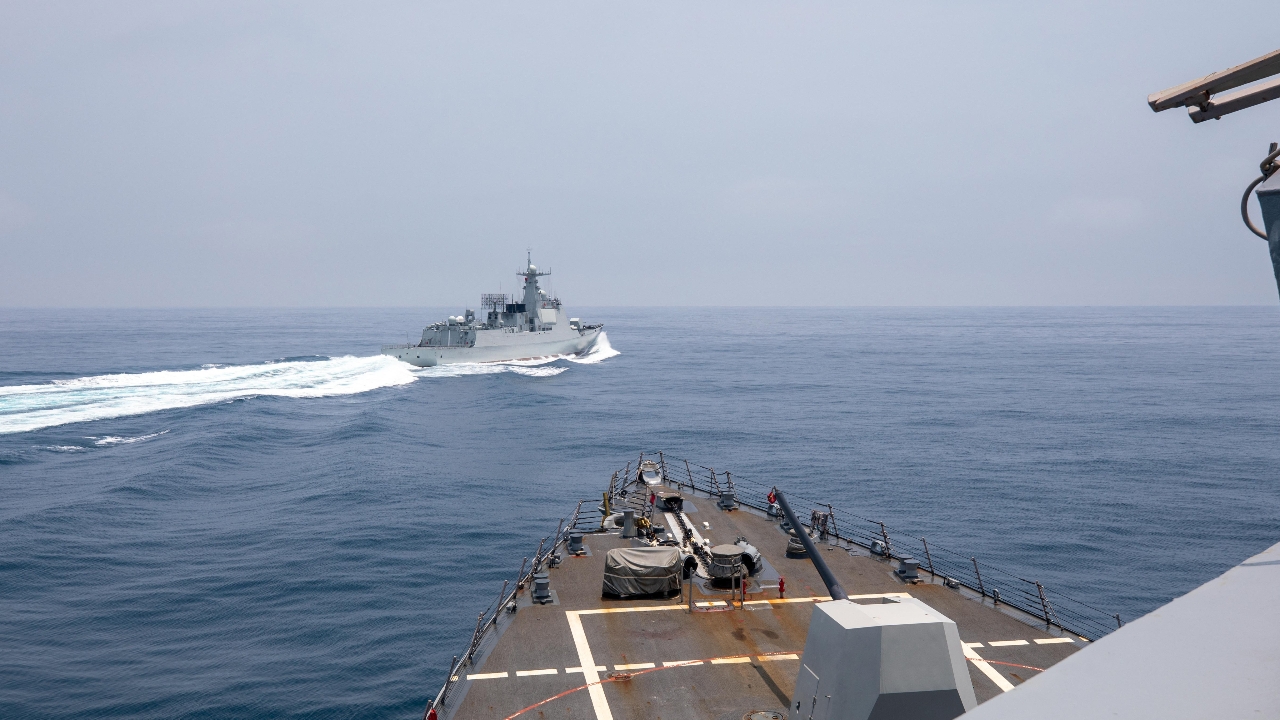
The Japanese government has officially protested China after a Chinese Navy destroyer conducted live-fire exercises in waters near Okinotorishima Island, which Japan claims as part of its exclusive economic zone, during patrols with Russia. China responded by denying Japan's claim to the area and accused Japan of fabricating a threat to justify military reinforcement.
The Japanese government revealed today (21 Jul) that it submitted a diplomatic protest to China after a Chinese Navy missile-guided destroyer conducted live-fire drills in waters near Okinotorishima Island, south of Japan, during joint naval operations with the Russian Navy.
The Joint Staff Office of Japan’s Self-Defense Forces stated that China's Luyang III-class destroyer carried out live-fire exercises about 180 kilometers southwest of Okinotorishima Island after being detected operating alongside two other Chinese warships and a Russian frigate.
Japan stated that before starting the live-fire drills, the Chinese warships issued navigational warnings via radio to vessels in the area, but Japan considered these actions potentially hazardous to maritime safety in the region.
Minoru Kihara, Japan’s Cabinet Secretary, said the government expressed its concerns to China through diplomatic channels and confirmed it will closely monitor Chinese and Russian military activities around Japan, as well as strengthen surveillance of the country's airspace and waters.
Meanwhile, Japan’s Defense Minister Shinjiro Koizumi, who is visiting the United Kingdom, said the incident reflects increasingly close military cooperation between China and Russia, citing earlier Chinese submarine missile tests and more than ten joint bomber flights by China and Russia around Japan in recent times.
However, Lin Jian, spokesperson for China’s Ministry of Foreign Affairs, rejected Japan’s allegations, stating that Japan’s concerns are "baseless" and accusing Japan of exaggerating external threats to justify enhancing its military capabilities.
China also asserted that its naval operations in the high seas comply with international laws and practices, accusing Japan of distorting facts and creating a narrative attacking the lawful actions of other nations.
The core dispute lies in the status of Okinotorishima Island, which Japan claims as an "island" entitled to declare an exclusive economic zone (EEZ) around it, while China maintains Okinotorishima is merely a "rock," not qualifying for EEZ claims under the United Nations Convention on the Law of the Sea.
The Japanese military revealed this is the first time the government has publicly disclosed detecting China’s live-fire exercises within waters Japan claims as its EEZ, although the drills themselves did not directly violate international law.
Prior to the live-fire drills, Japan’s Self-Defense Forces detected a fleet of four ships from China and Russia, including China’s Renhai-class destroyer, Luyang III-class destroyer, Fuchi-class supply ship, and Russia’s Steregushchiy-class frigate, transiting the strait between Okinawa and Miyako Islands en route to the Pacific Ocean.
In recent years, Japan has expressed concern over China’s expanding military role in the Pacific Ocean, especially after last year when two Chinese aircraft carriers operated near Iwo Jima for the first time, alongside increased frequency of joint patrols between China and Russia around the Japanese islands.
The latest incident is likely to heighten tensions in bilateral relations already strained by disputes over Taiwan, regional security, and maritime claims in the Pacific Ocean.
.sourceAssociated Press/Reuters