

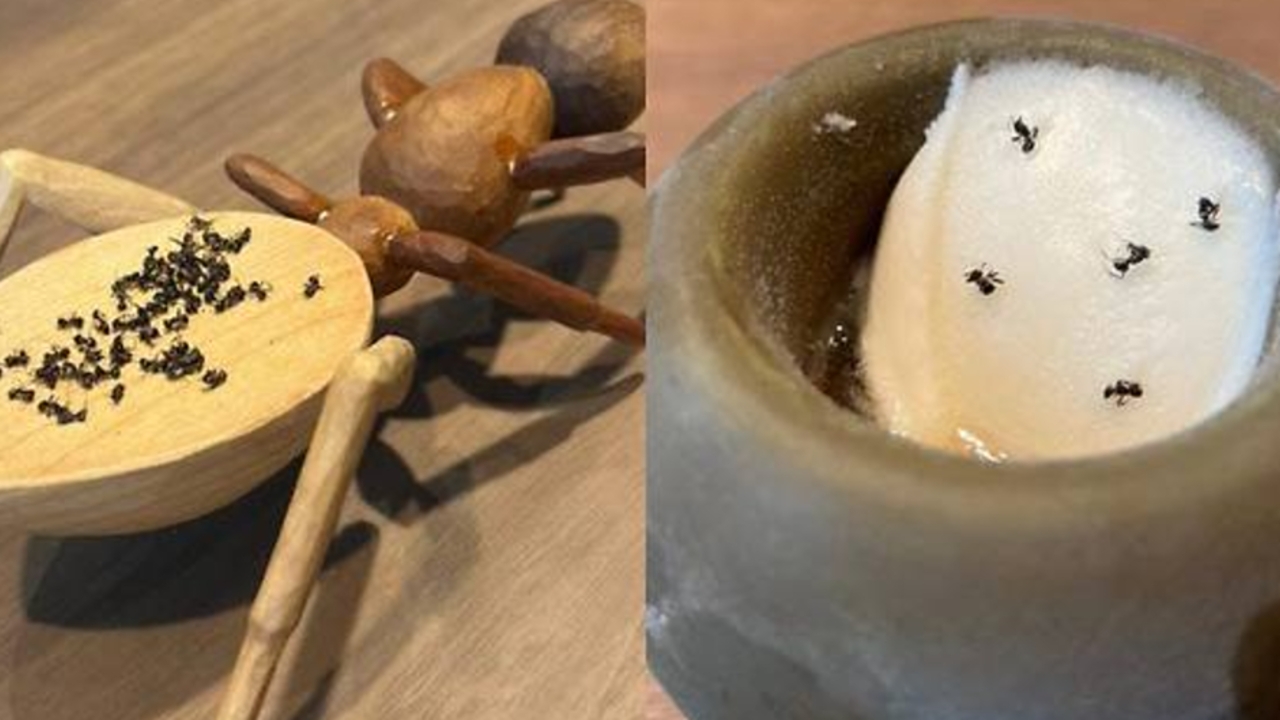
South Korean prosecutors have requested the court to sentence the owner of a Michelin 2-star restaurant in Seoul to one year in prison for violating food safety laws after using "ants" imported from the U.S. and Thailand as ingredients in dessert menus. South Korean law does not permit ants as food ingredients. It is estimated that over four years, the restaurant used more than 49,000 ants, generating revenue exceeding 120 million won from these dishes.
South Korean prosecutors filed a petition asking the court to impose a one-year prison sentence on the owner of a Michelin 2-star restaurant in Seoul, who is charged with violating food hygiene laws by using "ants" as decoration and ingredients in dessert menus, despite ants not being listed among the insects legally permitted for consumption under South Korean law.
During the trial on 20 July at the Seoul Western District Court, prosecutors also requested the court to fine the restaurant's operating company 20 million won (approximately 460,000 baht) in addition to sentencing the owner to prison.
According to the indictment, the owner and the company imported dried ants from the United States and Thailand starting in 2021, which were used to garnish sorbets and certain dessert items in tasting menus for nearly four years.
South Korean law permits only 10 types of insects as food, such as grasshoppers, crickets, and some other species, but ants are not included on the approved list and therefore cannot be used as food ingredients.
Prosecutors stated that the restaurant sold over 12,200 servings of sorbet containing ants, generating approximately 120 million won (around 2.73 million baht), and used about 49,000 ants during the period of the offense.
The case came to light after South Korea's Ministry of Food and Drug Safety officials discovered photos and reviews posted online by customers showing dishes garnished with ants. This led to an investigation revealing the importation of ants from abroad.
Additionally, tests found that the ants used in the restaurant contained heavy metal levels up to 55 times higher than those found in commonly edible insects, raising concerns about consumer safety.
The defense admitted most facts but insisted that ants were used only in a small portion of the 15-course menu, exclusively as a garnish on sorbets. Customers could opt out of having ants, in which case the restaurant would substitute fermented vinegar or edible flowers instead.
The restaurant owner's lawyer argued that only about 60% of customers chose to try the ant-containing dishes, while prosecutors calculated the number of ants assuming all customers consumed those dishes, thus inflating the figures. The lawyer also cited examples of restaurants in countries like Denmark, the United Kingdom, and Australia that use ants as food ingredients.
However, the court has not disclosed the name of the restaurant or its owner. Currently, South Korea has 10 Michelin 2-star restaurants, all located in Seoul.
The court is scheduled to announce the verdict on 2 September. South Korean law requires that approval for using insects as food must pass safety, toxicity, nutritional value, and hygienic farming and processing standards.
Although ants are considered traditional food or ingredients in many countries, especially in Asia, Africa, and Latin America—for example, red ants and their eggs popular in Thailand and Cambodia, or queen ants in Colombia regarded as delicacies—under South Korean law, ants remain unapproved as commercial food ingredients, leading to this legal case.
/sourceJoongAng Ilbo/hani.co.kr/BBC