

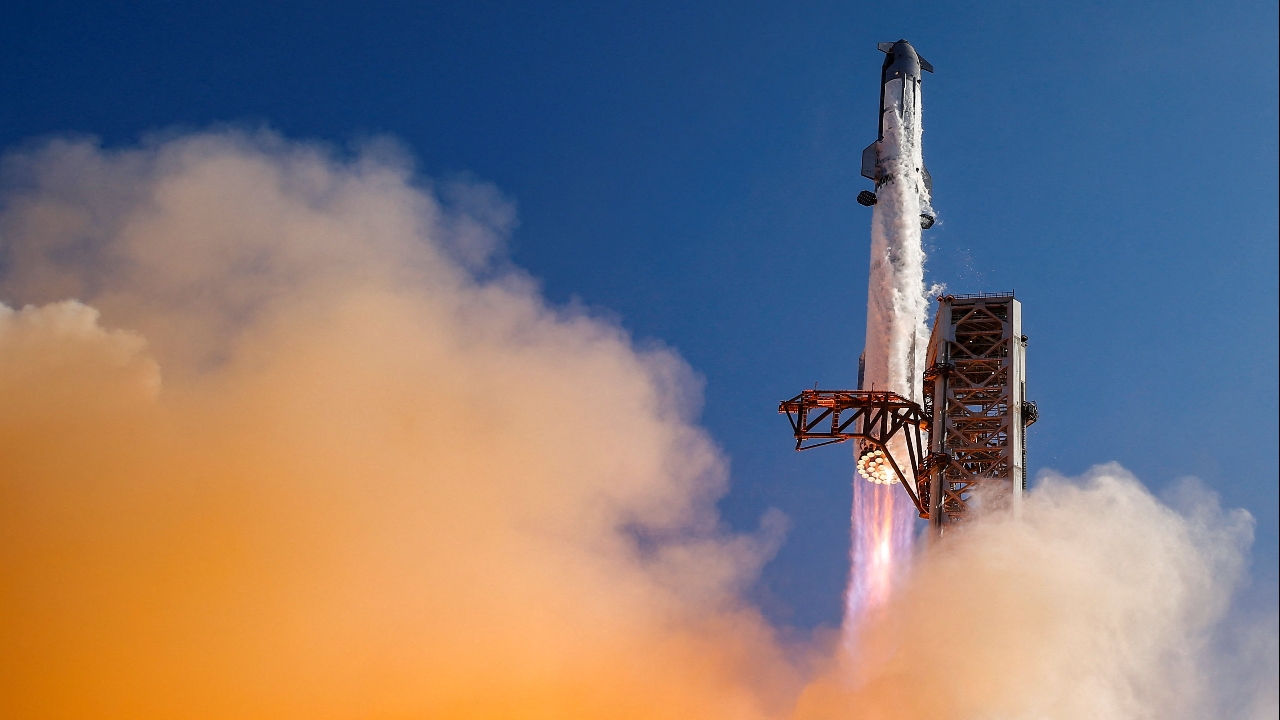
SpaceX successfully conducted the 13th test flight of its Starship rocket, launching 20 new Starlink V3 satellites into space as planned, with preparations underway for Starship to enter full commercial service by the end of this year.
The Starship rocket, standing about 122 meters tall—roughly the height of a 40-story building—was launched from a rocket launch site in Texas at approximately 18:50 local time.
This mission carried 20 Starlink V3 satellites for testing. These new-generation satellites offer improved performance over previous models, including greater bandwidth and internet speed. After successfully connecting to the Starlink network, all the satellites re-entered Earth's atmosphere along predetermined trajectories and burned up completely as part of the test plan.
During the flight, cameras mounted on the rocket captured images of Earth from about 190 kilometers altitude, including thunderstorms and lightning visible below. Meanwhile, SpaceX engineers at the operations center in Hawthorne, California, cheered at every critical phase of the mission and shouted "USA" in celebration.
This flight also served as a test of the new Starship model, which is crucial to SpaceX's long-term plans, including expanding the Starlink internet network, sending NASA astronauts to the Moon by 2028, and deploying thousands of artificial intelligence (AI) processing satellites into orbit in the future.
After about one hour of operation, Starship re-entered Earth's atmosphere. The heat shield sustained less damage than in previous tests, marking significant progress toward Elon Musk's goal of making the rocket capable of regular flights and landings like an airplane.
The upper stage of the rocket reignited its engines to adjust its trajectory before descending into the Indian Ocean, simulating a landing for a real mission, with plans to land on solid ground in Texas in the future.
However, the test was not entirely smooth. The Super Heavy booster, the first stage of the rocket, failed to return to Earth as planned after five engines failed to reignite to slow its descent, causing it to crash into the Gulf of Mexico at higher than expected speed.
Dan Huot, a SpaceX spokesperson, said the company aimed for the booster to land softly on the water, but the outcome showed it still had too much speed before touching down.
In a previous test in May, the booster’s engines also failed to ignite fully, resulting in a similar crash into the Gulf of Mexico.
SpaceX aims to begin using Starship to launch larger quantities of Starlink V3 satellites by the end of 2026 to enhance the network's capacity for Direct-to-Cell service, which enables standard mobile phone connections directly to satellites even in areas without terrestrial cellular coverage.
Click to read news aboutInternational news