

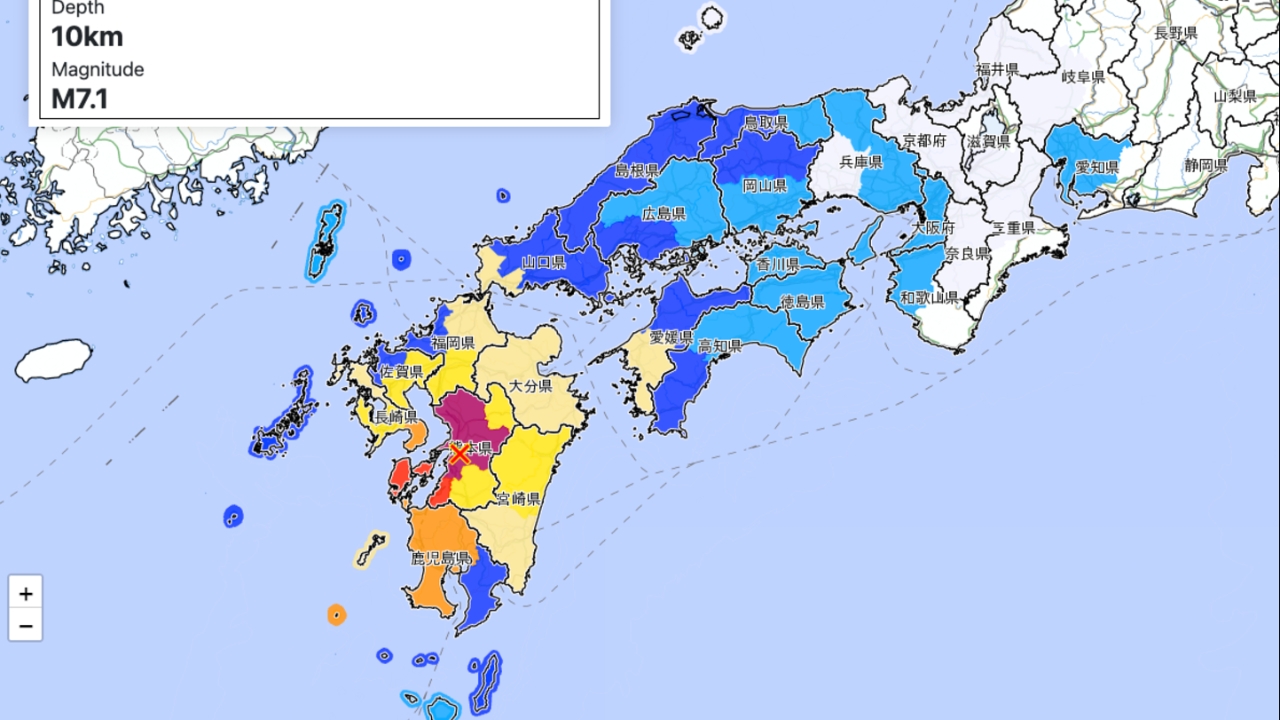
A powerful magnitude 7.1 earthquake struck southwestern Japan, centered in Kumamoto Prefecture on Kyushu Island. The tremors reached a maximum intensity of 7 on Japan's Shindo scale, the highest level. This prompted the Japan Meteorological Agency to issue a 1-meter tsunami warning for the Ariake Sea and Yatsushiro Sea coasts, urging residents to evacuate to higher ground immediately.
The Japan Meteorological Agency (JMA) reported that at 16:27 local time on 28 July, a strong magnitude 7.1 earthquake occurred with its epicenter in Kumamoto Prefecture on Kyushu Island in southwestern Japan. The earthquake's focal depth was approximately 10 kilometers.
The maximum seismic intensity measured was level 7 on the Japanese Shindo scale, the highest on this scale, recorded in the cities of Uki and Higawa in Kumamoto Prefecture.
Additionally, several areas in Kumamoto experienced intensities of 6+ including Minami ward of Kumamoto City, Yatsushiro, Uto, Misato, and Mashiki. Other cities such as Kamiamakusa, Koshi, Ozu, Nishihara village, Mifune, and Ashikita felt intensity levels of 6-.
Following the earthquake, the JMA issued a tsunami warning for the Ariake Sea and Yatsushiro Sea coastal areas, predicting tsunami waves could reach up to 1 meter high, possibly arriving around 17:00 local time.
NHK television reported that tsunami waves might have already begun reaching some areas. They urged coastal residents to evacuate to higher ground or safe buildings immediately and to avoid approaching the shore until the warning is lifted.
Additionally, aftershocks registering a maximum intensity of level 4 were recorded at approximately 16:39, 16:59, 17:18, and 17:27.
Japan’s Prime Minister Sanae Takaichi stated that multiple injuries, collapsed buildings, and fires have been reported following the major earthquake in southwestern Japan. "We are assessing the extent of injuries and property damage, but I have been informed that there are already many injured," she said. She added that "power outages and fires have occurred in some areas, roads and bridges have been damaged, and buildings have collapsed."
About half an hour after the earthquake, NHK reporters on site wearing helmets broadcast live, reporting that shaking was ongoing and so intense that it was difficult to stand. "The tremors are continuing as I speak, and I myself feel my heart pounding. Some people might feel the same," the reporter said. "When the quake struck, the shaking was so severe I could barely stand. Please remain cautious as tremors may continue."
So far, no fatalities or severe damage have been reported, but officials are urgently inspecting the impact on buildings, roads, utilities, and infrastructure in affected areas.
Kyushu Electric Power Company reported that about 45,000 households and facilities in Kumamoto are without electricity. No abnormalities have been detected at the Genkai Nuclear Power Plant in Saga Prefecture or at the Sendai Nuclear Power Plant in Kagoshima Prefecture. Radiation levels around these plants remain unchanged. Kyushu Railway Company announced suspension of all train services, including the Kyushu Shinkansen line, due to the earthquake.
Professor Takuya Nishimura from Kyoto University’s Disaster Prevention Research Institute, an expert in earthquake mechanisms, said, "This earthquake appears to have occurred along the Hinagu fault zone, located southwest of the 2016 Kumamoto earthquake epicenter. This area has remained active since the 2016 Kumamoto earthquakes. Because the epicenter is shallow, it is believed that areas near the epicenter experienced strong shaking."
He added, "It is important to determine whether the entire Hinagu fault slipped during this earthquake or if parts of it remain unruptured to the south. If some segments remain unruptured, there is a possibility of successive large earthquakes, similar to the 2016 Kumamoto event."
Japan is among the most earthquake-prone countries globally, situated at the convergence of four major tectonic plates within the "Ring of Fire." This results in hundreds of earthquakes each year, accounting for about 18% of the world's seismic events.
The country continues to bear the lessons from the massive 9.0 magnitude earthquake in 2011, which triggered a devastating tsunami that killed or left missing approximately 18,500 people and caused the Fukushima nuclear crisis.
Previously, on 20 April, Japan experienced a 7.7 magnitude earthquake in the northern region, injuring at least 10 people and prompting the government to issue a special warning about the risk of an 8.0 or greater earthquake, though the warning was lifted after one week.
Japanese authorities continue to monitor the situation closely, urging residents to follow official announcements and adhere strictly to safety guidelines.
Source.NHK./ AFP