

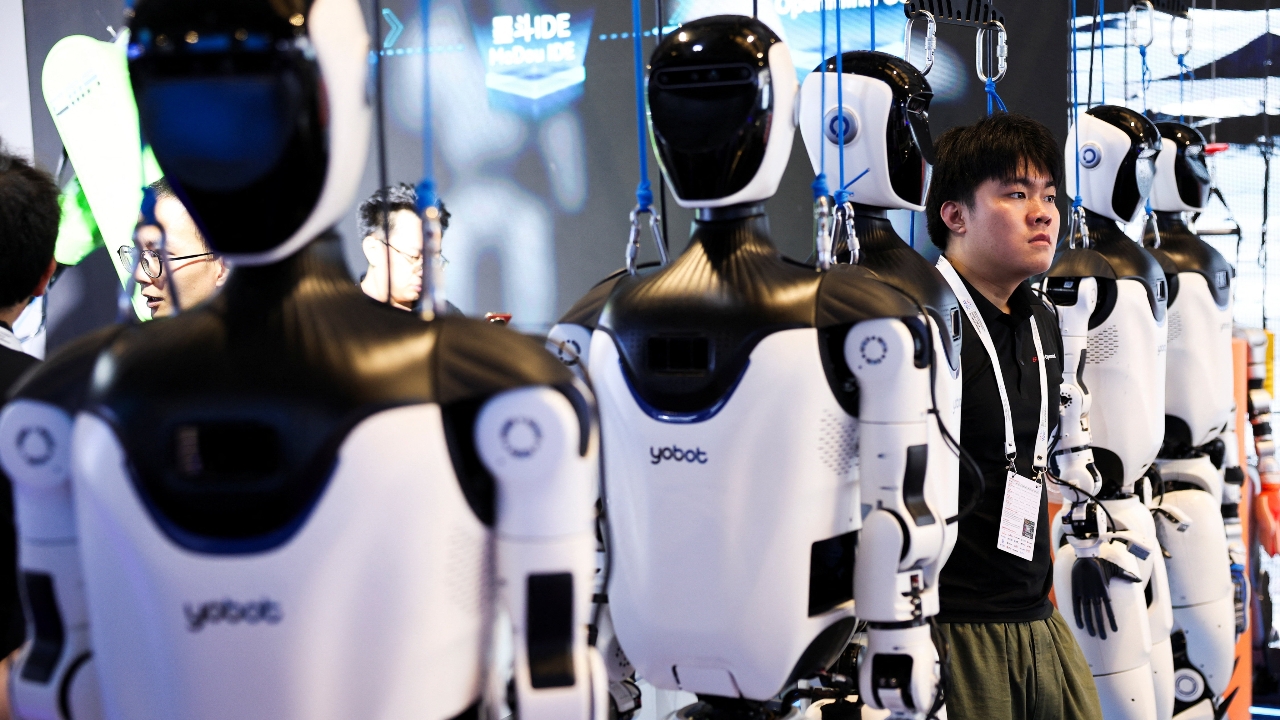
President Donald Trump announced a ban on importing humanoid and advanced robots manufactured abroad, particularly from China, citing risks to national security and the possibility that they could be used for espionage and data theft.
Under President Donald Trump's administration, the U.S. government announced a ban on importing humanoid and advanced robots made overseas, especially from China, citing potential national security risks. Officials warned these robots could be used as tools for spying, data theft, or remote control by foreign governments.
Announced last Tuesday, the measure covers all types of advanced robots, including humanoid and quadruped models, many produced by Chinese companies fiercely competing with the U.S. in robotics and artificial intelligence (AI) technology.
Additionally, the U.S. Federal Communications Commission (FCC) announced a ban on importing electric inverters—critical devices used in data centers and solar power systems—citing potential vulnerabilities that could impact the economy and national infrastructure.
Brendan Carr, FCC Chairman, stated that the agency is taking steps to protect critical U.S. supply chains and reduce security risks.
The FCC noted that foreign-made inverters could allow manufacturers to remotely shut down systems, steal data, enable unauthorized access, or be used by foreign governments to launch cyberattacks.
Foreign-made robots are also viewed as potential tools for spying on American citizens, enhancing foreign intelligence capabilities, or being hijacked remotely in the event of a cyberattack.
However, this measure applies only to new robot and inverter models to be imported in the future and does not affect products previously authorized for import or sale in the U.S.
All these devices will be included in the Covered List, a catalog of products the U.S. government considers national security risks.
This move represents an escalation of pressure on China amid the intensifying trade war and technology competition between the two countries.
Previously, the U.S. imposed high tariffs on Chinese electric vehicles, effectively blocking their entry into the American market, and restricted exports of high-performance semiconductors to China to slow Beijing's development of AI and military technologies.
Meanwhile, U.S. Treasury Secretary Janet Yellen warned that Chinese AI companies could face sanctions if found to be stealing U.S. intellectual property.
The Chinese government affirmed that the country's AI advancements result from research, development, and international cooperation, not the copying of foreign technologies.
Currently, Chinese tech companies such as Unitree, UBTech, and AgiBot are accelerating development of humanoid robots for factories, homes, and service sectors, racing to market ahead of U.S. competitors like Elon Musk's Tesla and Boston Dynamics.
Source:BBC
Click to read related news aboutInternational News