

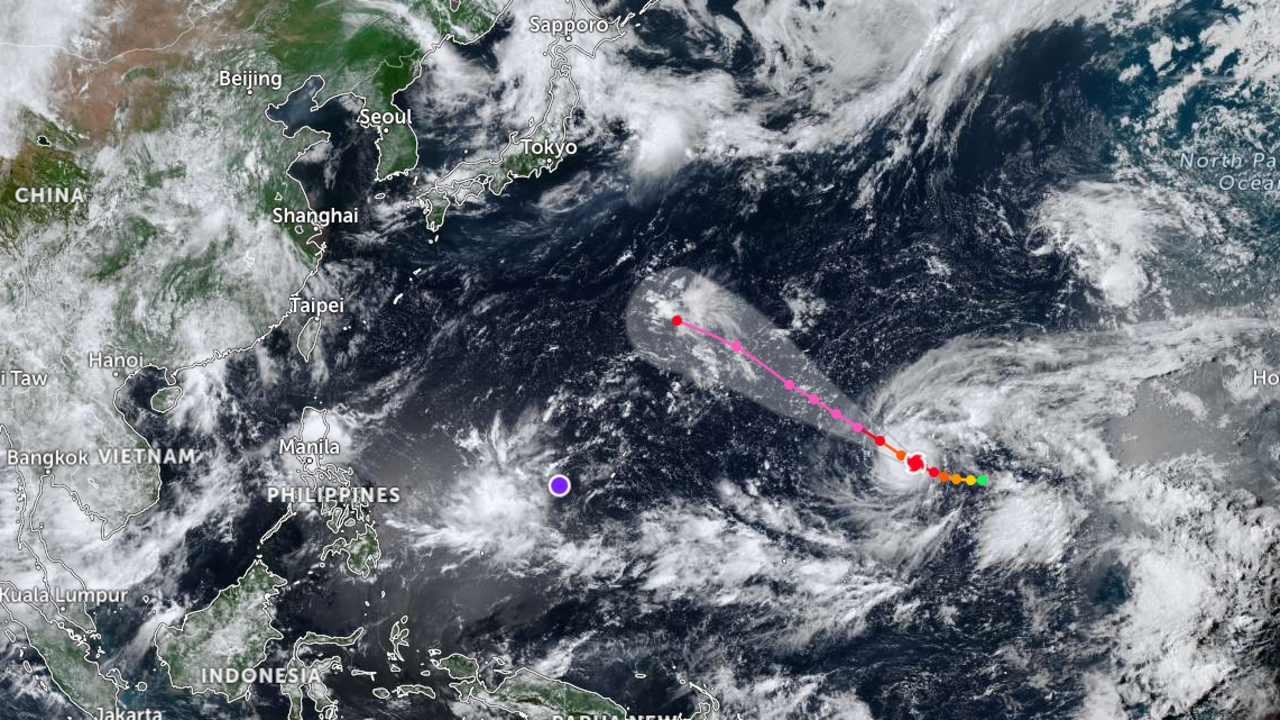
Typhoon Dolphin, the 13th typhoon of this year, is expected to escalate into a super typhoon by 30 July and may become the strongest typhoon of the year. It is moving northwest at 15 kilometers per hour near the Marshall Islands in the Pacific Ocean, with maximum sustained winds currently at 216 kilometers per hour. It is forecast to approach the southeastern waters of Japan within the next five days. /
The U.S. Navy Joint Typhoon Warning Center (JTWC) reported the latest update on Typhoon Dolphin, the 13th typhoon affecting Japan, on the morning of 29 July. The storm is intensifying rapidly and is likely to become the most powerful super typhoon since the start of the 2026 storm season.
On the morning of 29 July, the center of Typhoon Dolphin was located approximately 715 kilometers south-southeast of Wake Island. Over the past six hours, the storm has moved northwest at about 15 kilometers per hour.
The Japan Meteorological Agency classifies Dolphin as a "very strong typhoon," with a central pressure of 955 hectopascals and maximum sustained winds of 216 kilometers per hour.
The storm is expected to continue moving in this direction for the next four days under the influence of a high-pressure system over the central North Pacific Ocean. Reports indicate that this latest storm in the western Pacific basin will not impact or threaten any land areas at least until the end of this week.
At 02:00 on 29 July, Typhoon Dolphin became the fastest intensifying tropical cyclone in the western Pacific basin since Typhoon Noru in 2022. Within just 24 hours, the storm's one-minute sustained wind speeds increased by about 150 kilometers per hour, reflecting a rapid intensification process under highly favorable environmental conditions for storm development.
Previously, the storm underwent rapid intensification, reaching Category 3 status by 20:00 on 28 July, with wind speeds increasing by an average of 110 kilometers per hour within 24 hours. This makes it one of the fastest-developing storms in recent years.
The JTWC forecasts that conducive meteorological conditions will allow Typhoon Dolphin to further intensify into a "super typhoon," with maximum wind speeds expected to reach 305 kilometers per hour by 31 July.
This massive intensification could enable Typhoon Dolphin to break records, surpassing Typhoon In-Fa to become the strongest storm globally this year, or matching the strength of Typhoon Nepartak in 2016, recognized as the most powerful tropical cyclone in July in the 21st century.
The intensity of this typhoon may approach that of Typhoon Wanda in 1956, which remains the strongest recorded July typhoon in history.