

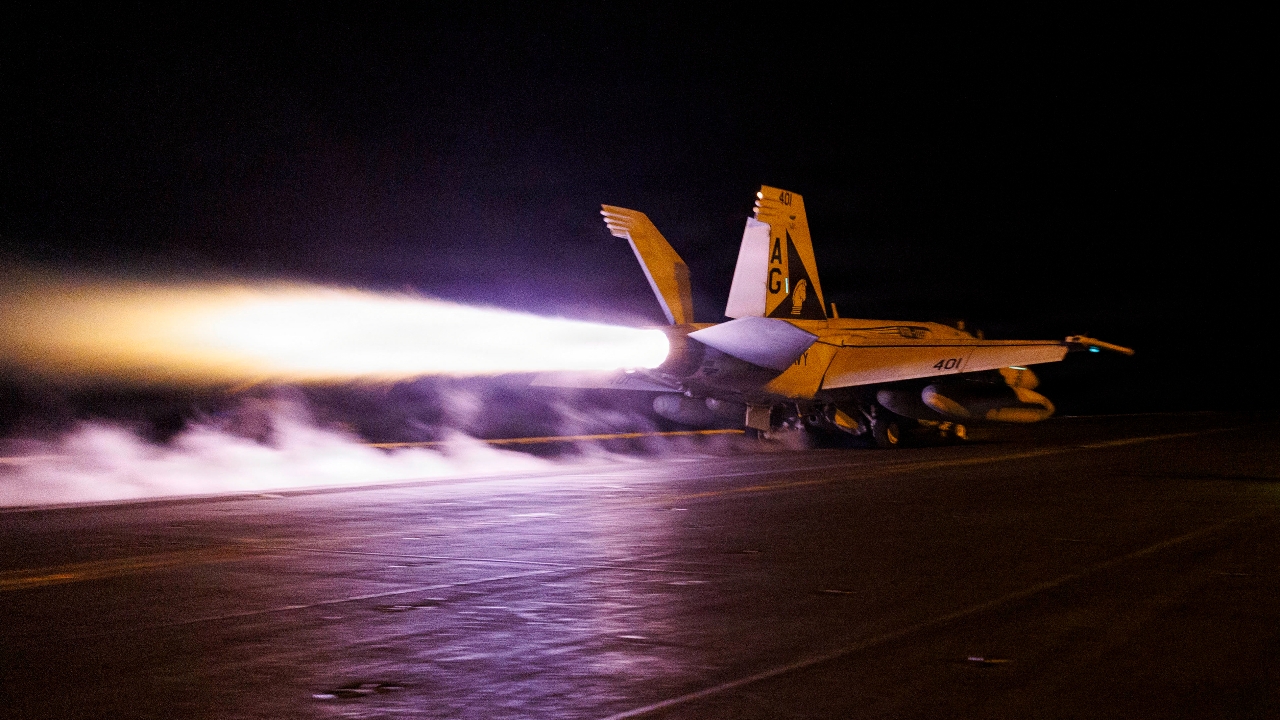
Saudi Arabia, together with the United States, launched airstrikes against Iran-backed armed groups in Iraq to retaliate against drone and missile attacks on US military bases and Saudi energy infrastructure, while global oil prices surged over 4% amid concerns over oil shipments through the Strait of Hormuz.
The US Central Command (CENTCOM) disclosed that US and Saudi forces jointly conducted airstrikes on Iran-backed armed group targets in eastern Iraq in response to more than 30 drone attacks over the past 72 hours, which the US said were ordered by Iran’s Islamic Revolutionary Guard Corps (IRGC).
CENTCOM stated the strikes targeted weapons supply bases and logistics centers of Iran-aligned armed groups accused of orchestrating attacks on US bases and Saudi energy infrastructure, urging Iran and its proxy network to cease attacks or face further US military actions.
Although the US did not name the targeted groups, the Iraqi Popular Mobilization Forces (PMF), a coalition of Iran-backed militias, confirmed at least 10 of their fighters were killed and condemned the strikes as a "dangerous escalation" and a violation of Iraq’s sovereignty.
Just hours earlier, Iran launched multiple long-range missiles at US bases in the Middle East; the US military reported successfully intercepting all missiles, while Iran claimed the targets were US bases in Jordan.
Additionally, Iran’s Tasnim news agency reported that the IRGC attacked three oil tankers in the Strait of Hormuz, reaffirming that Iran maintains "full control" over this vital oil transit chokepoint.
Saudi Arabia’s Ministry of Defense revealed that before the joint US-Saudi strikes, their military intercepted several unmanned aerial vehicles aimed at oil refineries and storage facilities in the eastern region, attributing the drones to Iran-backed armed groups in Iraq.
This latest escalation follows a brief lull in US-Iran hostilities just days prior, when President Donald Trump stated the US and Iran were engaged in "very friendly negotiations," although the Iranian government denied any talks were underway.
The attacks coincided with Israeli Prime Minister Benjamin Netanyahu’s visit to Washington, his first since the Middle East war erupted in February, where he met President Trump at the White House to discuss regional security and efforts to prevent Iran from acquiring nuclear weapons.
The renewed tensions prompted an immediate global energy market response, with Brent crude oil prices rising over 4.3% to $87.70 per barrel, while US West Texas Intermediate (WTI) crude increased 4.2% to $82.62 per barrel amid fears the conflict could disrupt oil shipments through the Strait of Hormuz, one of the world’s most critical oil transit routes.
US Department of Defense data indicate that since President Trump ordered military operations against Iran in February, at least 624 US service members have been injured, including 417 wounded during joint US-Israeli strikes on Iran.
Analysts view Saudi Arabia’s direct military cooperation with the US as a significant development that could broaden the Middle East conflict and increase risks to energy stability and the global economy moving forward.
/sourceBBC/ AFP