

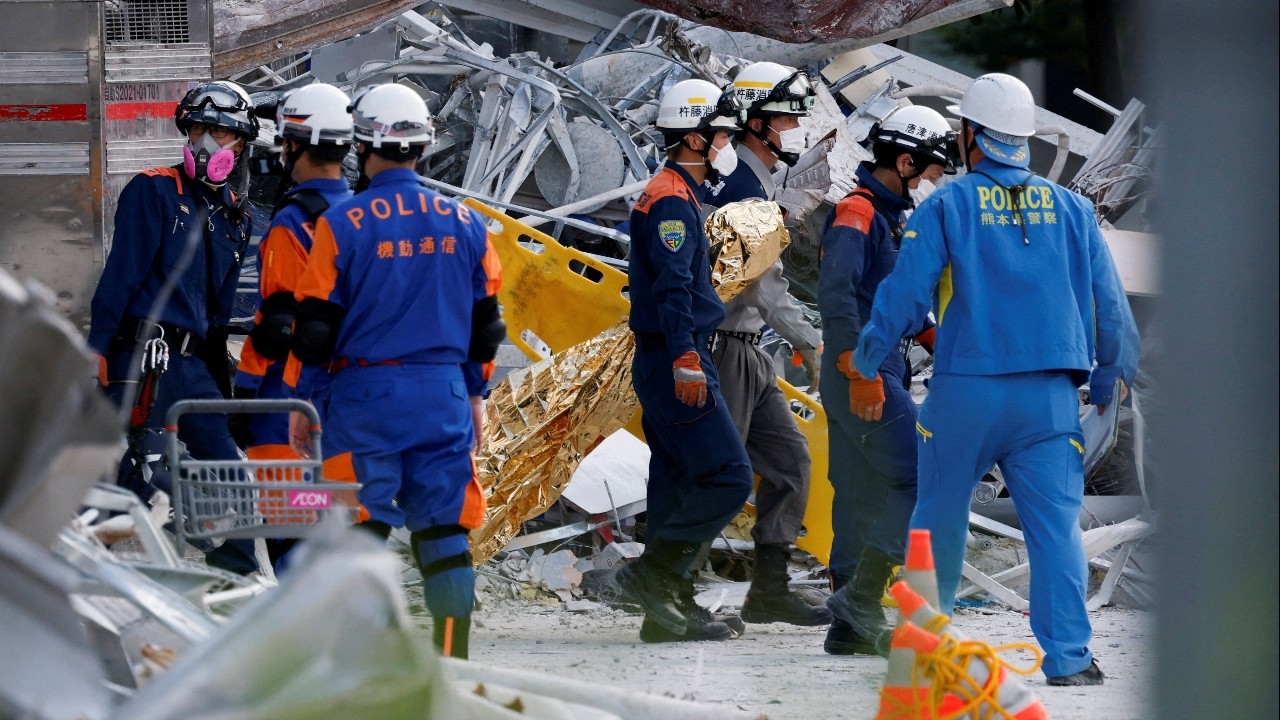
The earthquake in Japan has claimed 28 lives so far. Hundreds of officials continue searching for missing persons beneath the rubble of the Aeon shopping mall in Kumamoto Prefecture, while tens of thousands of households remain without electricity and running water.
The death toll from the 7.1-magnitude earthquake that struck Kumamoto Prefecture in southwestern Japan on 28 July has risen to 28, according to a statement from the Japanese government on Thursday (30 Jul).
Japanese government spokesperson Minoru Kihara said that this figure includes deaths still under investigation to determine if they are related to the earthquake.
Meanwhile, hundreds of rescue workers are mobilizing to search for survivors who may still be trapped beneath the rubble of the Aeon department store in Kashima city, Kumamoto Prefecture, which collapsed following a major explosion.
Reports indicate that after the earthquake, Aeon evacuated everyone from the building, but about 50 minutes later, a powerful explosion severely damaged the structure. It remains unclear how many employees were still inside at the time of the blast.
Footage from inside the rubble shows rescue workers in orange suits and white helmets carefully navigating twisted steel beams, dangling electrical wires, and collapsed ceiling debris as they search for survivors.
In addition to the Aeon incident, officials confirmed five more deaths from the collapse of a chimney at Nippon Paper Industries in Yatsushiro city, with four people still reported missing.
This earthquake caused widespread damage across Kyushu island, destroying many homes, damaging bridges, and causing multiple fires.
As of Thursday morning, more than 22,670 homes and businesses remain without electricity, while data from Wednesday indicated around 84,000 households are experiencing water supply outages.
Local TV footage shows many residents lining up to buy drinking water and fuel amid conditions that have yet to return to normal.
Meanwhile, the affected areas continue to experience aftershocks and intense heat, with temperatures expected to reach 35 degrees Celsius, prompting authorities to issue heatstroke warnings.
Although the United States Geological Survey (USGS) measured the earthquake's magnitude at 6.8, the Japan Meteorological Agency continues to assess it as a 7.1 magnitude event.
Japan sits at the intersection of four major tectonic plates within the "Ring of Fire," making it one of the most earthquake-prone countries in the world, accounting for about 18% of all global earthquakes.
Kumamoto Prefecture previously experienced a severe earthquake in 2016 that killed 273 people and injured over 2,800 others.
The major 2011 earthquake and tsunami off Japan's coast, measuring 9.0, remains the country's most devastating modern disaster, with about 18,500 people dead or missing and triggering the Fukushima nuclear crisis.
:Sourcechannelnewsasia
Click to read related news aboutInternational News