

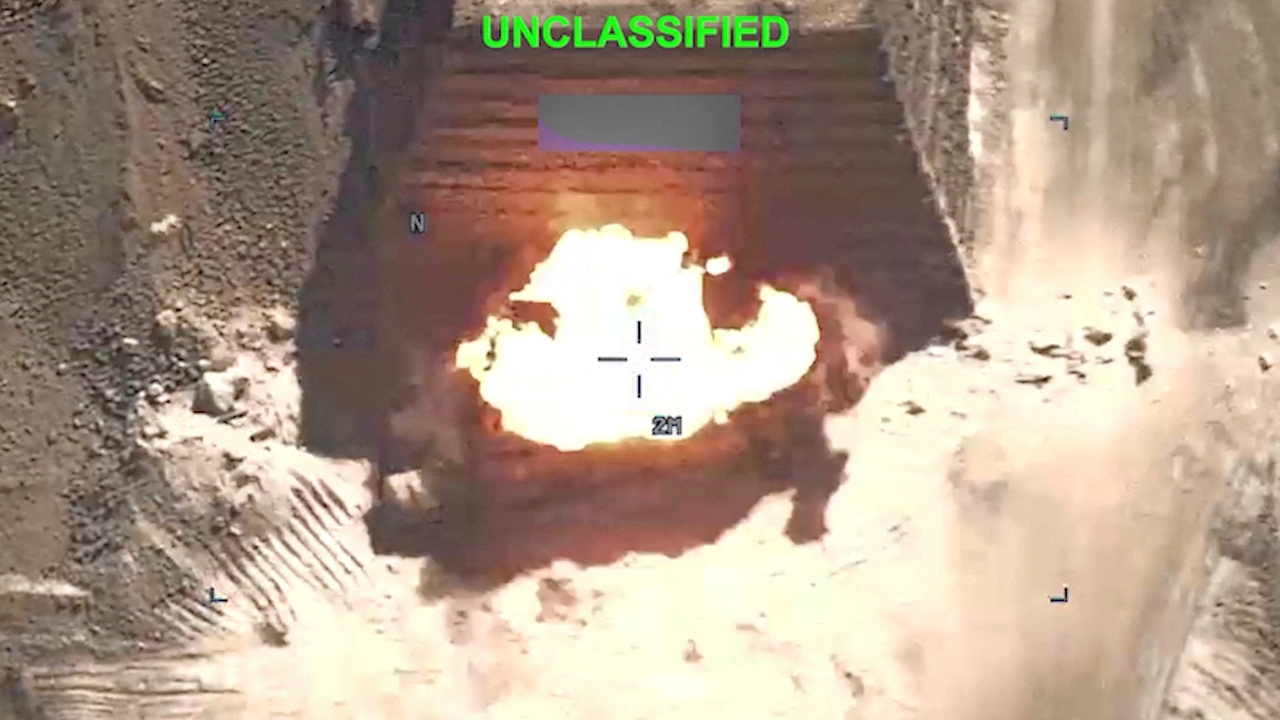
The US military launched a major airstrike operation against targets of Iran's Islamic Revolutionary Guard Corps to retaliate against Iran's missile attacks on a US base in Jordan and vessels in the Strait of Hormuz. President Donald Trump declared he would "respond with full force." Meanwhile, the conflict spread to Iraq and Egypt, driving global oil prices higher and raising concerns about regional stability.
The US Central Command (CENTCOM) announced that the airstrike operation against Iran concluded at 10:00 p.m. local Washington time on 29 July after about two hours. CENTCOM stated it hit dozens of Islamic Revolutionary Guard Corps (IRGC) targets across Iran, including military command centers, missile and drone bases, coastal surveillance and defense systems, and maritime operational capabilities.
The US military said the operation was in response to Iran's missile attempts against the US base in Jordan and ships in the Strait of Hormuz last Tuesday, confirming that air defense systems successfully intercepted all missiles.
A few hours before the strike, President Donald Trump said at the White House that it was time for the US to retaliate against Iran's attacks. "Now it's our turn. We will hit them hard," he stated. However, Trump emphasized that the US remains open to negotiating with the Iranian government if a peace agreement can be reached.
Iran confirmed it fired missiles at the US base in Jordan and ships in the Strait of Hormuz in retaliation for US and Israeli attacks, rejecting Oman's proposal for joint management of the Strait of Hormuz, a critical global oil and natural gas shipping route.
The IRGC stated the strikes targeted US airbases and command centers in Jordan and also attacked three oil tankers in the Strait of Hormuz, claiming those vessels were navigating "unsafe and illegal" routes.
A day before Iran's strike, the US and Saudi Arabia launched their first joint operation, targeting Iran-backed armed groups' strongholds in eastern Iraq. The Popular Mobilisation Forces (PMF), supported by Iran, reported at least 20 killed and 32 wounded. The Iraqi government condemned the strike as a violation of its sovereignty, while Trump affirmed the operation was coordinated with the Iraqi government.
Several news agencies reported that the Saudi defense minister met with US Vice President J.D. Vance to urge Washington to avoid expanding the war into Yemen and prevent further attacks on Iran-backed armed groups.
The escalating conflict caused global crude oil prices to surge rapidly, with Brent crude rising nearly 8% intraday before settling near $90 per barrel. West Texas Intermediate (WTI) crude prices also increased.
Despite rising tensions, preliminary shipping data shows dozens of cargo and oil tankers continue transiting the Red Sea, while navigation through the Strait of Hormuz remains limited due to ongoing conflict in the area since February.
The war involving the US, Israel, and Iran began in February after US and Israeli airstrikes on Iran. At that time, President Trump said the operation would last only a few weeks.
Although a temporary ceasefire was reached in June, it collapsed due to renewed fighting near the Strait of Hormuz. Now in its fifth month, the conflict raises concerns about further regional escalation potentially drawing more Middle Eastern countries into the war, impacting the global economy and long-term energy security.