

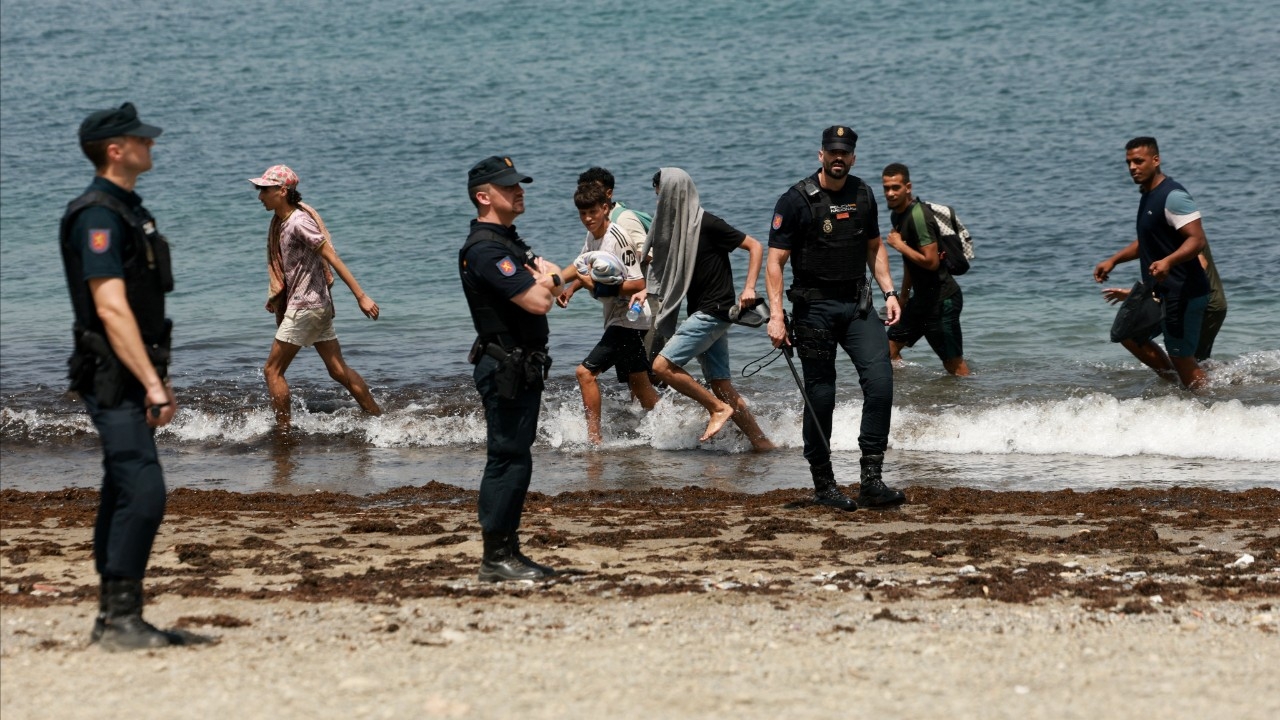
The situation in the Spanish city of Ceuta is returning to normal after over 60,000 migrants who swam from Morocco around border fences into the territory have nearly all left.
On Saturday, 1 Aug 2026 GMT+7, Spanish authorities revealed that more than 60,000 migrants who swam and traveled from Morocco into Ceuta, the Spanish exclave in North Africa, have almost all left the area, while several European Union (EU) countries have begun tightening border controls to handle the influx.
Juan Jesús Vivas, President of Ceuta's autonomous city government, told reporters that an estimated 60,000 migrants crossed over from neighboring Morocco into Ceuta within a few days, but on Saturday, Spain's Interior Minister stated that nearly all migrants have now left.
“The situation has eased and is nearly back to normal,” Spain’s Interior Minister Fernando Grande-Marlaska told reporters.
Meanwhile, AFP reported that on Friday, after migrants had spent the night wandering the beaches and streets of Ceuta or sleeping on sand, some youths turned back to say “Adiós” to officials before crossing back into Morocco.
On Saturday morning, under the watchful eyes of Spanish military and police, the remaining migrant youths gradually crossed back into Morocco. If anyone stayed too long along the coastal route, military personnel would detain and immediately escort them back.
Many migrants entered Ceuta by swimming around small border barriers that extend into the Mediterranean Sea before returning to Ceuta’s territory. Grande-Marlaska revealed that at least 67 people died attempting this crossing.
“We all just want to go to Europe to work and make a living, that’s all,” said 19-year-old Senegalese migrant Souleymane Bodian to AFP outside a migrant aid center in Ceuta, where dozens of sub-Saharan African migrants were awaiting official processing.
The sudden influx of migrants into Ceuta caused alarm and became a political crisis in Europe.
On Saturday, 22 EU member states jointly issued an open letter calling for an urgent video conference of interior ministers to agree on quick coordinated responses to “prevent uncontrolled border crossings from happening again.”
Earlier, Italy suspended the Schengen Agreement with Spain—which previously allowed visa-free border crossing—effective for one month from Saturday, while several European countries proposed suspending Spain’s membership in the Schengen area, though this is practically unlikely.
Spanish Prime Minister Pedro Sánchez sent letters to the European Commission president and the European Council president, sharply criticizing some EU countries for their “selfish” response.
European Commission President Ursula von der Leyen posted on X that the EU aims to learn lessons to improve Europe’s resilience and recovery, emphasizing that “not a single migrant reached mainland Spain or other parts of the EU” during the surge.
Follow international news:https://www.thairath.co.th/news/foreign
Source:cna