

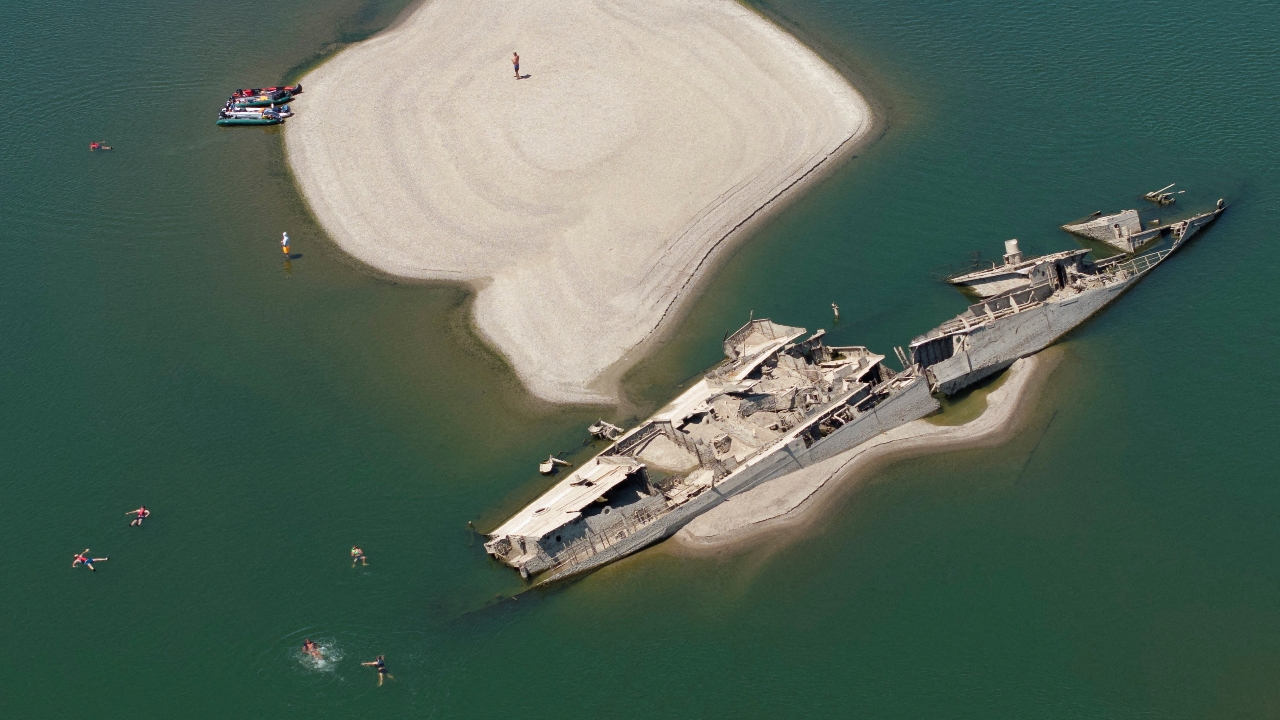
Heatwaves and droughts sweeping across Europe have caused the Danube River's water level to fall to a historic low, revealing the wreckage of a German Nazi battleship from World War II and numerous other sunken ships. Meanwhile, several countries are facing impacts on navigation, tourism, and electricity generation, with Hungary and Romania forced to reduce nuclear power output due to insufficient cooling water.
The ongoing heatwave affecting many parts of Europe, combined with prolonged drought, has led to the Danube River—a crucial European waterway—dropping to its lowest recorded levels in many areas. This has exposed the wreckage of German Nazi military ships sunk during World War II, as well as several shipwrecks unseen for decades.
The Danube River stretches over 2,800 kilometers, flowing through 10 countries from Germany to the Black Sea. In Prahovo, Serbia, the receding water level has revealed the hull of a German World War II battleship, while locals cool off by swimming nearby.
The European Investment Bank reports that approximately 200 sunken ships lie beneath the Danube, including cargo vessels and barges, many destroyed during World War II. Near the town of Opatovac, Croatia, the wreck of the Hungarian cargo ship Fulton, which sank in 1937, has also re-emerged.
The low water levels are affecting more than just navigation; tourism and industry across several countries are impacted as well. In Budapest, Hungary, the national water management authority recorded the Danube's level at just 23 centimeters, breaking the previous record low of 33 centimeters set in 2018.
Abnormally low water levels have forced tourist cruise ships in Budapest to dock several kilometers upstream instead of at their usual piers. Most cargo vessels have ceased operations as the water depth is insufficient for safe navigation.
This situation is severely affecting the energy sector in Hungary and Romania, where nuclear power plants rely on Danube water to cool their reactors.
Hungarian Prime Minister Péter Márki-Zay revealed that the Paks nuclear power plant—which generates nearly half of Hungary's electricity—may need to shut down for several weeks. The water level drop has made safe operation impossible, with all four reactors, producing a combined 2 gigawatts, currently running at less than 50% capacity and potentially shutting down entirely by early next week. This would be the first such shutdown in 44 years.
Prime Minister Márki-Zay stated that although Hungary can import electricity to meet demand, the reduced domestic output alongside rising electricity use due to the extreme heat—especially in the evenings when demand may increase by up to 20%—could strain the country's power grid. He has called on major industrial users to reduce energy consumption.
Meanwhile, Romania has declared an energy emergency for August after power production declined due to low Danube water levels. Prime Minister Ilie Bolojan announced plans to increase electricity imports from Ukraine, Greece, and Bulgaria to compensate for the shortfall, acknowledging that both Romania and Hungary have had to significantly reduce nuclear power output.
Romania's nuclear power producer Nuclearelectrica has already shut down one reactor and has not yet determined when it can be restarted, as Danube water levels continue to fall.
Experts warn that if the heatwave and drought persist, Europe could face widespread consequences for energy, transportation, and the economy, since the Danube is a vital transportation route and water source sustaining many countries in Central and Eastern Europe.