

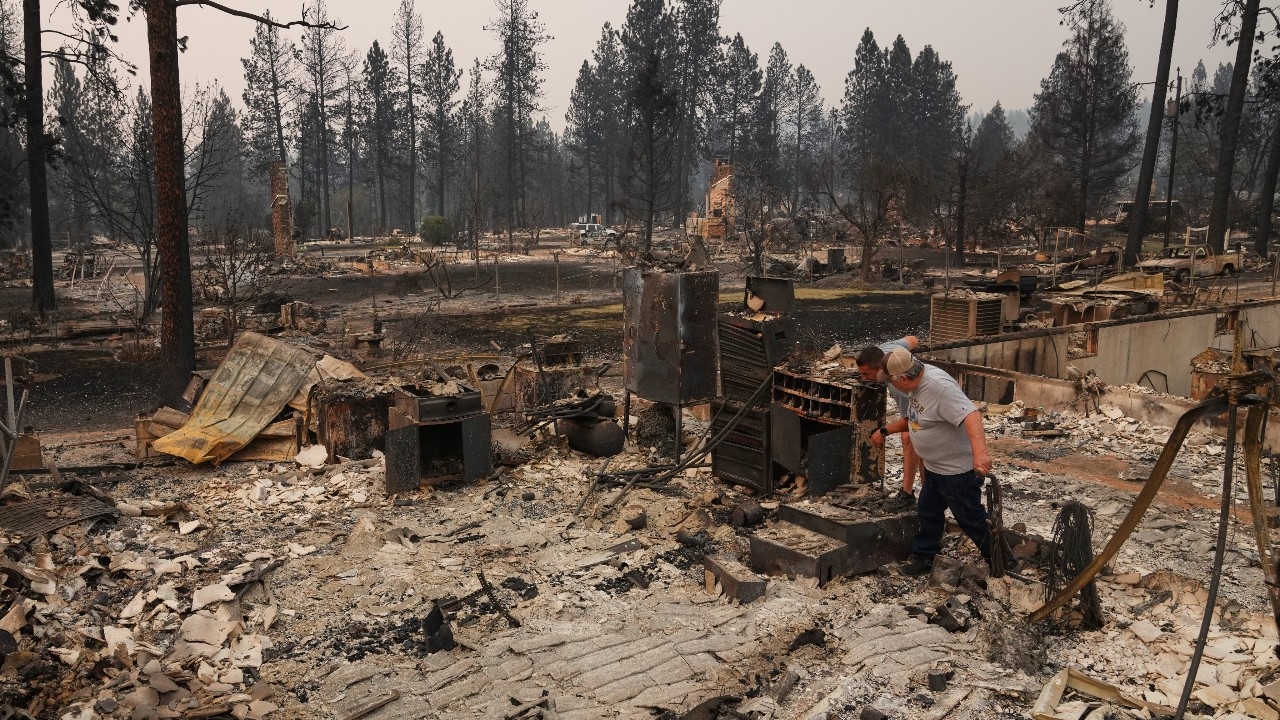
Three large wildfires around Spokane, Washington, in the northwest United States, have continued to spread heavily since starting last weekend. At least 700 buildings have been destroyed, and about 65,000 people have been evacuated from danger zones. Authorities have arrested a 37-year-old man suspected of arson.
Officials reported that aerial surveys found between 700 and 1,110 structures potentially damaged or destroyed, mostly residential homes. Complete damage assessments remain pending because many areas are still unsafe to enter.
The three wildfires have burned a combined area of over 8,000 acres (about 20,000 rai). The most severe fire, the "Old Trails" blaze, crossed the Spokane River Saturday afternoon before spreading into the city and nearby communities. Images show many homes reduced to chimneys, bricks, and foundations, while some neighboring houses suffered less damage.
John Novels, a Spokane city official, said approximately 65,000 people were ordered to evacuate. Authorities are trying to reach 14 individuals who are currently unreachable by phone, but there is no official report of missing persons.
Lisa Brown, Mayor of Spokane, stated that officials are assessing damage area by area and monitoring hotspots for potential flare-ups. It remains unclear when residents can return home, with some areas possibly requiring several weeks before reentry.
The Spokane County office disclosed that 37-year-old Aaron F. Farinacchi was arrested and charged on suspicion of arson related to the Old Trails wildfire. He is being held on a $1 million bail. It is not yet clear whether he has legal representation.
No fatalities or injuries have been reported so far, but officials warn there may be additional casualties as they gain access to heavily burned areas. Some residents are reported missing after evacuations.
About 1,100 firefighters are battling the three fires, with aerial firefighting aircraft dropping retardants along fire lines. However, as of Monday, 3 Aug 2020 GMT+7, no fire lines have been fully contained.
The situation slightly improved due to lower temperatures, increased humidity, and lighter winds on Monday and Tuesday, allowing officials to make progress. However, weather is expected to become hot again midweek, with temperatures reaching the mid to high 30s Celsius and relative humidity dropping to the low double digits.
Washington Governor Bob Ferguson declared a state of emergency on 1 Aug 2020 GMT+7, citing a fourth consecutive year of drought, unusually high temperatures, and strong winds that have accelerated wildfire spread. He warned this could be the most severe natural disaster in Spokane’s history.
The Spokane wildfires are among many large fires currently burning in Washington State. Officials report approximately 15 to 16 major fires statewide, affecting more than 250,000 to 262,000 acres. David Uptgrove, director of the Washington State Department of Natural Resources, called this year an “exceptionally severe wildfire season” for the Pacific Northwest.
Data from the U.S. National Interagency Fire Center shows 44,722 wildfires nationwide so far this year, the highest for this period in at least a decade, burning nearly 5.2 million acres (about 2.1 million hectares).
Scientists say prolonged droughts and intense heat waves, increasingly frequent and severe due to human-driven climate change, are raising the risk of large wildfires in North America, Europe, and other regions worldwide.
Daniel Swain, a climate scientist at the University of California, Los Angeles, noted eastern Washington recently experienced one of the warmest winters on record, leading to severe snowpack shortages and worsening drought during wildfire season.
In addition to Washington, wildfires are spreading in Idaho, Oregon, and Utah, as well as British Columbia, Canada, where severe drought and fire-favorable weather persist.
Officials warn that fighting wildfires in the region will remain challenging. After a short period of cooler weather, high temperatures, low humidity, and strong winds are expected to return midweek, potentially worsening wildfire conditions.
Source: AFP /Reuters/Associated Press