

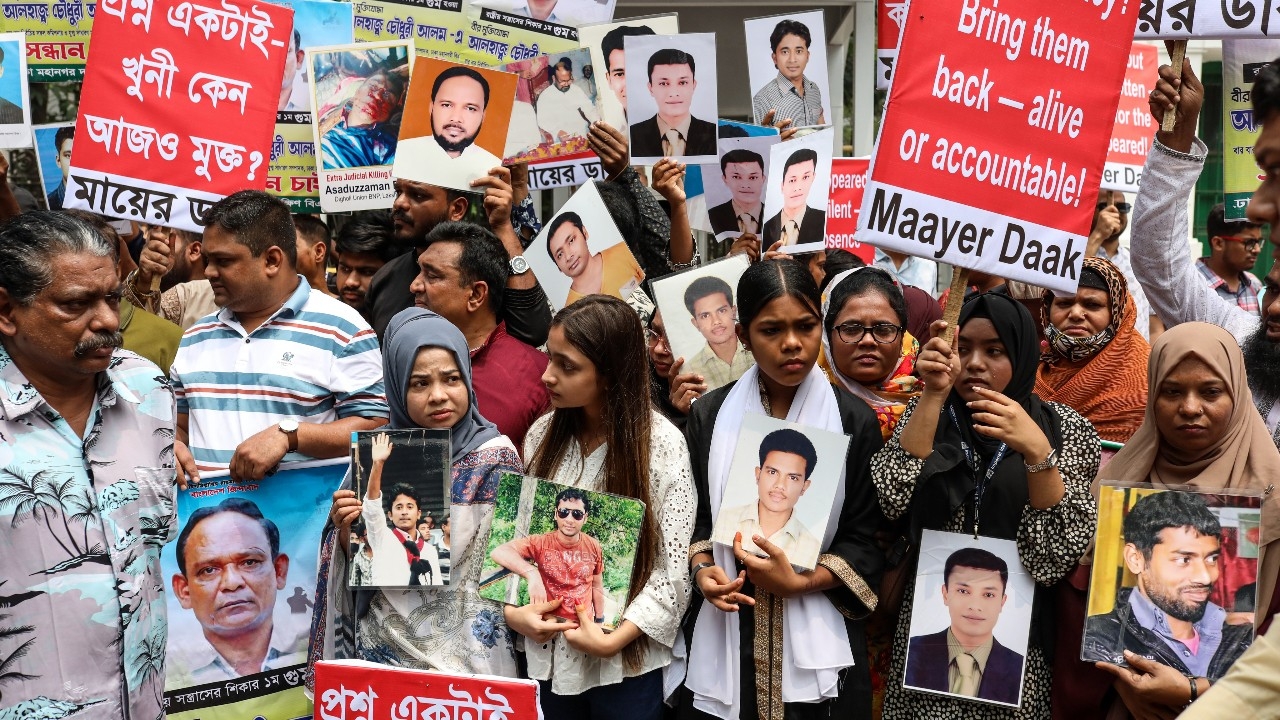
The Bangladesh government has approved the principle of a draft law to prevent and remedy enforced disappearances, prescribing the maximum penalty of "death" and fines up to approximately 2.6 million baht if the victim dies or remains missing for over five years. Data shows at least 1,569 enforced disappearance cases occurred during the 17 years that former Prime Minister Sheikh Hasina governed, with 251 victims still missing and believed dead.
The Bangladesh government has approved the principle of the 2026 draft law to prevent and remedy enforced disappearance cases, stipulating the death penalty as the maximum sentence if the disappearance results in the victim's death. This draft law must still pass parliamentary approval before becoming effective.
The Bangladesh Cabinet approved the draft law at a Monday meeting chaired by Prime Minister Tarique Rahman. The draft classifies enforced disappearance as a distinct criminal offense, allowing authorities to arrest suspects without a warrant, with no bail and no possibility of settlement.
Under the draft law, if an enforced disappearance causes the victim's death, a corpse is found, or it cannot be confirmed whether the missing person is alive or dead after five years, the perpetrator may face the death penalty or life imprisonment, plus fines up to 10 million taka, about 2.6 million baht.
The draft law also accelerates the justice process by mandating investigations to conclude within 120 days and trials to finish within 120 days. Additionally, courts may issue search warrants to locate the missing, conduct trials in absentia, and admit digital evidence.
The law aims to protect victims and their families by granting them the right to information about investigation progress, facts of the case, and the fate or whereabouts of the missing person. It also provides legal aid, medical care, rehabilitation, and a government-supported compensation fund.
Victims' families can claim compensation from the convicted perpetrators' assets; if assets are insufficient, the state will pay compensation. The draft law also permits using the missing person's assets for necessary expenses of spouses and dependent family members.
If a person remains missing for five years, the law allows issuing a missing person certificate enabling heirs to handle inheritance matters. The government will establish a central database on enforced disappearance cases and facilitate international cooperation for tracking and investigation.
The proposed law follows findings by an inquiry commission established after former Prime Minister Sheikh Hasina was ousted, which identified at least 1,569 enforced disappearance cases during her 17-year tenure, with 251 victims still missing and presumed dead.
Hasina has been accused of using security forces to suppress political opposition, with many detainees and disappeared persons being political opponents from the Bangladesh Nationalist Party (BNP) and Jamaat-e-Islami, a major Islamist party.
Hasina was ousted amid mass protests in 2024 and fled to India. A Dhaka court convicted her in absentia of crimes against humanity in 2025 and sentenced her to death. Now aged 78, she remains in India but told AFP last week she intends to return to Bangladesh within the year.
BNP leader Tarique Rahman pledged during the February 2026 election to end state-supported violence that occurred under Hasina's government.
However, human rights groups warn that political conflict, weak law enforcement, and a culture of impunity remain factors driving violence in Bangladesh.
This new draft law builds on the 2025 Temporary Law on Prevention and Remedy of Enforced Disappearance, enacted by the previous interim government, and must undergo legislative and parliamentary review before becoming law.
.sourceThe Daily Star / AFP