

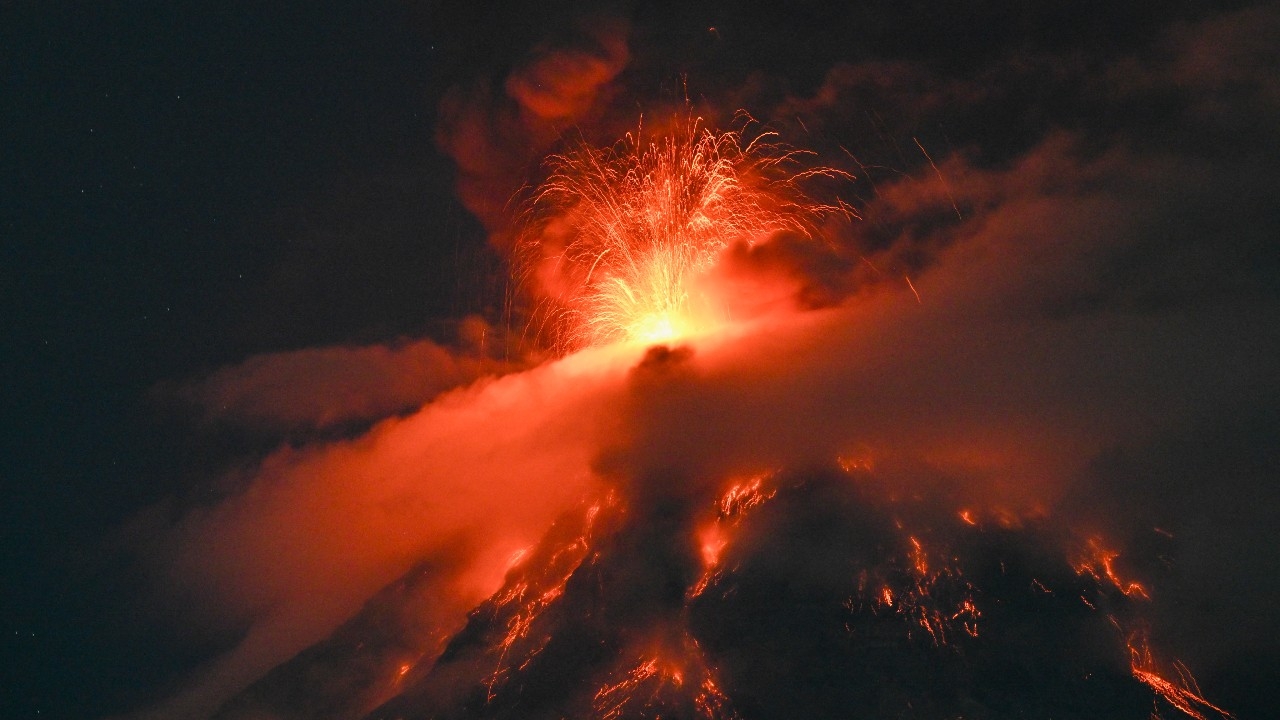
Guatemalan authorities declared an orange alert, the country's second-highest level, after Fuego volcano—one of Central America's most active volcanoes—erupted violently, sending lava and ash clouds more than 6 kilometers high. They ordered evacuations of nearby villages and suspended schooling in vulnerable areas.
Guatemalan officials issued an orange "danger" alert nationwide after Fuego volcano erupted violently with signs of intensifying activity. Authorities ordered evacuations of villages near the volcano for safety. The National Coordination for Disaster Reduction (Conred) reported the eruption began Monday morning and intensified by evening, with lava flowing down slopes and ash plumes reaching over 6,000 meters high.
Fuego volcano stands 3,763 meters tall and is about 35 kilometers from Guatemala City. Emergency agency images showed a powerful eruption turning the sky above the volcano red, with glowing lava flowing down the slopes. Authorities began evacuating two villages near the volcano, warning residents to prepare for immediate self-evacuation if ordered or if conditions become life-threatening.

Valeria Urisar, Conred spokesperson, stated that people should follow the principle of "self-evacuation" if the situation threatens their lives and urged strict compliance with official instructions.
Guatemala’s National Institute of Volcanology warned that Fuego volcano is entering a “phase of increased violent eruptions,” with the potential for hot volcanic debris flows down the slopes. Communities on the volcano’s western and southern sides face the highest risk.
Volcanic ash continues to fall on surrounding communities while traffic police have closed a mountain highway connecting the country’s southern coast with Antigua, a major tourist city and UNESCO World Heritage site, to prevent danger.
Guatemala’s Ministry of Education ordered suspension of in-person classes in communities within two municipalities near the volcano to protect students and staff from risks posed by eruptions, ash fall, and hot volcanic debris.
The orange alert represents Guatemala’s second-highest emergency level, just below the red alert, which is reserved for the most severe emergencies.
Guatemala lies on the Pacific "Ring of Fire," making it prone to frequent earthquakes and volcanic eruptions. Fuego volcano is among the most active and frequently erupting volcanoes in Central America.
In recent years, authorities have repeatedly evacuated residents around the volcano. Last year, over 500 people were relocated to shelters after Fuego emitted strong gas and ash bursts. Earlier in 2023, about 1,200 people were evacuated during eruptions.
One of the most severe events occurred in 2018 when lava flows and hot volcanic debris destroyed nearby villages, resulting in 215 deaths and a similar number of missing persons.
Guatemalan authorities continue to closely monitor the eruption and stand ready to escalate evacuation measures if Fuego’s activity intensifies or lava and volcanic debris approach populated areas.
Source: AFP