

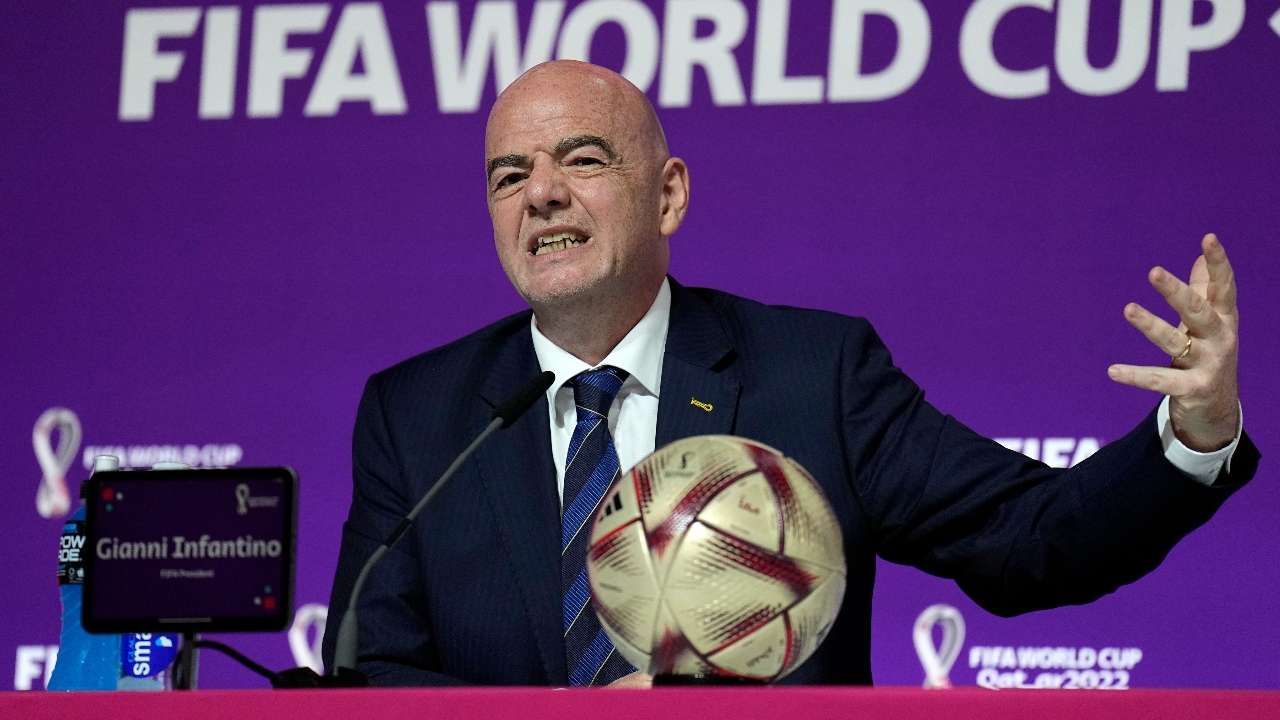
Gianni Infantino, President of the International Federation of Association Football (FIFA), apologized to the 211 member associations after facing strong criticism over the plan to establish a new company to sell commercial competition rights to private investors. He affirmed he will correct the mistakes and prevent recurrence, while still retaining the confidence of senior executives to continue leading world football.
Gianni Infantino, FIFA President, apologized for the "mistake" made by pushing the proposal to set up a new company to manage commercial rights for major football competitions, after facing strong opposition from various parties. He confirmed he will continue serving as FIFA President.
The move came after Infantino convened a FIFA executive meeting at the African continental office in Rabat, Morocco, to discuss the crisis caused by the FIFA Forward Enterprise (FFE) proposal, which was withdrawn last week.
Following the meeting, FIFA issued a statement saying the executive board "fully reaffirms its support" for Infantino as President, while acknowledging that the handling of the FFE proposal should have been done differently and should not have made the FIFA Council or the 211 member associations feel excluded from the decision-making process.
Infantino and FIFA Secretary General Mattias Grafström jointly signed a letter to FIFA Council members, vice presidents, and all 211 member associations, sincerely apologizing for the mistake and pledging to review procedures to prevent similar incidents from occurring again.
The withdrawn FFE proposal involved FIFA selling about 20 percent ownership in a new commercial rights management entity to private investors, expected to raise approximately $4.2 billion to support global football development. The proposal covered rights related to both the men's and women's World Cup tournaments.
However, the plan was sharply criticized, especially by the Union of European Football Associations (UEFA), which stated it had lost confidence in Infantino and accused the proposal of lacking transparency and proper stakeholder consultation.
Pressure also came from within FIFA, with Grafström having sent an internal memo to staff describing the events leading to the project's cancellation as "a sad and regrettable episode," while FIFA's Chief Operating Officer Kevin Lamour said officials felt they were not fully informed about the plan.
Carlos Gordero, Infantino's senior adviser, resigned in protest against the plan, while Arsène Wenger, FIFA's head of global football development, said he was not involved in drafting the proposal and considered its withdrawal absolutely necessary.
Former Portuguese national player Luis Figo, who ran for FIFA President in 2015, called for Infantino's resignation, while UEFA Vice President Laura McAllister said the scandal has plunged Infantino's leadership into crisis.
Meanwhile, Canadian Prime Minister Mark Carney expressed distrust in Infantino, stating that senior executives and board members not being consulted on such an important proposal is a serious matter for an organization's leader.
Despite heavy pressure, Infantino retains support from many countries, particularly non-European football associations that rely on FIFA funding for their operations. Countries such as Qatar, Kuwait, Lebanon, Sri Lanka, Indonesia, and the Philippines have publicly backed Infantino.
Several African football executives have also voiced support for Infantino, although the Confederation of African Football (CAF), representing 54 member countries, has yet to declare an official position.
Another advantage for Infantino is the absence of a clear challenger for the FIFA presidential election next March, despite Prince Ali bin Al-Hussein, President of the Jordan Football Association and two-time presidential candidate, accusing FIFA of "blackmail" and vowing not to support Infantino.
There are also allegations that Infantino may have promised Morocco the 2030 World Cup final hosting rights in exchange for support. FIFA has denied these claims, calling them false and misleading, and confirmed that the decision on the venue for the 2030 final—co-hosted by Morocco, Spain, and Portugal—will be made at the appropriate time.
This crisis is one of the most significant tests of Infantino's tenure since he became FIFA President in 2016. It comes just months before the fourth-term presidential election in Morocco next March and could impact his efforts to remain in office until 2031.