

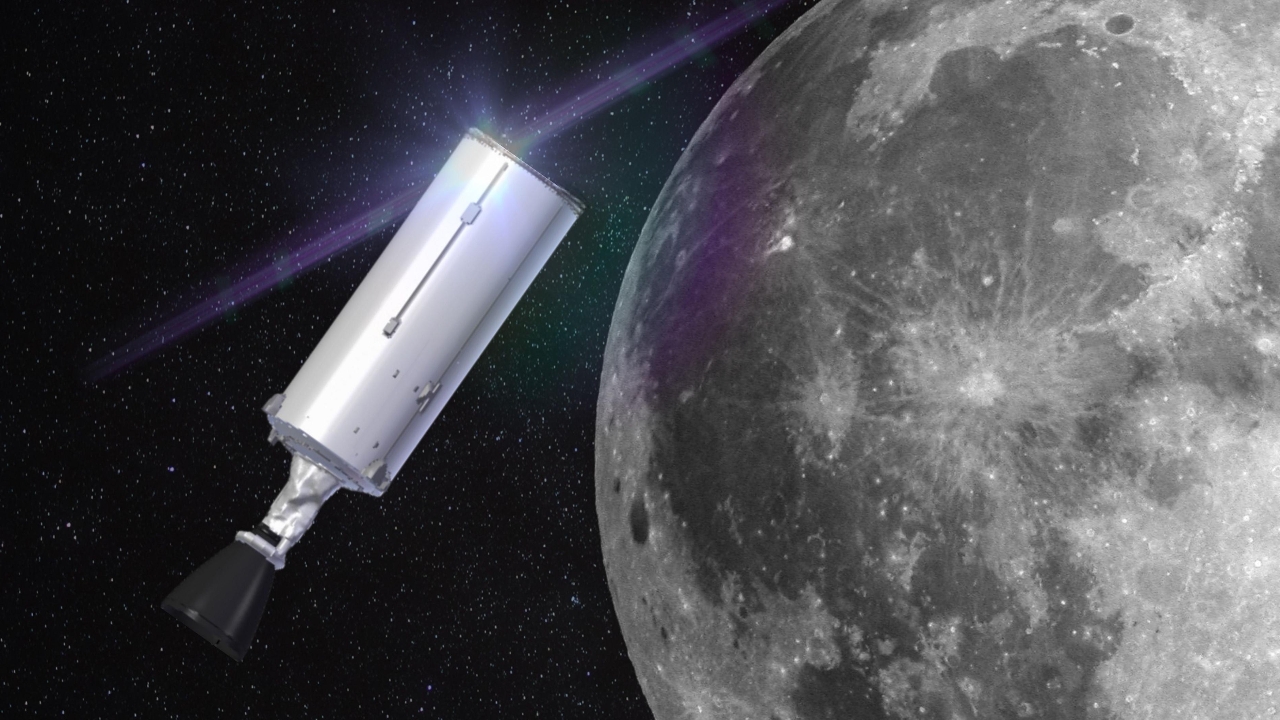
A SpaceX Falcon 9 rocket part weighing about 4 tons crashed into the Moon at an estimated speed of approximately 8,690 kilometers per hour, as predicted. Scientists have confirmed the event after a telescope in Chile detected gas traces from the impact. NASA expects the crash to have created a crater about 18 meters wide and 4 meters deep. Meanwhile, South Korea's lunar probe "Danuri" successfully captured images of the collision and the lunar surface before and after the impact.
Scientists confirmed that the upper stage of SpaceX's Falcon 9 rocket crashed into the lunar surface as predicted on Wednesday (5 August), after drifting in space since January 2025. The collision was unintentional and posed no danger to Earth.
The rocket part is roughly the height of a five-story building, comparable to a bus, and weighed about 4,000 kilograms at impact. It is estimated to have struck the Moon at around 8,690 kilometers per hour at approximately 06:35 UTC.
The European Southern Observatory (ESO) reported that the Very Large Telescope in Chile detected evidence of the impact by observing spectral lines — or chemical "fingerprints" — of sodium and lithium gases in dust and debris ejected from the collision site. These gases were visible for about 5 to 10 minutes after the event. Scientists suggest the sodium likely originated from lunar soil, while the lithium probably came from the rocket itself. Further data analysis will confirm details of the impact.
Benjamin Fernando, a scientist at Los Alamos National Laboratory in the U.S. and lead author of the research on this impact, stated that the collision was confirmed to have occurred. Space analysts noted that the crash was unavoidable due to the rocket's orbital trajectory leading to the lunar surface.
Another key piece of evidence came from "Danuri," South Korea's first lunar probe. The Korea Aerospace Research Institute (KARI) revealed that Danuri successfully captured images of the Falcon 9 rocket part striking the lunar surface.

KARI stated the impact occurred near the Einstein crater at 15:34 local time on Wednesday in South Korea. Images from Danuri show a dark shadow and radial patterns forming on the lunar surface at the moment of impact, along with geomorphological changes at the collision site.
Danuri also captured images of the area before and after the collision, providing scientists with data to analyze how the lunar surface was altered by a man-made object. This information will assist NASA's Lunar Reconnaissance Orbiter mission in studying future impact sites.
NASA reported that the impact likely formed a crater about 18 meters wide and 4 meters deep, scattering dust and rock debris around the site. Scientists plan to use this data to study the effects of collisions involving human-made objects and improve methods for accurately tracking objects in space.
NASA reiterated that the event poses no risk to Earth and will attempt to collect data from the impact site, although it may take several days for probe data to be transmitted back to Earth.
This Falcon 9 rocket was launched in January 2025 to deliver two landers to the Moon: "Blue Ghost" from U.S. company Firefly Aerospace and a lander from Japanese company ispace.
After deploying both landers into space, the rocket's booster returned to Earth as usual, but the upper stage remained in space because lunar missions require more thrust than missions sending objects into low Earth orbit.
Typically, SpaceX adjusts the upper stage's trajectory after completing its mission so that it re-enters Earth's atmosphere and burns up or safely falls into the ocean. In this case, the rocket exhausted its remaining fuel and lost control of its path, after which solar activity and gravitational forces altered its orbit, ultimately directing it toward the Moon.
This incident has sparked debate about managing space debris — the defunct satellites and rocket parts orbiting Earth, which currently number in the tens of thousands.
Bill Gray, a software developer specializing in tracking space objects, said that although the event was scientifically valuable and not harmful, it highlights the ongoing challenge of handling leftover space equipment from missions.
Collisions of human-made objects with the Moon are relatively rare. In the past, the U.S. and Soviet Union have deliberately and accidentally crashed spacecraft into the Moon. NASA intentionally crashed a rocket stage into the Moon in 2009 to study dust and debris ejected from the surface. In 2022, a Chinese rocket part also crashed into the Moon after a test mission.
Scientists warn that excessive space debris in Earth's orbit could trigger a chain reaction of collisions, known as the "Kessler Syndrome," potentially cluttering certain orbital regions with debris and hindering satellite launches and future space missions.
For the 2025 mission, the U.S. Blue Ghost lander successfully touched down and conducted lunar soil studies, while the Japanese ispace lander, carrying a small rover, crashed during descent and impacted the lunar surface.
NASA and SpaceX are discussing ways to prevent unintentional crashes of rocket parts on the Moon in future missions, especially as many countries accelerate lunar exploration. NASA aims to establish a sustained human presence on the Moon in the future.