

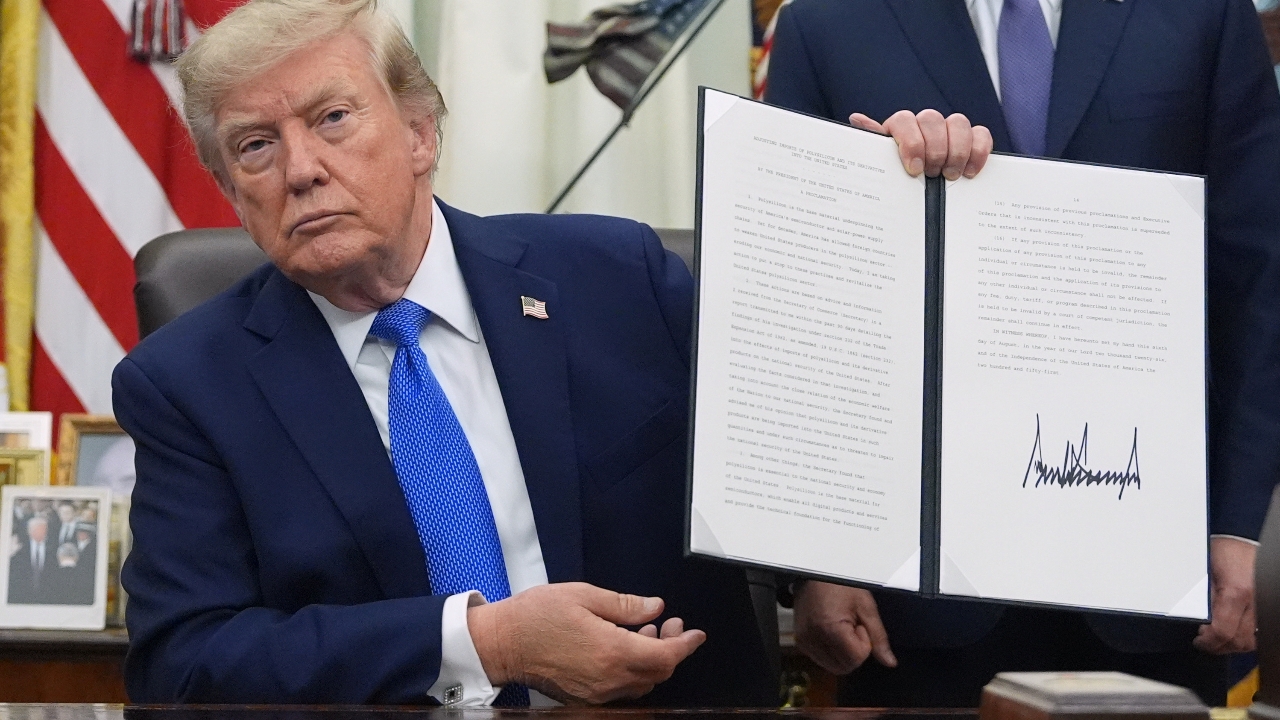
U.S. President Donald Trump signed an executive order imposing a 15% tariff on products made from polysilicon, a key raw material in the semiconductor chip and solar panel industries. The order also sets minimum import prices to protect American producers and counter fierce competition from China.
President Donald Trump signed an executive order setting a 15% import tariff on goods made from polysilicon, a vital raw material for manufacturing semiconductors or chips and solar panels. The order includes minimum import prices for polysilicon and related products and will take effect on 4 December.
Trump’s order is issued under Section 232 of the Trade Expansion Act of 1962, which authorizes the U.S. government to take trade measures to protect national security after investigating the security impact of foreign polysilicon production.
The White House stated the measure aims to support domestic supply chains for chip and solar energy production to enhance competitiveness with China, especially in artificial intelligence (AI) and energy sectors.
Polysilicon is highly purified silicon and a foundational raw material in both semiconductor and solar panel manufacturing. In the chip industry, polysilicon is processed into silicon wafers for chip production, while in solar energy, wafers are made into solar cells and assembled into solar panels.
Trump noted that the U.S. allowed foreign companies to unfairly compete with domestic polysilicon producers for decades, causing the U.S. share of global polysilicon production to fall from about 50% in 2005 to under 2% in 2024, while China has dominated the market nearly as a monopoly.
Under the order, the U.S. will set minimum import prices at $21 per kilogram for polysilicon, $100 per kilogram for polysilicon ingots and wafers, $0.22 per watt for solar cells, and $0.38 per watt for solar panels.
Additionally, the U.S. Department of Commerce will create incentive programs for companies investing in domestic polysilicon and downstream product manufacturing to boost national production capacity.
Currently, the U.S. has two main polysilicon plants: Hemlock Semiconductor in Michigan, a joint venture between Corning and Japan’s Shin-Etsu Handotai, and Wacker Chemie’s facility in Tennessee.
Corning stated the decision will support increased domestic production investment and long-term competitiveness, while Wacker Chemie said it is assessing the impact of the new measure.
Several U.S. solar energy producers have supported Trump’s measure, viewing it as a boost to domestic production and investment. Although U.S. solar panel assembly plants have increased following tax incentives introduced in 2022, many manufacturers still rely on imported wafers and solar cells.
The new U.S. measure is also significant for the semiconductor industry, as large polysilicon demand from the solar sector supports supply of this essential material for chip manufacturing. The Semiconductor Industry Association notes that chips account for about 2.4% of global polysilicon demand.
China condemned the measure, with its embassy in Washington, D.C. stating the tariff will "severely damage" bilateral trade. China vowed to take protective actions for its companies, accusing the U.S. of using state power to pressure Chinese businesses and warning that trade discrimination will not enhance U.S. competitiveness.
This move occurs amid intense U.S.-China competition in technology, especially artificial intelligence development, where chip manufacturing is critical. Both countries continue to have trade conflicts and export controls on technology.
In the same week, China announced retaliatory measures including tightening export controls on drones and opening a security investigation into imports of printers and copiers.
Analysts view the polysilicon tariff as another Washington effort to reduce China’s role in strategically important technology supply chains. Some trade experts warn that delaying the measure until December may lead to a surge in imports before the tariff takes effect.