

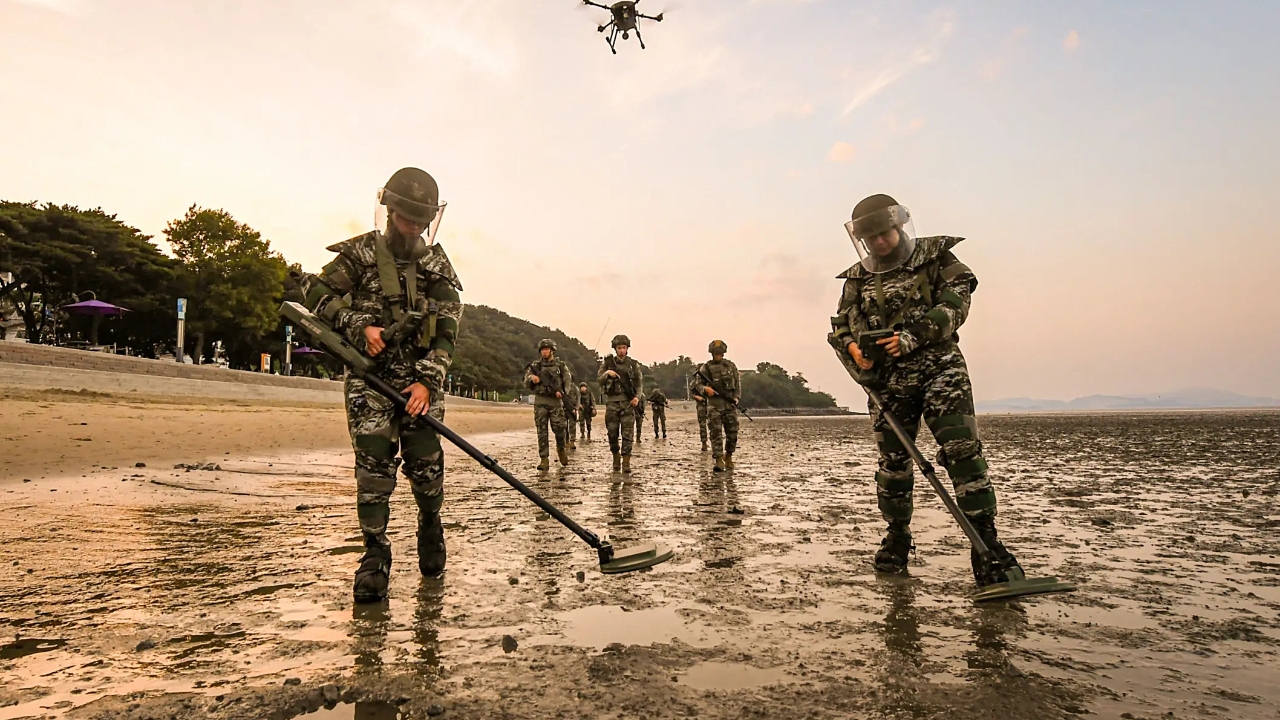
South Korean authorities are urgently recovering at least 15 North Korean anti-personnel landmines that were swept ashore along the coastal area of Incheon following heavy rains and flooding near the border during the monsoon season. The military has secured the area and warned citizens and tourists not to touch any suspicious objects under any circumstances.
Choi Young-ran, head of civil defense for Ganghwa County in northwestern South Korea, revealed that suspicious objects were found along the coastline between 23 July and 3 August, and officials were able to recover a total of 15 landmines.
Ganghwa County is an archipelago at the mouth of the Han River, bordering North and South Korea. It is a highly sensitive area due to its proximity to the Demilitarized Zone (DMZ), known as one of the most heavily mined areas in the world.
Military data reported by Yonhap News Agency states that approximately 800,000 landmines are buried around the DMZ area, mostly remnants from the Korean War between 1950 and 1953, though mine-laying has continued sporadically in recent years.
One recent incident occurred on 27 July when fishermen reported suspicious floating objects near Hwangcheon Harbor. Military officials investigated and found three wooden boxes, used as containers for landmines. One box was empty, while the other two contained still-active landmines, which were safely destroyed by the military on site.
Earlier, officials found landmines along the coast of Seodo on 24 July, and another explosive was detected washed ashore in Gyodong County, confirmed by surveillance footage from military units.
South Korean authorities believe these landmines may have been dislodged by heavy rainfall and strong currents in North Korea during July, then carried by sea currents to the shores of Ganghwa Island. They do not rule out the possibility of more landmines washing ashore.
The South Korean military has intensified search operations for landmines and hazardous objects on Ganghwa Island and nearby western islets, including beaches, ports, and accessible coastal areas, increasing patrols both day and night in high-risk zones.
Ganghwa County authorities have installed 42 warning signs at coastal tourist sites and ports and have issued public warnings through community loudspeaker systems.
Officials in Ganghwa County warn the public and tourists that if they find any suspicious objects along the coast, they must not approach or touch them and should immediately notify authorities, as some landmines remain active and could detonate.
The landmines found are anti-personnel mines made with pinewood casings instead of metal, containing explosives and fuses that activate under pressure on the lid, posing a significant risk to people walking on beaches or engaging in coastal activities.
Last month, the South Korean military warned that heavy rains might have washed explosives from North Korean territory into rivers crossing the border, potentially causing severe danger if landmines reach downstream areas.
South Korea experienced a serious landmine incident from North Korea in 2015 when two South Korean soldiers patrolling near the DMZ stepped on a mine and suffered injuries resulting in the loss of their legs. This incident affected tourism in the area and heightened fear among local communities.
Meanwhile, residents of Ganghwa continue to collect shellfish along the coast despite the risk from landmines. One local said about 300 people still gather shellfish by hand during this period and expressed concern that new landmine discoveries could impact their livelihood and tourism in the area.
Beyond the landmine threat, North Korea also suffered heavy rain and flooding in late July. NK Pro, a specialized media outlet, reported via satellite images that hundreds of homes in a large border military base were damaged, likely due to a dam collapse. At least 380 single-story houses were completely washed away.
South Korean authorities have urged the public to exercise increased caution, especially during the summer when many tourists visit beaches and coastal attractions. They emphasize that if any suspicious or foreign objects are found, people should not investigate themselves but immediately notify military or police for safe inspection and disposal.