

Colombia's new president faced challenges on his first day in office after a dissident armed group from the Revolutionary Armed Forces of Colombia, known as "FARC," launched attacks at two major locations: a car bomb detonated at a toll booth on a main highway, and an explosive drone targeted a police station. The attacks resulted in the death of one police officer and multiple injuries, following the president's announcement of a hardline policy against armed groups and drug trafficking.
Colombia experienced two explosions on Saturday (8 Aug), the very day Abelardo De La Espriella was sworn in as the new president. The incidents occurred just one day after his inauguration ceremony in Cali, located in the southwest of the country.
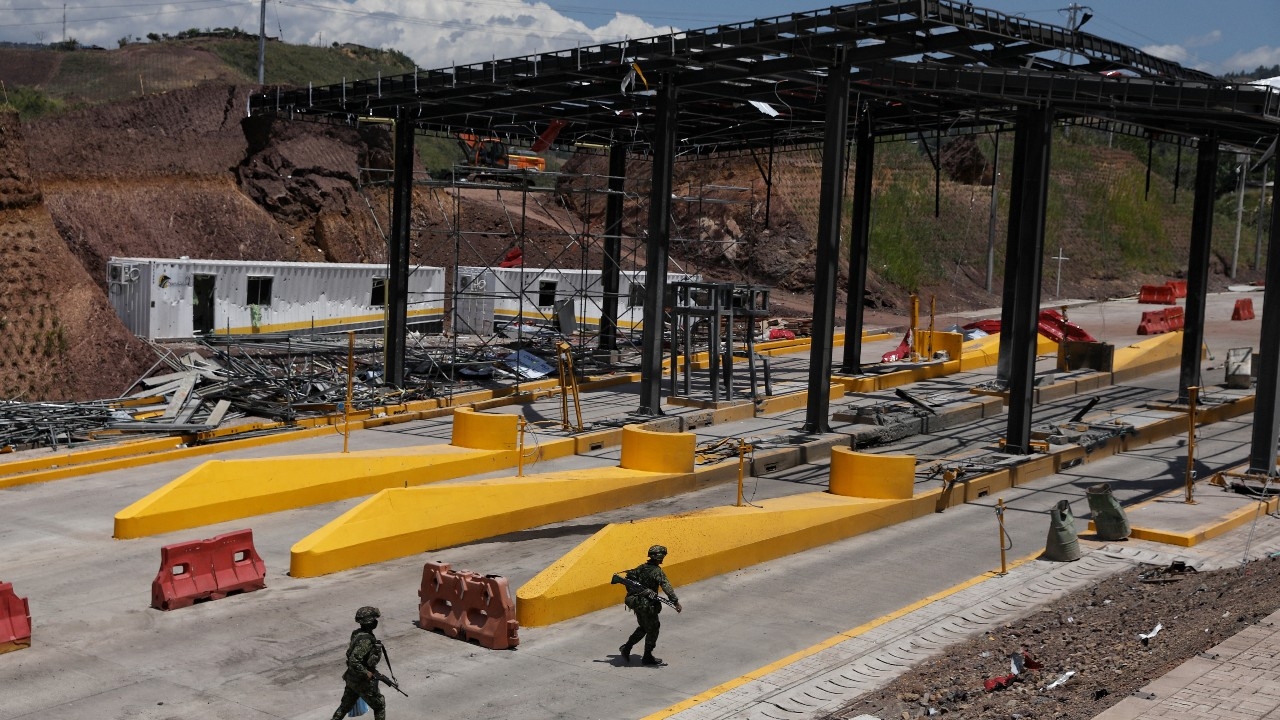
The first incident took place at a toll booth on the Pan-American Highway within the municipality of Santander de Quilichao, connecting Cauca and Valle del Cauca provinces. The Colombian army stated that the attack was carried out by a dissident armed group from the Revolutionary Armed Forces of Colombia (FARC). A car left parked there was used as a bomb, after which the perpetrators fled on motorcycles.
The explosion caused minor injuries to two security officers, and burnt vehicle debris was scattered across the toll area. Authorities closed the site and employed sniffer dogs to search for additional explosives.
The blast also severely affected nearby homes. Residents reported that the force of the explosion knocked people off their beds, shattered windows, and caused injuries from broken glass.
Jorge Octavio Guzmán, governor of Cauca province, said the attack was not an isolated incident but part of a systematic effort. He believes the armed group aims to separate Cauca from the rest of the country to maintain control over thousands of hectares of territory.
Another attack occurred about 1,000 kilometers away in Cesar province in northern Colombia, when an explosive-laden drone struck a police station in the early morning. This attack killed one police officer and wounded several others. Authorities have yet to identify the perpetrators.
President De La Espriella condemned the attacks, stating that those responsible would receive no leniency or protection and would be held accountable. Elsa Noguera, Minister of Transport, said the government is working swiftly to restore traffic on the affected routes and emphasized that Colombia will not surrender to violence or allow infrastructure connecting different regions to be destroyed.
The alleged attackers, according to the military, are a faction that split from the historic 2016 peace agreement between FARC and the Colombian government. Some dissident armed groups continue operations in rural areas and remain involved with drug trafficking networks.
De La Espriella, 48, a lawyer and businessman with no prior political experience, narrowly won the presidential runoff election in June, defeating Iván Cepeda, a progressive senator allied with former president Gustavo Petro.
The new president campaigned on a tough policy platform, pledging to combat "terrorism from drug trafficking without ceasefire" and ending peace talks with armed groups previously supported by the former government. He warned illegal groups that they face two choices: abide by the law or confront the security forces.
Additionally, De La Espriella announced plans to increase airstrikes against guerrillas and drug trafficking networks, including building large prisons modeled after El Salvador's approach to suppress gangs, with support from the U.S. and Israel.
On the same day, the new president ordered the transfer of 117 inmates connected to prior peace negotiations to eight maximum-security prisons. The prison authority said this move aims to restore full government control over prisons and prevent criminal organizations from using them as bases for illegal activities.
These explosions come amid Colombia's worst surge in violence in a decade. Although the peace accord with FARC was signed about 10 years ago, many parts of the country remain under the influence of dissident armed groups, including those involved in producing and trafficking cocaine to global markets.
.sourceAssociated Press/AFP