

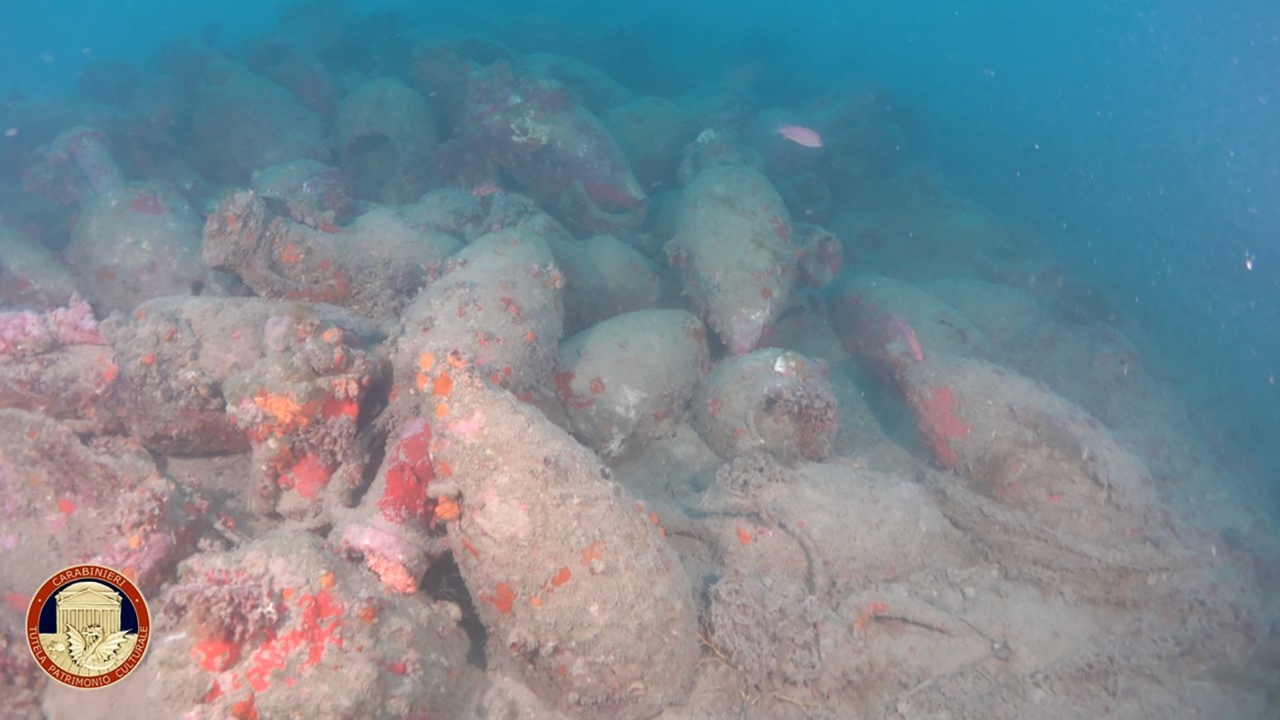
Italian divers and cultural heritage police have discovered the remains of an ancient Roman trading ship over 2,000 years old, measuring 21 meters in length, submerged 46 meters deep off the coast of Sicily. The shipwreck is well-preserved and carries several hundred ancient "amphora" clay jars. Italy's Culture Minister described it as one of the most significant underwater archaeological discoveries in recent years.
Expert divers in Italy found the ancient Roman shipwreck beneath the sea off the coast of Mazara del Vallo, on the western side of Sicily. The shipwreck is believed to be more than 2,000 years old, possibly dating to the 2nd or 1st century BCE.
The shipwreck lies about 3 nautical miles from the shore and is submerged at approximately 46 meters depth. Officials estimate the ship to be about 21 meters long and 6 meters wide. Inside, hundreds of amphora—tall clay containers used for storing goods in ancient times—were found, mostly of the Dressel 1A type, associated with transporting wine, olive oil, and grain.
Additionally, two lead anchor stocks and another structure made of the same material were found, making this discovery important for the study of Roman maritime navigation and trade.
Alessandro Giuli, Italy's Minister of Culture, praised the find as one of the most significant underwater archaeological sites in recent years. He also commended the joint efforts of the Carabinieri cultural heritage unit and the Sicilian maritime archaeology office for their successful collaboration.
Giuli stated that the sea continues to return precious pieces of history to humanity. The Mazara del Vallo shipwreck tells stories about people, maritime routes, and trade exchanges that made the Mediterranean a crossroads of civilizations. He emphasized that further studies will be conducted to uncover the ship's history and share this knowledge with the public.
The discovery came after a tip from the public, prompting coordinated exploration by relevant agencies, including the Palermo Carabinieri cultural heritage protection unit, the Sicilian maritime archaeology office, and Carabinieri divers from Messina, supported by a patrol vessel from Trapani.
Giacomo De Mola, a fisherman and recreational diver involved in the discovery, recounted that while exploring the seabed, he noticed a large object on his scanner and initially thought it was a rock. Upon diving down for closer inspection, he realized it was not a rock but an ancient shipwreck filled with numerous amphora.
De Mola described the find as the most remarkable discovery of his life and said it was hard to explain the feeling of being among the first people in nearly 20 centuries to see this site again. Underwater images also revealed eels, sea bass, and many marine creatures living among the clay vessels.
Officials said the area will be protected and secured during further examination. Experts will document and study the archaeological context to determine details about the ship, its maritime routes, and the cargo it carried.
The Mediterranean Sea is a significant site for ancient shipwrecks. In 2023, a shipwreck dating to the 1st or 2nd century BCE was found northwest of Rome, also containing hundreds of amphora. In 2018, a Greek merchant ship over 2,400 years old was discovered off the Bulgarian coast, praised at the time as the oldest and best-preserved ancient shipwreck found.
This shipwreck discovery occurred just days after Italy announced another major geological find off Sicily’s coast. Researchers identified a large underwater volcanic vent near Panarea Island in the Aeolian Islands, along with a new hydrothermal vent releasing gases from the seabed.
The structure lies about 1 nautical mile northeast of Panarea Island at a depth of approximately 60–80 meters. The vent measures about 100 by 60 meters. This find will help scientists study the area's submarine volcanic system in more detail and may help solve geological evolution puzzles of Panarea Island in the future.