

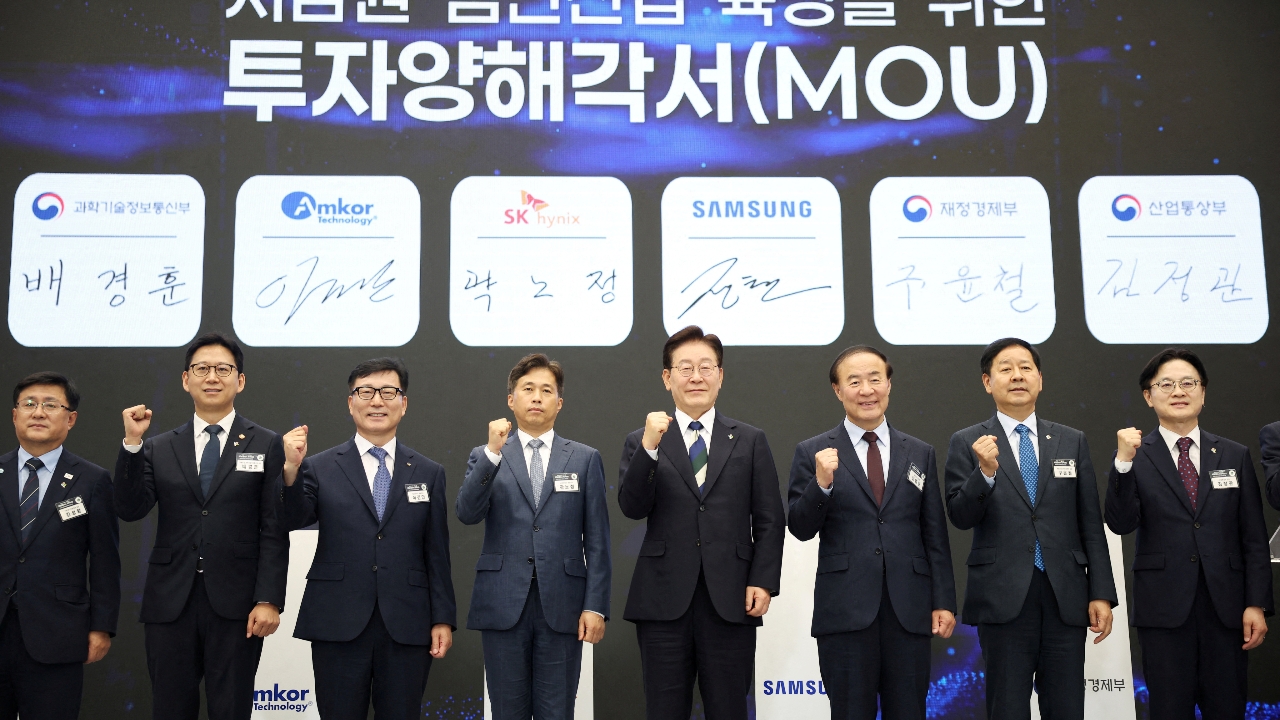
South Korean President Lee Jae-myung has ordered the Ministry of Defense to accelerate relocating the military air base's mission in Gwangju to a temporary site by mid-2028 to clear the way for developing a large-scale semiconductor production hub in the country's southwest region. Samsung and SK Hynix are expected to invest approximately 800 trillion won.
President Lee Jae-myung of South Korea has instructed the Ministry of Defense to expedite the temporary relocation of the Gwangju Air Base mission to another base by mid-2028 to speed up construction of a new chip manufacturing center in the area.
During a meeting with executives from companies involved in the project, Lee Jae-myung said that if the Ministry of Defense can relocate the Gwangju Air Base mission to another base by mid-2028, it would help the project progress much faster.
The South Korean government has designated an area of about 8.3 million square meters in Gwangju and its surroundings for the project. This site was chosen for its transportation advantages, and most of the land has already been leveled, enabling rapid infrastructure development.
The chip cluster project is part of a large investment plan announced by the South Korean government in June, covering development in the semiconductor industry, artificial intelligence (AI), and AI data centers across various regions of the country.
Specifically, for the semiconductor production hub in Gwangju and the Honam region, major Korean chipmakers Samsung Electronics and SK Hynix have committed to investing around 800 trillion won (about 18.6 trillion baht). This is one of the largest investment plans in the country, aiming to expand advanced chip manufacturing capabilities.
President Lee has ordered government agencies to carry out necessary administrative steps concurrently to shorten project timelines and called for improvements or relaxation of regulations that hinder progress, to enable the investment to proceed as quickly as possible.
The South Korean leader said the country must move beyond "fast" and advance "at lightning speed," emphasizing that next year could be a "golden period" that opens the door to a new future for South Korea, depending on how well the country prepares.
The South Korean government expects that this large-scale investment will help decentralize economic growth away from the capital region and transform other regions into centers of future industries.
Lee also stressed that the benefits from investments and the country's capabilities should not be concentrated in a single company or region but should create advantages for people and communities throughout the nation.
Therefore, the accelerated relocation of the Gwangju Air Base is a key government step to clear space for the chip cluster project, which is designed as a crucial mechanism to strengthen South Korea's semiconductor and AI industries and to reduce the concentration of technology industries solely in the capital region.