

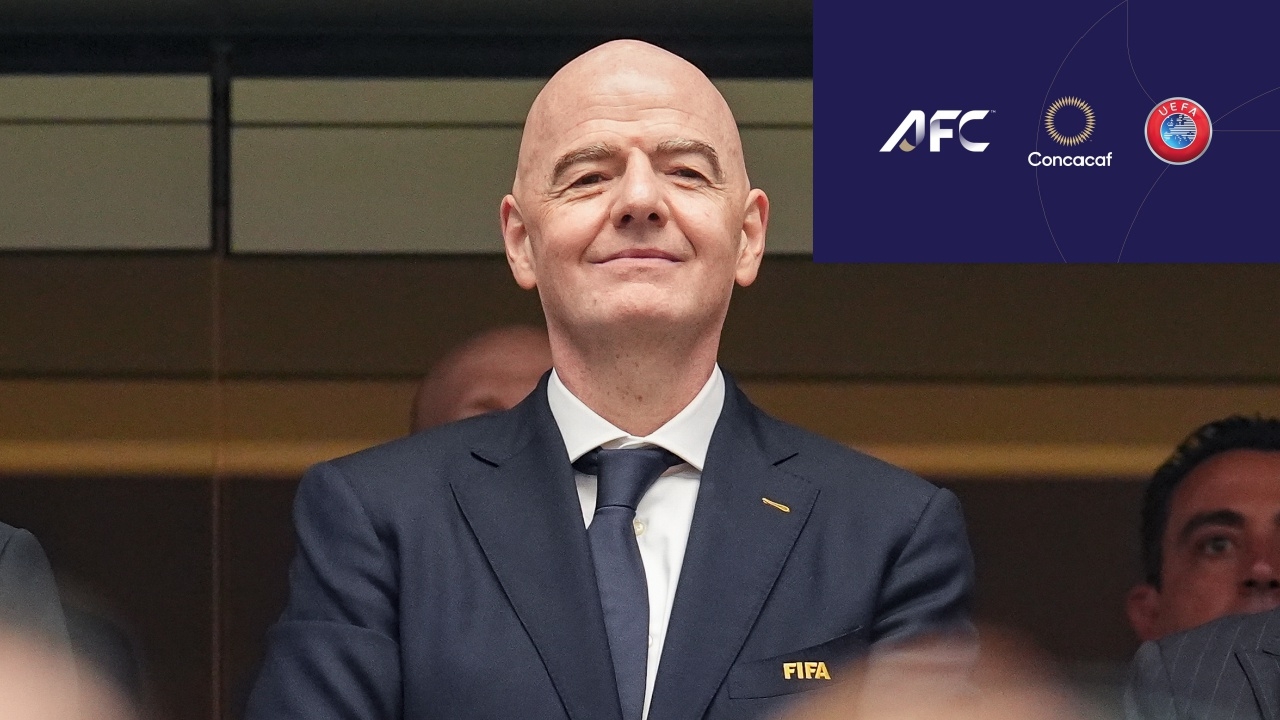
Three of the world's most influential football confederations—UEFA, the Asian Football Confederation (AFC), and the Confederation of North, Central America and Caribbean Association Football (CONCACAF)—issued an open letter attacking FIFA President Gianni Infantino. They accused him of destroying trust and placing himself above the organization after FIFA proposed establishing a new company to manage commercial rights and ticket sales for competitions including the World Cup, and offering to sell a 21% stake to private investment firms before the project was halted amid strong opposition.
Tensions within the world of football have intensified after UEFA, the AFC, and CONCACAF jointly issued an open letter accusing Gianni Infantino, president of the Fédération Internationale de Football Association (FIFA), of destroying member trust and wielding power above the broader interests of football.
The key trigger was the FIFA Forward Enterprise (FFE) project, a plan to create a new company to manage all commercial and ticketing rights for FIFA, including the men's and women's World Cups. The plan included provisions to sell a 21% stake to private investment companies, pushed through rapidly to avoid board scrutiny. The project was suspended after strong dissatisfaction arose among continental football confederations, especially UEFA, which openly opposed it and threatened to consider boycotting all FIFA competitions.
The open letter, signed by the presidents and general secretaries of all three confederations—Alexander Ceferin of UEFA, Salman bin Ibrahim Al Khalifa of AFC, and Víctor Montagliani of CONCACAF—as well as their general secretaries, stated that the issue is not about money but about "transparency in football and the integrity of those elected to govern the organization."
The three confederations accused the proposal process of being rushed and conducted without meaningful consultation with member associations. They also said the proposal was pushed forward to meet deadlines before members had sufficient opportunity to review the details.
The letter also rejected FIFA’s explanation that the error was merely a "communication failure," with the three confederations viewing the incident as a decision-making failure and a breach of trust toward the football institutions FIFA is supposed to protect.
The letter stated that the attempt to sell shares in enterprises related to the World Cup was a serious decision-making error, not just a procedural mistake, and that it damaged the trust of institutions FIFA is meant to safeguard.
Another concern highlighted was a secret meeting held in Morocco, which FIFA stated was attended by senior FIFA officials, while elected representatives on the FIFA Council or representatives from member associations were not invited to participate.
The three confederations viewed the meeting, attended by only some senior FIFA officials and held outside FIFA’s Zurich headquarters, as reinforcing concerns about a lack of transparency in football governance.
UEFA, AFC, and CONCACAF therefore called for the entire situation to be investigated by a "fully independent third party" instead of allowing FIFA, FIFA officials, or anyone within the football world to conduct the investigation themselves.
The three confederations also called for all documents, records, and evidence related to the process to be preserved to allow for a thorough fact-finding review.
This conflict arose after FIFA issued a statement last Saturday condemning what it called a coordinated and ongoing attempt to undermine the organization and Infantino, and said FIFA would present a report on the matter to the FIFA Council in October.
However, the three confederations felt that allowing FIFA to produce the report itself was insufficient, and demanded an external independent body conduct the investigation.
In the open letter, the three confederations emphasized that football’s successes over the past decade were not the work of any one individual but a result of collaboration among FIFA, continental confederations, member associations, players, clubs, and many others working for the sport.
The confederations stated that football is a shared passion worldwide and not the property of any single person or institution. They called on football leaders to serve the sport rather than use power to control it.
This dispute represents one of the most severe governance crises in world football in recent years, reflecting rising tensions between FIFA and continental football confederations over the management of commercial interests, decision-making authority, and transparency in global football governance.
/sourceYahoo Sports/BBC