

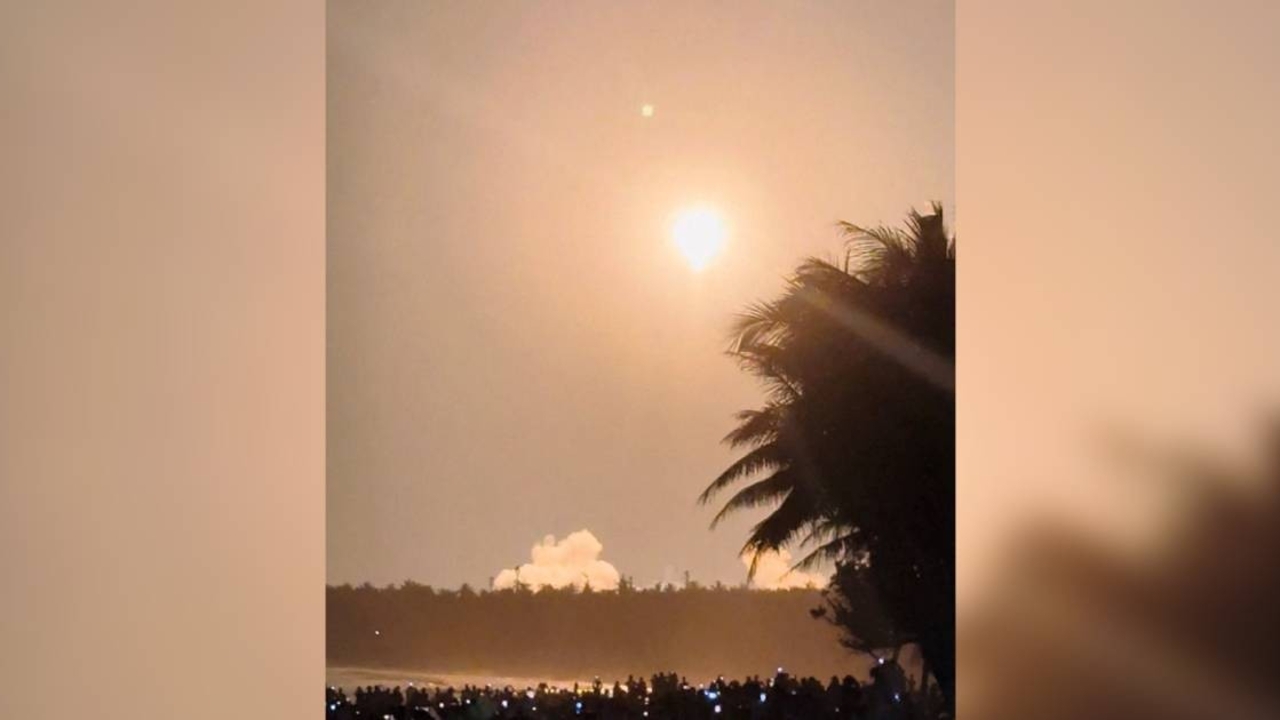
China failed to deploy a communication satellite into space after the Long March 7A rocket experienced an anomaly shortly after liftoff from a launch site in Hainan province. Social media images showed fireballs and debris falling to the ground. There are no initial reports of injuries, and Chinese authorities are investigating the cause.
China failed to place a communication satellite into orbit after the Long March 7A carrier rocket, carrying the Zhongxing-4B (ChinaSat-4B) satellite, encountered an anomaly during flight shortly after launching from the Wenchang Spacecraft Launch Site in Hainan province, southern China, at 20:02 local time on Monday (10 Aug).
China's official Xinhua News Agency reported that the mission was unsuccessful and that investigations and analyses are underway to determine the cause of the anomaly.
Meanwhile, Singaporean media and videos shared on social media showed what appeared to be the rocket exploding and catching fire in the sky. One clip posted about an hour and a half after launch showed the rocket engulfed in flames approximately 85 seconds after liftoff, then turning into gray smoke with debris falling to the ground.
Space analysts noted that from the released launch footage, the rocket was destroyed at a relatively low altitude and speed, making it likely that neither the satellite nor the rocket parts reached orbit.
The Long March 7A is a medium-sized rocket designed for missions deploying satellites into higher orbits. This failure marks the first since its maiden flight in March 2020, which also experienced an in-flight anomaly. The rocket resumed successful operations the following year, completing over ten consecutive missions before this recent incident.
The ChinaSat-4B satellite belongs to the same series as ChinaSat-4A, launched in 2024. This type of satellite supports transmission of voice, data, radio, and television signals over wide areas, including remote regions difficult to reach with terrestrial networks.
Experts say the investigation results will determine whether the problem is confined to the Long March 7A rocket or if broader checks on components, manufacturing processes, and launch site operations are needed. However, it is expected this incident will not significantly impact other Chinese space missions.
Elon Musk, founder and CEO of SpaceX, commented on the incident via platform X, stating, "Rockets are incredibly hard," and expressed hope that China will recover quickly from the failure.
China continues to advance its space program, aiming to land astronauts on the moon before 2030 and preparing the Chang'e-7 mission to explore the lunar south pole, scheduled for launch in the second half of 2026. This mission will use the Long March 5 rocket, a different model from the Long March 7A, so there is currently no indication that this malfunction will affect the Chang'e-7 schedule.
. . .ReutersAFP