

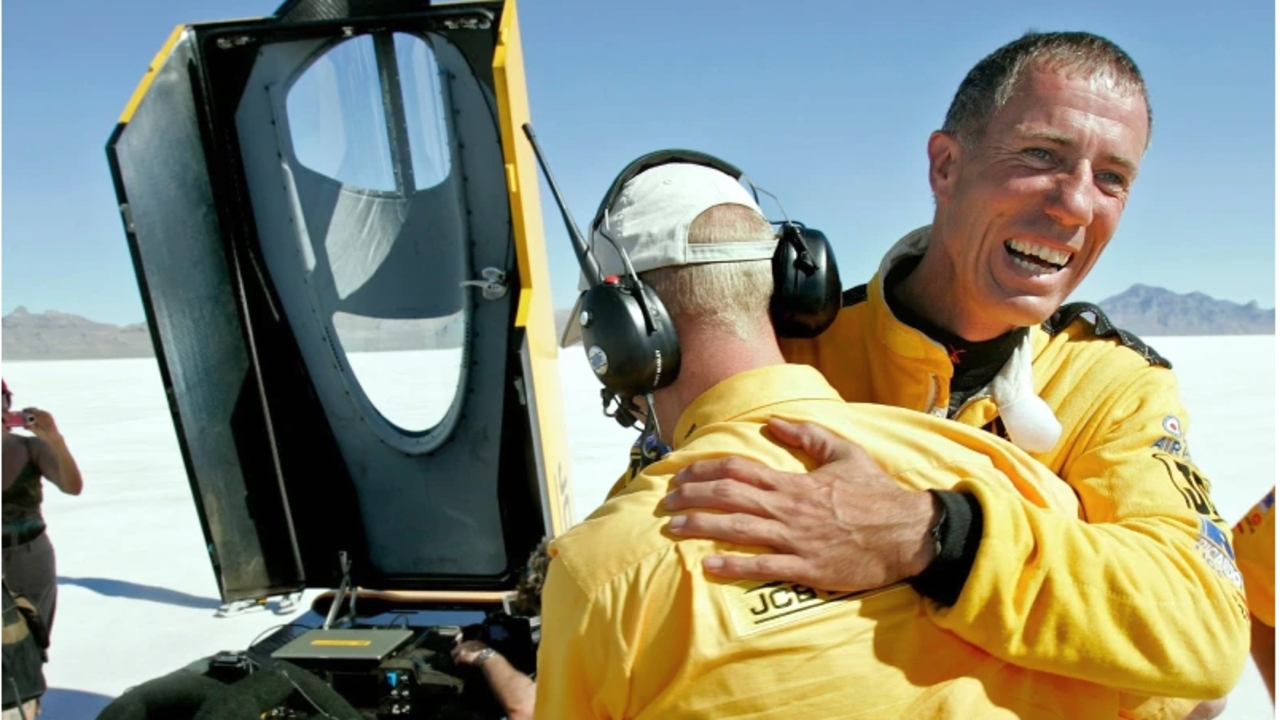
Andy Green, a British race car driver, set a new world record by driving a hydrogen-powered race car at over 653 km/h on the Bonneville Salt Flats in Utah, USA, reinforcing the potential of hydrogen technology for vehicles.
Andy Green, a 64-year-old British driver known for land speed records and being the first to break the sound barrier in a car, set a new world record on 11 August by driving a hydrogen-powered internal combustion engine race car, reaching a speed of 406.320 miles per hour, or about 653.9 kilometers per hour, on the Bonneville Salt Flats in Utah, USA.
This is the highest recorded speed for this type of race car, according to the Fédération Internationale de l'Automobile (FIA). The vehicle is equipped with two hydrogen internal combustion engines producing a combined 1,600 horsepower, designed by British construction equipment manufacturer JCB.
The approximately 9.75-meter (32-foot) race car sped along a straight 10-mile (about 16-kilometer) stretch of the Bonneville Salt Flats, with engineers and observers watching the record attempt from a distance.
Green revealed that the salt surface at Bonneville posed a major challenge due to its extreme slipperiness, causing the wheels to spin freely even in high gear, which forced the engineering team to reduce engine power to maintain vehicle control.
He described the surface as highly challenging and praised the engine’s capability to still deliver power enough to cause wheel spin even at high speeds.

This speed also shatters the previous hydrogen internal combustion engine car record of 185.5 miles per hour, or approximately 298.5 kilometers per hour, by a wide margin.
However, the speed of 653.9 km/h remains far below the land speed record Green set in 1997 when driving the jet-powered Thrust SSC, which reached 763.035 miles per hour, or 1,227.985 kilometers per hour, becoming the first car to break the sound barrier.
Green also set a diesel engine car speed record at Bonneville in 2006, reaching 350.092 miles per hour, or about 563.4 kilometers per hour. This return attempt aimed to break the old record using hydrogen power, which he considers the fuel of the future.

Green stated that working with JCB’s engineering team produced a new hydrogen-powered race car that emits very low direct carbon emissions from combustion, as burning hydrogen primarily produces water vapor from the exhaust. He called it remarkable to demonstrate this technology and what engineering can achieve.
JCB said hydrogen engine technology could play a key role in heavy industry, which demands high power, and the company is developing hydrogen-fueled construction machinery.
However, experts note that hydrogen is not automatically clean, as its environmental friendliness depends on production methods. Currently, most hydrogen worldwide is produced from fossil fuels, while green hydrogen made using renewable energy remains a small fraction.
The Bonneville Salt Flats, about 160 kilometers west of Salt Lake City, is an ancient lakebed with an expansive salt surface, known as one of the best natural venues for land speed records due to its flat terrain and dry desert climate.
This record attempt was not only a speed competition but also a showcase of hydrogen-powered vehicles and clean engine technology attracting attention in the automotive and heavy industry sectors worldwide.
Source:AP
Click to read more related newsInternational News