

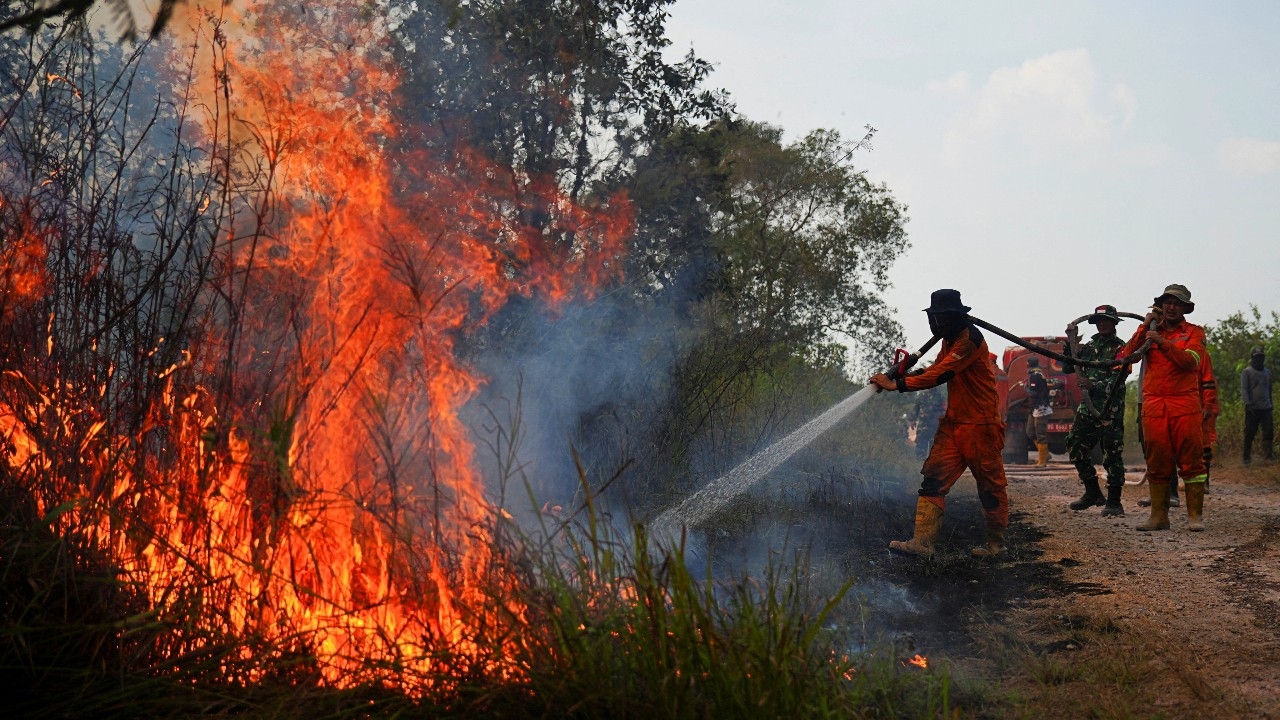
Indonesia is rushing to mobilize forces to control wildfires that have burned more than 668,750 rai nationwide amid an unusually long and hot dry season driven by El Niño. This has led to school closures in several areas, while smoke drifting across the border into Malaysia has caused air quality in many places to reach "unhealthy" levels.
Indonesia is intensifying its response to widespread wildfires across the country. Latest data show that since early 2026, over 107,000 hectares—or more than 668,750 rai—have been burned, with nearly 50,000 personnel deployed to firefighting missions in multiple provinces.
Authorities are focusing on six provinces with severe situations: Jambi, South Sumatra, West Kalimantan, Central Kalimantan, South Kalimantan, and Riau, due to their extensive peatland areas that are highly prone to wildfires during the dry season.
In addition to deploying personnel and firefighting equipment on the ground, the government has also deployed aircraft and helicopters. On 10 August, Djamari Chaniago, Coordinating Minister for Security Affairs, stated that Indonesia has sent 43 helicopters and up to 15 fixed-wing aircraft to support cloud seeding operations in critical areas.
Cloud seeding involves aircraft dispersing substances such as silver iodide and salt to stimulate rainfall. However, the operation’s effectiveness depends on the presence of sufficient clouds in the area.
The situation has affected education in several areas. In Pontianak city, West Kalimantan province, students have been instructed to study from home due to wildfire haze covering the city, with online learning to continue until air quality improves.
Adi Rusdi Kamtuno, Mayor of Pontianak, said the city is clearly impacted by the haze, especially during nighttime and mornings. Schools affected by the haze have adjusted their teaching methods to ensure student safety.
In Central Kalimantan province, residents report facing wildfires for over a month. Darwin Romi, an indigenous Dayak resident in Palangkaraya city, said the haze has thickened, causing eye irritation and strong smoke odors. Some fires have encroached near residential areas, while water sources used for firefighting are becoming scarce.
Wildfires are also occurring on Java Island. In Bromo Tengger Semeru National Park, East Java province, fires have burned continuously for several days, consuming about 5,625 rai—or roughly 2% of the park area—prompting authorities to close the park to tourists since 8 August.
Officials report deploying about 200 firefighters, including forest rangers, police, and military personnel, supported by three water-dropping helicopters and fire trucks. They are working to extinguish the fires and douse the area to prevent re-ignition.
Satriyo Nurseno, a local disaster management official, said that all available resources are being mobilized to fight the fires and keep the area wet, hoping to fully control the fires before moving on to prevent flare-ups.
The cause of the fires in Bromo Tengger Semeru National Park remains under investigation, but local authorities suspect negligence after individuals started fires in the area and mistakenly believed they had fully extinguished them when they had not.
Besides the burned areas on Java, authorities have also warned of new heat spots near the crater of Mount Bromo, an active volcano and significant tourist attraction in Indonesia.
Smoke from the wildfires has drifted across the strait into Malaysia. In Serian town, Sarawak state on Borneo island, the air pollution index (API) reached 195 on 13 August, categorized as "unhealthy" and the highest level recorded in the state that day.
According to Malaysian standards, an API between 101 and 200 is considered unhealthy, 201 to 300 very unhealthy, and above 301 hazardous. Reports indicate at least nine areas in Sarawak had API levels in the unhealthy range.
Malaysia’s Meteorological Department has advised residents in affected areas to stay indoors. They noted the situation is linked to cross-border haze originating from Indonesian Kalimantan. Malaysia previously closed schools for two days in 2015 due to severe haze health concerns caused by Indonesian wildfires.
Indonesia is facing an unusually severe dry season in 2026. The Indonesian Agency for Meteorology, Climatology and Geophysics (BMKG) has warned of high risks for drought and wildfires, partly due to an intensified El Niño phenomenon.
BMKG reported that Indonesia’s average temperature in July was 27 degrees Celsius, higher than the normal average of 26.2 degrees Celsius, marking the highest July temperature increase since 1991.
El Niño is a natural phenomenon affecting wind patterns, air pressure, and rainfall globally. In India and Southeast Asia, it typically causes drier conditions. The previous El Niño contributed to 2023 and 2024 becoming the two hottest years on record worldwide.
The area burned by wildfires in Indonesia since early 2026 is more than double the total burned area for all of 2023, reflecting the severity of this year’s fire season and raising concerns over ongoing haze impacts on public health and air quality in Indonesia and neighboring countries.