

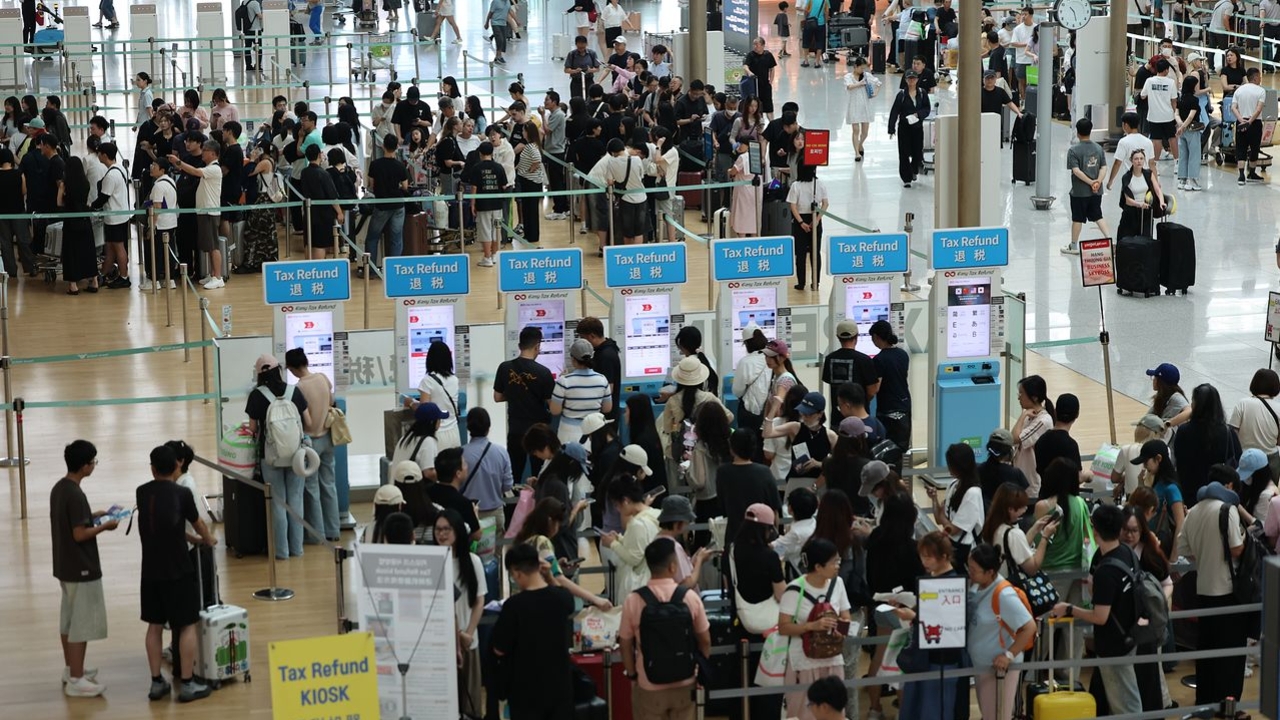
South Korea's Incheon International Airport set a new record as the world's busiest international passenger airport in the first half of 2026, surpassing London's Heathrow Airport in the UK and Singapore's Changi Airport, with nearly 38.4 million passengers in just six months. The US-Iran conflict was among the factors prompting passengers to shift routes from Middle Eastern aviation hubs to Incheon.
Incheon International Airport, South Korea's main gateway, became the world's busiest international passenger airport for the first time during the first six months of this year, according to preliminary data from the Airports Council International (ACI).
Data show Incheon handled approximately 38.39 million international passengers from January to June 2026, with London's Heathrow Airport ranking second at 37.79 million, and Singapore's Changi Airport third at 34.53 million passengers.
Achieving the number one spot marks a significant shift in the global airport rankings, as Incheon was ranked 12th in 2024 and 13th in 2025, while Heathrow ranked 5th in 2024 and 7th in 2025.
Dubai International Airport in the United Arab Emirates, which held second place in 2024 and 2025 based on full-year statistics, is expected to fall out of the top five this time due to passenger rerouting away from Middle Eastern aviation hubs.
Incheon International Airport Corporation stated that a key factor in the passenger increase is the US-Iran conflict, which disrupted flights and travel through Middle Eastern hubs, causing some passengers who previously used Dubai as a transfer point to Europe to reroute via Incheon instead.
Transfer passenger numbers at Incheon rose 18.1% from the same period last year to about 4.24 million, with transfers to Europe increasing by 63.2% to approximately 210,000 passengers.
Beyond geopolitical factors, travel to South Korea has steadily increased, especially tourists from China and Japan. In the second quarter of this year, foreign passengers accounted for 44.4% of all passengers passing through Incheon, a record high up from 39.5% in the same period last year.
Incheon also benefited from infrastructure expansion, completing all four phases in November 2024, enabling the airport to handle up to around 106 million international passengers annually. This ranks as the third highest international passenger capacity worldwide, behind Hong Kong and Dubai airports.
Currently, Incheon connects to 183 cities in 53 countries through 101 airlines. For comparison, Hong Kong International serves 139 cities, Shanghai Pudong International serves 92 cities, and Japan's Narita Airport serves 86 cities.
Incheon Airport opened in 2001 and reached a cumulative total of 1 billion passengers in just over 25 years, a faster pace than other major international airports.
Kim Bum-ho, Acting President of Incheon International Airport Corporation, expressed gratitude to the South Korean government, the public, and all airport staff for helping Incheon become the world's number one airport. He added that the corporation will focus on facilitating passenger convenience and enhancing regional air route connectivity.
The corporation is also investing in artificial intelligence (AI) technology and urban air mobility infrastructure to support the South Korean government's goal of attracting 30 million foreign tourists annually and strengthening South Korea's position as a global aviation hub.
. SourceBBC/The Korea Herald